Valsgärde, the boat graves near Uppsala: what Uppsala University has excavated since 1928
Valsgärde is a burial ground with boat graves about 3 km north of Gamla Uppsala, in Sweden. See what Uppsala University reports on the excavations from 1928 to 1952, the Vendel-period helmets, the broken glass vessels and the doubts the text itself leaves.
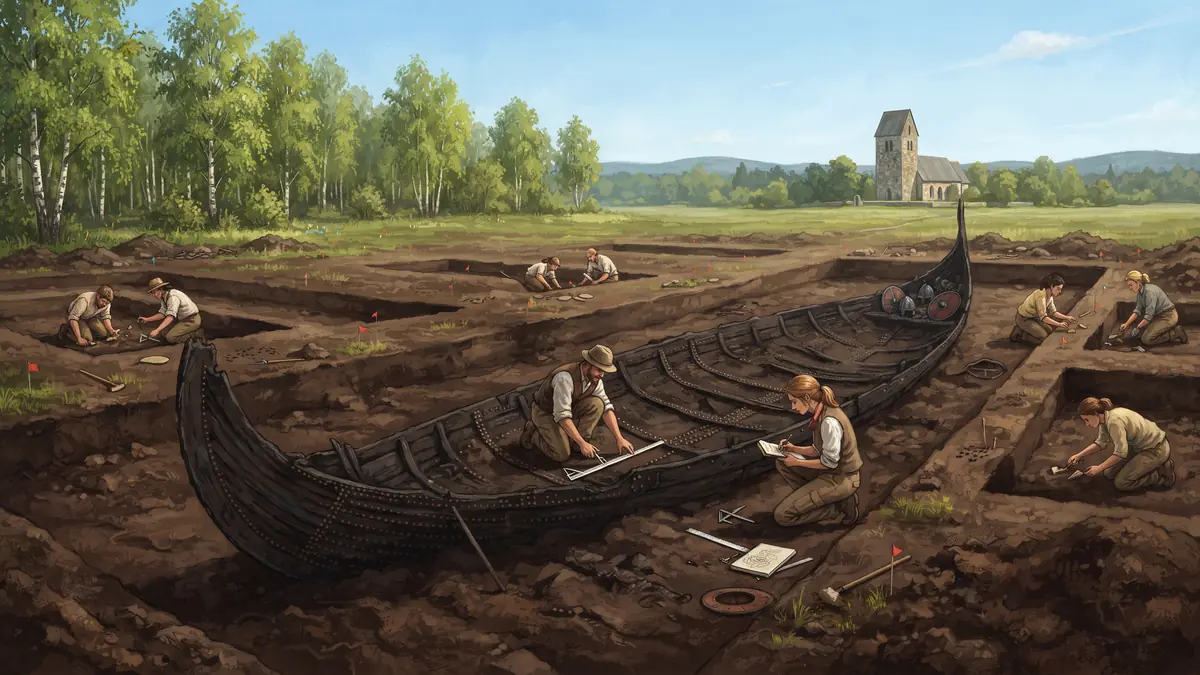
Valsgärde is a burial ground of the Vendel period and the Viking Age, about 3 km north of Gamla Uppsala, in Sweden. The excavations were carried out by archaeologists of Uppsala University, and the page of the Gustavianum Museum consulted is the source of this article.
The campaigns
From 1928 to 1936, under Professor Sune Lindqvist, eight boat graves were excavated. From 1946 to 1952, under Bertil Almgren and Bengt Schönbäck, the remaining six boat graves and a large number of cremation graves were excavated. In the 1990s, work continued on the settlement area and on a plateau with house foundations.
The boat graves
The page speaks of 15 unlooted boat graves, but the two campaigns described add up to 14, and the text does not explain the difference. For that reason, it is said here only that there are more than a dozen, and that the exact number must be checked at the source.
The finds
Among the finds are helmets of the Vendel period, from about 550 to the early seventh century, of a type known from only a few examples in the whole world. There is a glass beaker of about 550 to 650, and a large drinking glass, found in a boat grave, broken into about 600 pieces. The page records more than a thousand rivets documented from each boat, which gives an idea of the size of the vessels, although it gives no measurements.
The dead and the living
In the 1990s, the work moved from the burial ground to the settlement area and to a plateau with house foundations. This shows that the research is not limited to the graves, but the page does not say how the inhabitants and the buried were related. Nor does it say where the glass came from, although the drinking glass broken into about 600 pieces gives the measure of the task of those who study these finds.
Research in progress
The research project Vikingafenomenet, “The Viking Phenomenon”, uses the Valsgärde collections. That means the material is still being studied, and the conclusions may change.
What the text does not say
The page does not describe who the buried people were, does not give dates for each grave and does not say what was inside each boat beyond the finds cited. It would be a mistake to imagine a list of chiefs with names or titles: what there is are burial grounds with boats and objects, and the social reading of these burials belongs to the studies, not to this article.
What remains uncertain
The number of boat graves, as seen, appears with two values. The sizes of the boats were not given. And the finds cited are examples, not an inventory.
To dig a grid and find the boats hidden by the numbers on the edges, play The excavation at Valsgärde.
Sources.
- Uppsala University, "Valsgärde" page of the Gustavianum Museum (location, excavation campaigns, grave types, finds and the Vikingafenomenet project)