Forseti, the god who reconciles quarrels: what is known of the hall Glitnir
Forseti is the god to whom disputes are brought in Norse mythology. See what the article consulted says about the Gylfaginning, the hall Glitnir, the name Fosite among the Frisians and what remains unproven.
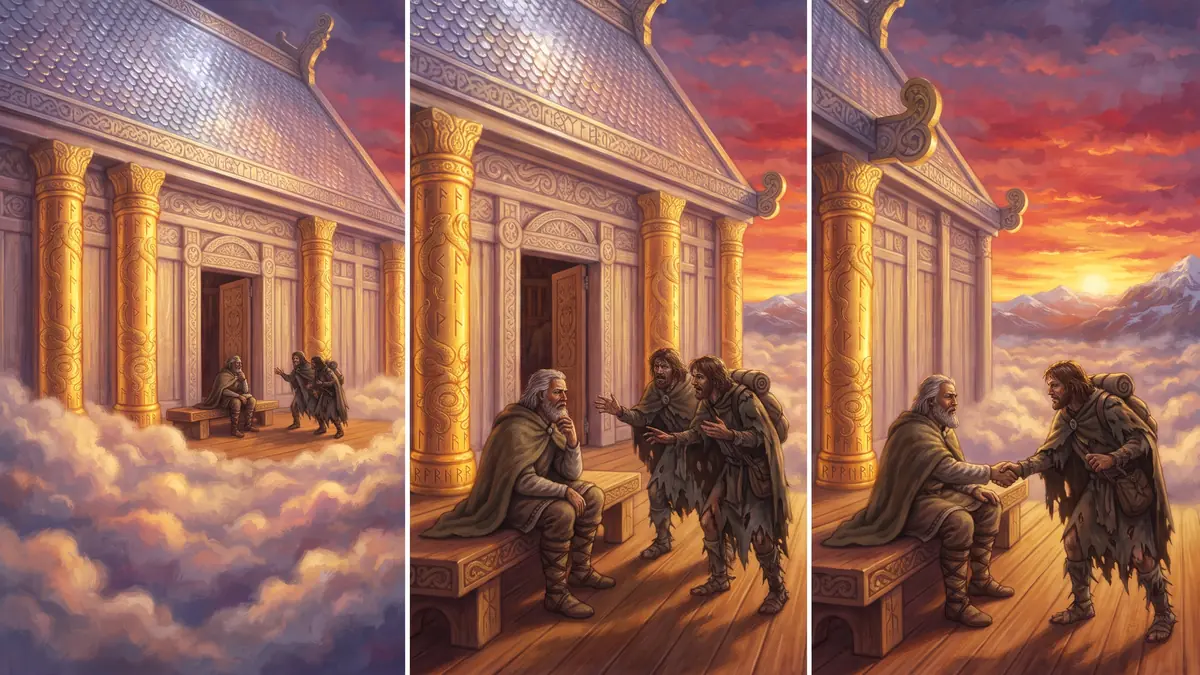
Forseti is a god of Norse mythology tied to disputes and settlements. The New World Encyclopedia article that serves as the basis for this piece is short, and what it offers fits into a few points. It is worth separating what it says from what is often repeated elsewhere.
The Norse source
The text rests Forseti’s role on a passage of the Gylfaginning, the part of the Prose Edda in which Snorri Sturluson describes the gods. There, Forseti has a hall in heaven called Glitnir. Whoever brings a quarrel to him leaves reconciled: in the words quoted, “all these return thence reconciled”. That sentence is what supports the image of the god as judge and mediator.
The hall Glitnir
The name Glitnir means “shining”. The article says the hall had a silver roof and golden pillars, and that its light could be seen from far away. This description comes from Orchard, a supporting work, and the article gives no other source for it.
The name among the Frisians
In Frisia, the god appears as Fosite or Foseti, and the article says he is thought to have been the chief god or an ancestor of the Frisian people. It then offers a hypothesis: the cult would have reached Norway from Frisia around the year 700, crossing the Oslofjord. The text treats this as something “thought”, not as established fact.
The name
In Old Norse, forseti carries the sense of a “chairman” of a meeting, someone who presides over an assembly. In modern Icelandic and Faroese the word means “president”, according to Lindow, cited in the article. That is why the name suggests someone who conducts a judgment.
At the end of the world
The article notes that Forseti is not named as a combatant at Ragnarök. For that reason it is assumed that he would stay out of the battle, but this is a deduction, not something an ancient text says.
Terms
Gylfaginning is the part of the Prose Edda that describes the gods; Glitnir is the name of the hall; Fosite or Foseti is the Frisian form of the name; forseti, in Old Norse, is one who presides. Together, these four terms sum up everything the article claims about the god: a hall, a sentence about reconciliation, a name that travels and a word that means to preside.
What remains uncertain
The article gives no passage from the Grímnismál or the Skáldskaparmál for Forseti; the only Norse source it cites is the Gylfaginning. The Frisian origin and the journey of the cult are hypotheses. Forseti’s absence from Ragnarök is a supposition. And the article itself leans on modern studies, not on the manuscripts, so a reader who wants to go further needs to open Snorri’s texts and the studies it cites.
To test your skill at reading a verdict, in a guessing game at the foot of the hall, play Forseti’s verdict.
Sources.
- New World Encyclopedia, "Forseti" (Gylfaginning, hall Glitnir, Fosite among the Frisians, etymology; relies on Orchard, Lindow and de Vries)