The Galloway Hoard, in Scotland: what the article says about the 2014 find
The Galloway Hoard is a treasure buried around the year 900 and found in 2014 by a metal detectorist in south-west Scotland. See what the source consulted gathers about the find, the contents, the vessel of Asian origin, the 2017 purchase and the questions that remain unanswered.
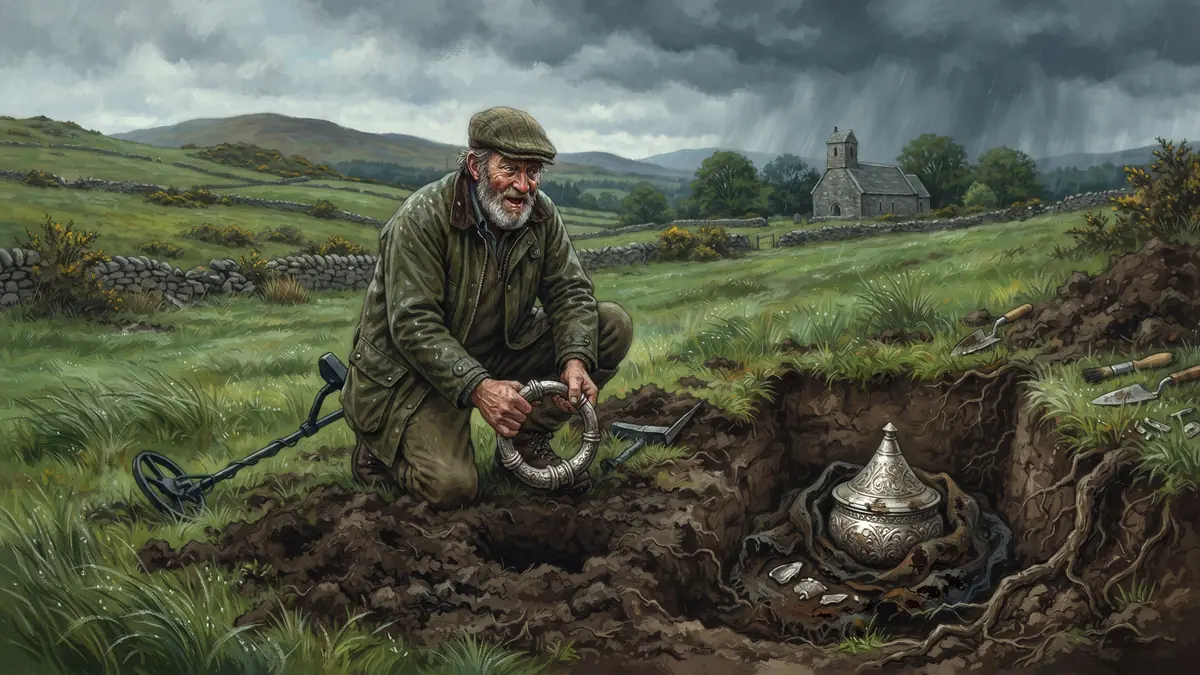
The Galloway Hoard is a treasure found in south-west Scotland. The source consulted tells how it was discovered, what it contained and what is still discussed.
The find
In September 2014, Derek McLennan, a metal detectorist from Ayrshire, found the first silver object, an arm ring, on Church of Scotland land near Balmaghie, in Kirkcudbrightshire. The county archaeologist, Andrew Nicholson, excavated the site, and McLennan found a second, lower level of the hoard.
The date
The article says the hoard was probably buried in the mid-ninth or tenth century.
What there was
There was a silver vessel with other objects inside, wrapped in cloth and with its lid in place. Among the finds are silver arm rings, some with Anglo-Saxon runic inscriptions, Anglo-Saxon disc brooches and an Irish silver brooch, a silver pectoral cross with a wire chain, silver ingots, glass beads and a gold-encased touchstone. There are also gold objects, a gold ingot, rock crystal pieces and Byzantine silk.
The vessel
At first the vessel was thought to be Carolingian, but later research showed it was made in Western Asia, probably in the Sasanid Empire. Its ornamentation includes a Zoroastrian fire altar, and lead isotope analysis links its silver and niello to the Nakhlak mine in Iran.
The purchase
After a fundraising campaign in 2017, the National Museum of Scotland acquired the hoard. The total value was set at £1.98 million by an advisory panel, and the museum paid that sum. The finder and the General Trustees of the Church of Scotland shared the money.
Terms
Detectorist is someone who searches for buried metal objects with a detector; niello is the dark inlay used to decorate silver; Sasanid refers to the Persian empire that the article points to as the probable origin of the vessel; a touchstone is a stone used to test the purity of metals. The article also speaks of glebeland, land belonging to a church.
Two levels
The first object, a silver arm ring, was the first to appear. After the county archaeologist’s excavation, McLennan found a second, lower level. The article records that it is not known why the hoard was buried in two levels.
What the find shows
The set gathers pieces of very different origins: arm rings with Anglo-Saxon runic inscriptions, an Irish brooch, Byzantine silk and a vessel from Western Asia. This shows that objects from distant places reached Scotland and were kept together, but the article does not explain through whose hands they passed.
What remains uncertain
The article lists doubts: who buried the hoard, and whether they were Vikings or Anglo-Saxons; why it was buried, and why in two levels; and whether it relates to a timber building and an early ecclesiastical site nearby. One suggestion cited is that it was “a safety deposit box that was never claimed”.
To sort the pieces by material, in chests of four places, play The Galloway hoard.
Sources.
- Wikipedia, "Galloway Hoard" (2014 find, contents, vessel from Western Asia, 2017 acquisition, open questions)