Hermóðr, the son of Odin who rode nine nights to Hel in search of Baldr
After Baldr's death, Hermóðr rides Sleipnir to the realm of Hel to ask for his brother's return. See what the source consulted gathers about the Gylfaginning, the Gjöll bridge, the conditional ransom and the doubts about who he was.
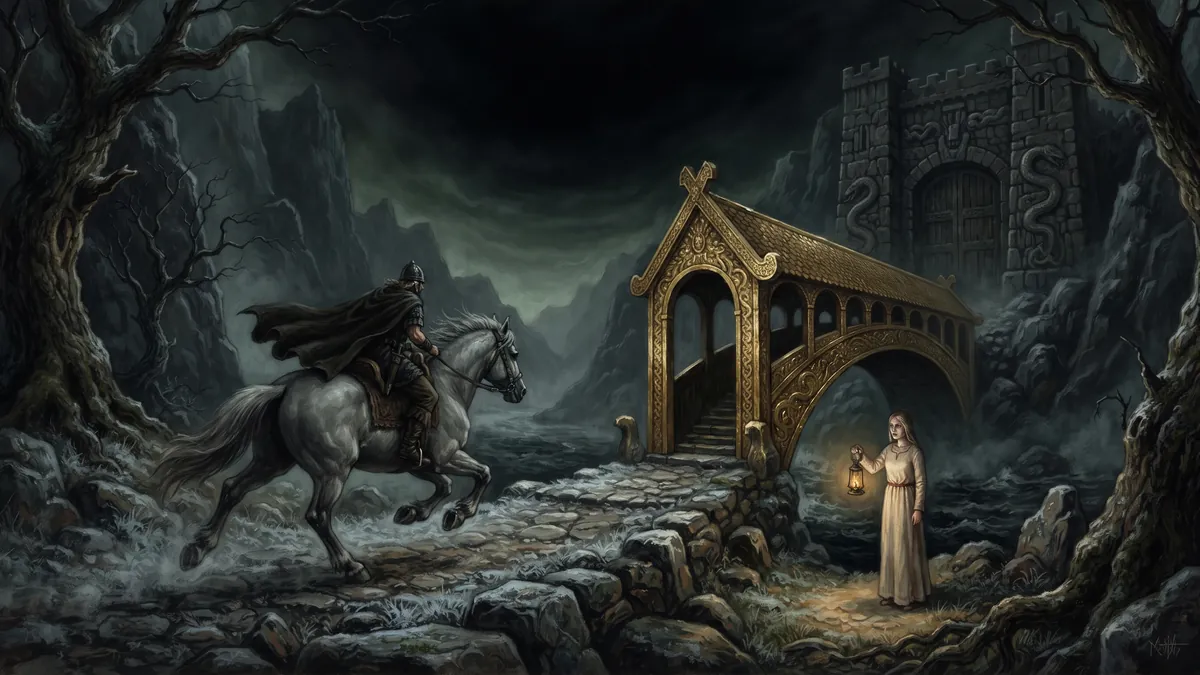
Hermóðr is, in Norse mythology, a son of Odin and a brother of Baldr. The source consulted explains the name as something close to “war-spirit”. His best-known role appears in the Gylfaginning, the part of Snorri Sturluson’s Prose Edda, in chapter 49.
The ride
After Baldr’s death, the gods are too stunned to act. Frigg asks who will ride to Hel to ask for Baldr’s return in exchange for a ransom. Hermóðr volunteers and mounts Sleipnir, Odin’s horse.
He rides nine nights through dark valleys to the Gjöll bridge, covered in gold and guarded by the maiden Móðguðr. She tells him Baldr has already passed and sends him on downward and to the north. At the gate of Hel, Hermóðr tightens Sleipnir’s girth, mounts again and makes the horse leap the gate.
In Hel’s house
In the hall, he sees Baldr in the seat of honour and asks Hel to free him, reminding her of the mourning of the Æsir. Hel answers that Baldr will be freed only if all things, living and dead, weep for him.
The gifts
Baldr sends the ring Draupnir back to Odin. Nanna sends a linen robe for Frigg and a finger-ring for Fulla.
Other texts with the same name
The article lists other mentions. In the Hyndluljóð, stanza 2, the name seems to refer to a mortal hero who receives a helmet and a mail-coat from the Highfather. In the Hákonarmál, stanza 14, Hermóðr and Bragi receive King Hákon the Good in Valhalla, without it being clear whether either is understood as a god. And in Beowulf, Heremod is an exiled Danish king who, in the Old English genealogies, descends from Sceafa and is usually the father of Scyld.
Terms
Sleipnir is Odin’s horse, which Hermóðr rides; Gjöll is the gold-covered bridge; Móðguðr is the maiden who guards it; Draupnir is the ring that Baldr sends back. The article does not deal with other sources, such as the Skáldskaparmál or the Gesta Danorum, and so this piece does not either. What it presents is the scene of the Gylfaginning and the mentions of similar names in three other texts.
What remains uncertain
Most manuscripts call Hermóðr a son of Odin, but the Codex Regius, usually considered the best, calls him sveinn Óðins, which may mean “Odin’s servant” rather than “son”. A later passage calls him Baldr’s brother, and a list of Odin’s sons includes him, which favours the reading of son. The link between the Hermóðr of the Edda and the Heremod of Beowulf is only a parallel of names, and does not prove that they are the same figure.
To repeat the rhythm of a night ride, with the right timing for each leap, play Hermóðr’s nine nights.
Sources.
- Wikipedia, "Hermóðr" (Gylfaginning, ch. 49; Hyndluljóð; Hákonarmál; Beowulf; Codex Regius)