L'Anse aux Meadows, the Norse site in Newfoundland: what the excavations showed
L'Anse aux Meadows, in Newfoundland, is a Norse site in North America, found in 1960. See what the source consulted gathers about the excavations of the Ingstads and Parks Canada, the eight buildings, the forge, the dates of 1014 and 1021 and the doubt about Vinland.
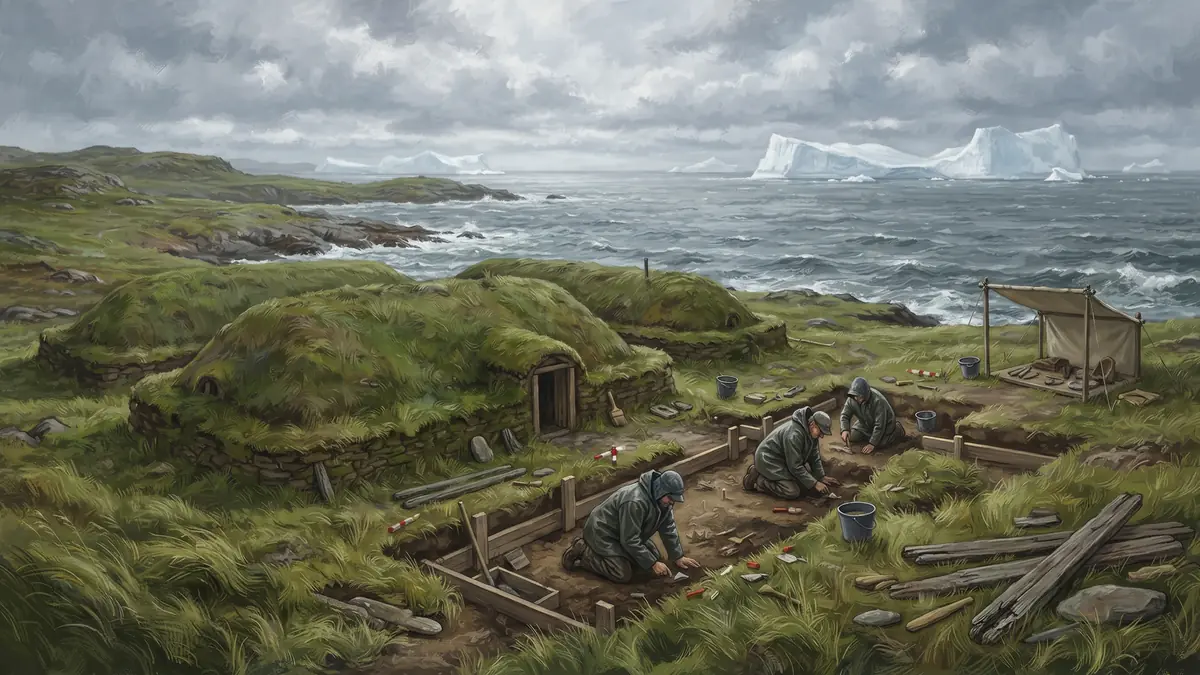
L’Anse aux Meadows is a Norse archaeological site in Newfoundland, Canada. The source consulted tells how it was found and what was uncovered.
The discovery
In 1960, the local resident George Decker led Helge Ingstad to some grass-covered mounds near the village. Helge and Anne Stine Ingstad carried out seven excavations from 1961 to 1968. Afterwards, Parks Canada excavated from 1973 to 1975, under the direction of Bengt Schonbach, and in 1976, under that of Birgitta Wallace. The site was reburied at the end of each period of excavation.
The buildings
The excavators found the remains of eight buildings, A to J, and possibly a ninth. The largest, Building F, was a dwelling of several rooms. Building J was a smithy, with a forge and slag. A separate smelting hut produced iron for only about 100 to 200 nails.
The dates
Radiocarbon dating gives a mean of 1014. A 2021 study in the journal Nature used tree rings and fixed the year 1021 as a year of Norse activity.
The nuts
The article says that butternuts do not grow naturally north of New Brunswick, which indicates that the Norse travelled farther south to obtain them.
The recognition
The site became a UNESCO World Heritage Site in 1978.
Terms
Radiocarbon is dating done by measuring carbon in organic remains; the growth rings of trees allow the year in which the wood was cut to be fixed; slag is the residue of iron smelting; Vinland is the name the sagas give to a land west of Greenland; Leifsbudir and Hóp are two settlements described in the sagas.
Two dates, two ways of reading the past
The mean of 1014 comes from several radiocarbon measurements, and the year 1021 comes from tree rings. The two dates are close and reinforce each other, but they say different things: one is a mean, the other marks a year of activity. The article does not claim that 1021 is the year of arrival or of departure.
The iron at the site
The forge of Building J and the smelting hut show that iron was worked there. The quantity produced, enough for only about 100 to 200 nails, is small, and the article goes no further than that.
What remains uncertain
Two sagas describe settlements called Leifsbudir and Hóp, and both have been linked to the site. Dr Stuart C. Brown called Ingstad’s claim that the site is Leifsbudir “wholly unconvincing”. The meaning of the name Vinland proposed by the Ingstads is debated, and the nuts suggest that the Norse reached regions where grapes grow as well. In other words, the site is Norse, and the date is firm, but the link with the names in the sagas remains in dispute.
To probe the ground, square by square, guided by the numbers of the neighbours, play The survey at L’Anse aux Meadows.
Sources.
- Wikipedia, "L'Anse aux Meadows" (discovery, excavations by the Ingstads and Parks Canada, buildings, forge, dating, butternuts, UNESCO, Vinland)