Borgring, the ring fortress of Køge: how a day's march pointed to a missing fortress
Borgring, on Zealand in Denmark, is a circular fort about 145 metres across, found in 2014 because the trelleborg-type fortresses lay a day's march from one another. See the discovery, the burnt gates and what remains unproven, such as the exact date and the builder.
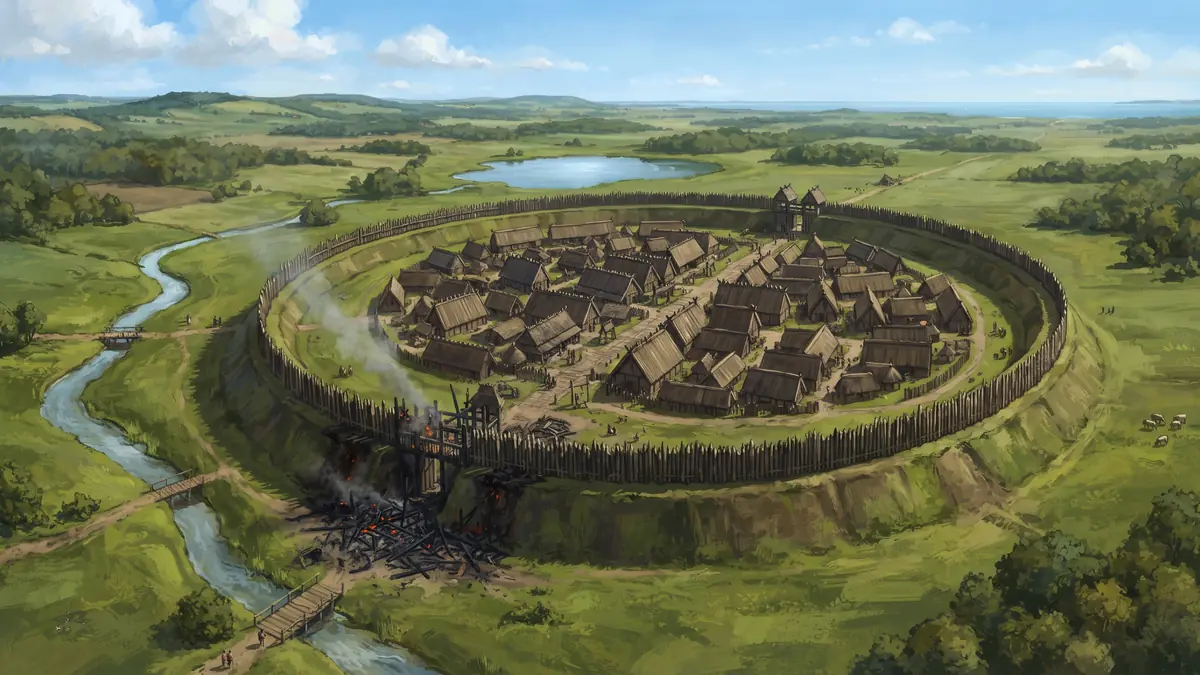
Borgring is a circular fort near Køge, on the island of Zealand, Denmark, in Højelse parish and close to Lellinge. The source consulted for this piece tells how it was found, what it was like and what remains uncertain. This piece follows that article, which warns that only minor sections of the site have been excavated.
Where it lies
Two streams flow through the Køge Ådal valley, and the fortress overlooks a presumed old high road, possibly from Roskilde or Ringsted. It is within easy reach of the Bay of Køge, described as one of the best natural ports on Zealand.
The discovery
Sophus Müller mentioned the site in 1875, without a certain date. A 1954 US Air Force aerial photo showed it only as a shadow in a field. In November 1970, echo-photography suggested a trelleborg, and warrant officer Valdemar Ryhl recognised the circular structure. In 1971–72, the National Museum excavated the site under Thorkild Ramskou, but the embankment remained undated. Around 2012–2014, Søren Sindbæk of Aarhus University noticed that trelleborgs were spaced about a day’s march, some 50 km, apart, which suggested a missing fortress in eastern Zealand. In 2014, new excavation showed that Borgring dates to the 10th century.
What it was like
The fort is circular, about 145 m across, the third largest of the original Danish ring fortresses. The rampart was 10 to 11 m wide and was topped by a palisade of pointed stakes. No moat was found. The Ellebækken stream to the west and a small lake to the north and northeast may have provided natural defence.
The gates
The 2014 excavations found the northern and eastern gates where a trelleborg layout would predict them. Burnt gate remains were found, which may point to military activity like that at the trelleborg in Slagelse. The gates are offset by about 11° from the cardinal points, perhaps so that the fortress would not look asymmetrical in the landscape.
The relatives
The fortresses of Trelleborg in Slagelse, Nonnebakken in Odense, Fyrkat in Hobro and Aggersborg beside the Limfjord are generally dated to about 980. Harald Bluetooth is presumed to be their master builder. The article says it is plausible that he also built Borgring, but that this is not proven.
Recognition
In 2023, the Viking-Age ring fortresses, Borgring among them, were inscribed by UNESCO, under reference 1660-001, together with four other fortresses.
Terms
Trelleborg is the type of Viking-Age circular fort, with an earth rampart, a palisade and gates at the cardinal points. A palisade is a fence of stakes. Højelse is the parish where Borgring lies. Køge is the neighbouring town.
What remains uncertain
The exact construction date has not been confirmed: the fort is usually dated to about 970–980, but conclusive dating has not been done. Only minor sections were excavated, and the purpose is uncertain, possibly defending trade routes or serving as barracks. The attribution to Harald Bluetooth is plausible but not proven. The name has also varied over time, and the renaming of 2014 caused public disagreement.
To connect every path to the centre of a fortress ring, play The paths of Borgring.
Sources.
- Wikipedia, "Borgring" (location, discovery, the 1971–72 and 2014 excavations, dimensions, gates, trelleborg-type fortresses, Harald Bluetooth, UNESCO 2023; relies on research by Søren Sindbæk and the Danish Castle Centre)