Borre, in Vestfold: seven great mounds, a buried ship and the style of knots and animals
The Borre cemetery in Norway has seven large mounds and 21 smaller ones, some more than 45 metres across. See what the excavations from 1851 to 2019 found, what the Borre style is and what remains only an indication.
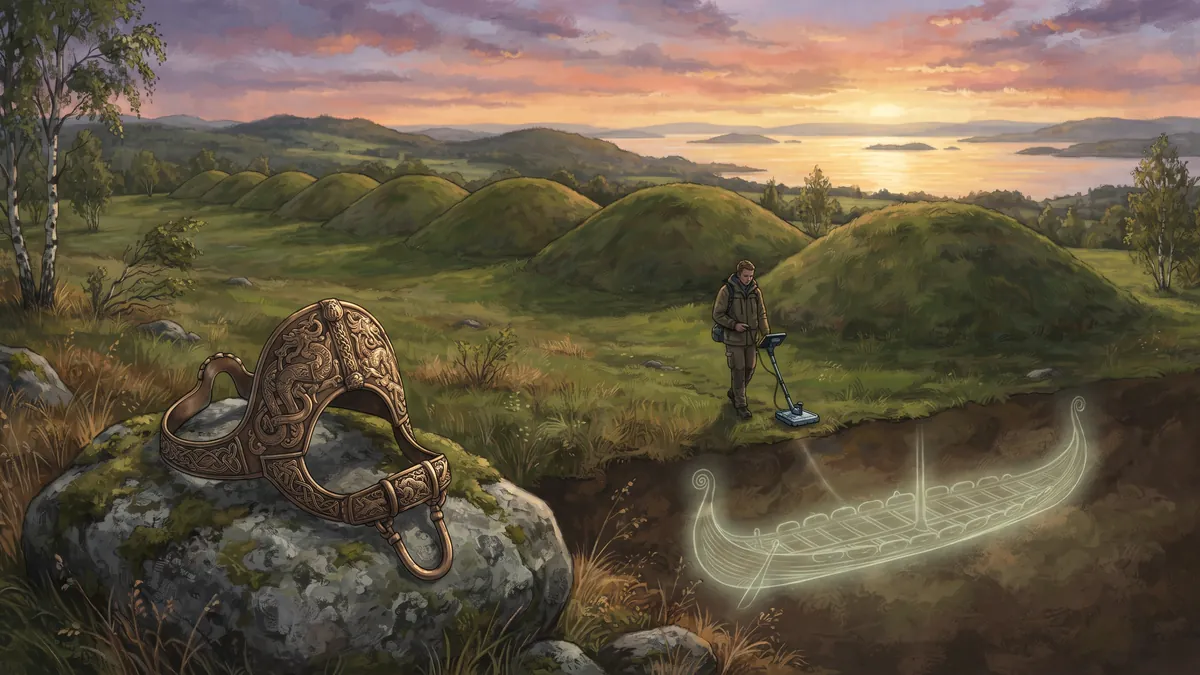
The Borre mound cemetery, in Norwegian Borrehaugene, is part of Borre National Park, in the municipality of Horten, in Vestfold county, Norway. The source consulted for this piece describes the group, the history of the excavations and the style of ornament that carries the name of the place. This piece separates what is established from what the article treats as likely.
The place
The name comes from Old Norse borró and haugr, meaning “mound”. The park covers 45 acres, or 18 hectares. The cemetery has seven large mounds and 21 smaller ones. Today seven large mounds and one cairn are visible. At least two mounds and one cairn were destroyed in modern times, and there are also 25 smaller cairns. The article says the cemetery may have been larger.
Enormous mounds
Some monuments are over 45 m in diameter and up to 6 m high. Excavations of the 1980s found that the oldest mounds date to about the year 600, before the Viking Age. For that reason the site can be seen as evidence of a local power centre, from the Merovingian period to the Viking Age.
The excavations
In 1851–1852, road-builders used one of the mounds as a gravel pit and destroyed large parts of a richly equipped grave in a Viking ship. The antiquarian Nicolay Nicolaysen examined what remained, which included weapons and riding equipment. Much of the craft work recovered is on display at the Viking Ship Museum in Oslo. In 1925, some smaller cairns were investigated and found to be simple cremation graves. Between 1989 and 1991, the archaeologist Bjørn Myhre led excavations in and around the park.
The Borre style
The craft style found here is known as the Borre style. It is known for animal and knot ornaments, often used to decorate harnesses.
What the radar showed
In October 2007, ground-penetrating radar surveys, made by the Swedish Central National Heritage Board on commission from the Vestfold county administration, revealed the remains of two prehistoric hall buildings, the first substantial building remains near Borre. In March 2013, a larger survey found another large hall building. In 2015, Erich Draganits and colleagues suggested that a prehistoric harbour was likely located at Borre, based on geomorphological analysis.
The ship of 2019
In March 2019, archaeologists found what is believed to be a buried Viking-era ship. According to the article, the evidence so far points to a ship burial, a type typically built as a tomb for high-ranking individuals.
Terms
Haugr is “mound” in Old Norse. A cairn is a heap of stones. Ground-penetrating radar is the technique that shows buried structures without digging. The Borre style is the style of animal and knot ornaments. The Midgard Viking Center, opened in 2000 as part of the Vestfold Museum, offers exhibitions and guided tours of the park.
What remains uncertain
The article says the cemetery “may have been larger”, that the ship of 2019 is only “believed” to be a Viking-era burial and that the evidence is preliminary, and that the harbour is “suggested” and “likely”, not confirmed. The reading of the site as a power centre is something it “can be seen as” showing. The article also gives no names for those who were buried.
To run along every thread of a knot without repeating any, in the spirit of Borre’s ornaments, play Borre’s knot.
Sources.
- Wikipedia, "Borre mound cemetery" (location, mounds, the 1851–52, 1925 and 1989–91 excavations, Borre style, ground-penetrating radar of 2007, 2013 and 2019, harbour, Midgard Viking Center)