Magni and Móði, the sons of Thor: the child who lifted a giant's foot and the ones who survive Ragnarök
Magni ("Strength") and Móði ("Wrath") are sons of Thor and are among those who survive Ragnarök. See the story of the three-night-old baby who frees his father from a giant, what the Edda says of each and what stays open.
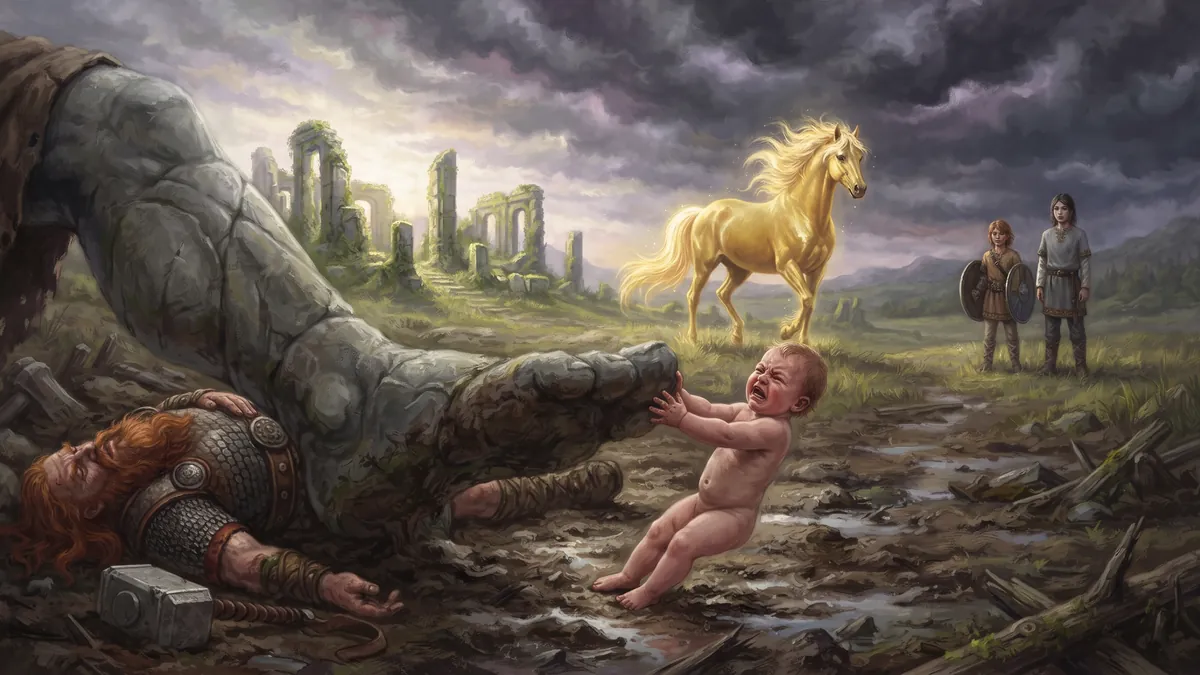
Magni and Móði are sons of the god Thor in Norse mythology. The names mean “Strength” and “Wrath”, and both appear among the survivors of Ragnarök, the final battle. The source consulted for this piece gathers what the Eddas, the poems and modern studies say about them. This piece separates what the texts state from what is interpretation.
The mother and the names
Magni’s mother is the giantess Járnsaxa, according to the Skáldskaparmál (chapter 17). Móði’s mother is not named, and may have been Járnsaxa, but this is not confirmed. The two are cited in different sources: the Hymiskviða (stanza 34), the Þórsdrápa, the Hárbarðsljóð (stanza 53), the Gylfaginning (chapter 53) and the Skáldskaparmál (chapter 4).
The three-night-old baby
The best known story is that of Magni. Thor kills the giant Hrungnir, and the giant’s foot falls across his neck, so that no one can lift it. Magni, only three nights old, throws Hrungnir’s foot aside and frees his father. In gratitude, Thor promises to give him the horse Gullfaxi, which had been Hrungnir’s. Odin objects, because in his opinion the horse should not go to the son of a giantess.
The survivors of Ragnarök
The Vafþrúðnismál names Magni and Móði among those who survive Ragnarök, but does not say what the role of each will be. The source recalls that Lindow compares Magni with Váli, another young god who survives, and that Simek sees Magni and Móði, together with Thor’s daughter Þrúðr, as embodiments of their father’s traits: strength, wrath and power.
Two readings of the names
Both names are ordinary Old Norse words, and so they can be read as simple qualities of the father, rather than as characters with stories of their own. This is the reading of Simek, who joins them with Þrúðr. Among the texts cited, the scene of Magni with Hrungnir’s foot is the one the source tells in most detail; of Móði, by contrast, the source records little beyond the name and the survival.
Terms
Ragnarök is the final battle of the gods. Gullfaxi means “golden mane”, the name of the horse. Hrungnir is a stone giant who challenges Thor. The Hymiskviða and the Hárbarðsljóð are poems of the Poetic Edda. The Skáldskaparmál and the Gylfaginning are parts of the Prose Edda.
What remains uncertain
Móði’s mother is not known with certainty. The source does not say that Magni and Móði inherit the hammer Mjölnir, and so this piece does not claim it: what the texts record is only that they survive. The role of each after Ragnarök is not stated either. All readings of what the names “symbolise” come from modern scholars, not from the medieval poets.
To turn pieces in quadrants until everything is back in order, play Magni’s turn.
Sources.
- Wikipedia, "Móði and Magni" (meaning of the names, Magni's mother, Hymiskviða, Þórsdrápa, Hárbarðsljóð, Gylfaginning, Skáldskaparmál, Vafþrúðnismál, studies by Lindow and Simek)