Naglfar, the ship made from the nails of the dead that sails at Ragnarök
Naglfar is the largest ship of Norse mythology, made from the nails of the dead, and carries monsters to the final battle. See what the Völuspá and the Prose Edda say, the doubts about its name and what remains uncertain.
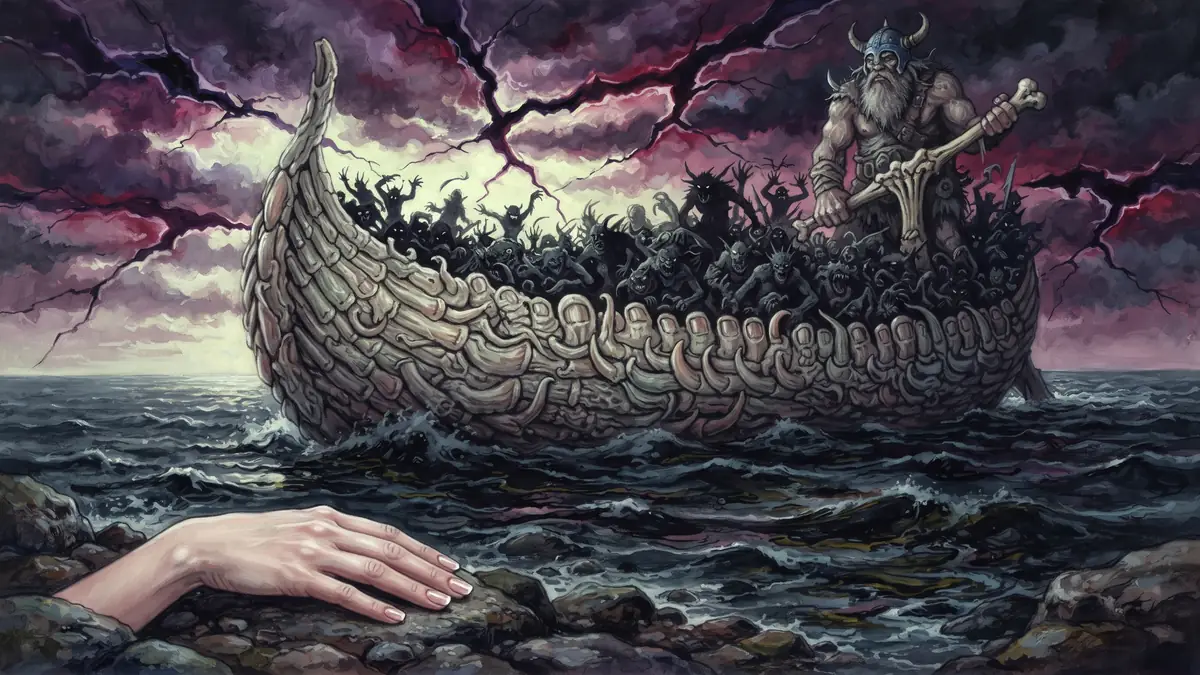
Naglfar is a ship of Norse mythology, made from the nails of the dead, which is to sail at Ragnarök, the final battle. The source consulted for this piece gathers what the Völuspá, the Prose Edda and modern studies say about it. This piece shows what the texts state and what scholars debate.
The ship in the poems and the Edda
The Völuspá, a poem of the Poetic Edda, mentions Naglfar in two stanzas. In them, Hrymr comes from the east at the helm of the ship, with Loki and a horde aboard. The Gylfaginning, of the Prose Edda, gives more detail. In chapter 43, Naglfar is described as the largest ship of all, and it belongs to Muspell. In chapter 51, Hrymr is its captain, and there is a warning that no one should die with untrimmed nails. The idea behind the warning is that the nails of the dead are the material the ship is made of, so that the ship grows with every nail left uncut. The Skáldskaparmál also names Naglfar.
The name
The etymology of the name is debated. The source records proposals by Noreen and by Feist (1909), by Sturtevant (1951) and by Lincoln (1977), without any one being accepted by all. The first part of the name recalls the word for “nail”, and the idea of a ship made of nails is the most common reading, but not the only one.
Hair, nails and the dead
The source cites an Indo-European parallel between hair, nails and the dead, brought by Lincoln, and a text in Avestan. According to that study, care in trimming nails and hair appears in other traditions of the same language family. This comparison helps to understand the warning in the Gylfaginning, but it is a modern interpretation.
An uncertain rune stone
The source mentions the Tullstorp rune stone, in Sweden, as a possible depiction of Naglfar, but the identification is uncertain. It also lists modern references to the ship in works of popular culture.
Terms
Ragnarök is the final battle of the gods. Muspell is the realm of fire, from which come beings who fight at the end of time. Gylfaginning is the first part of the Prose Edda. Völuspá is the poem of the seeress that tells the creation and the end of the world.
What remains uncertain
The source does not say that Loki steers the ship: what it records is that he comes aboard. There is no information here about Slavic parallels. The origin of the name, the identification of the Tullstorp stone and the exact sense of the warning about nails remain under debate. The texts reached us through medieval manuscripts, written after the conversion to Christianity.
To untangle the ship’s ropes without any crossing another, play The ropes of Naglfar.
Sources.
- Wikipedia, "Naglfar" (Völuspá, Gylfaginning chs. 43 and 51, Skáldskaparmál, etymology, Indo-European parallels, Tullstorp rune stone, modern references)