Battle of Tettenhall, 910: Edward, Æthelflæd and the end of a Viking army in Mercia
On 5 August 910, an army of Wessex and Mercia caught near Tettenhall the Northumbrian Vikings who were plundering Mercia. See what the sources say about the campaign, the kings killed and what is still unknown.
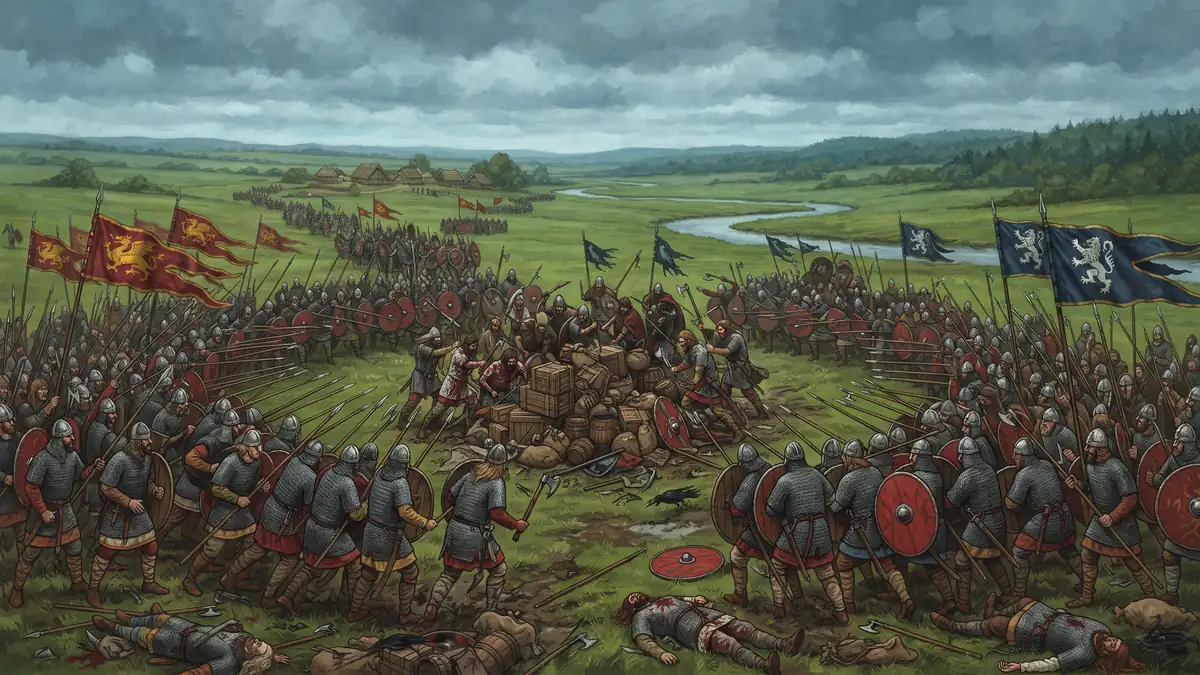
The Battle of Tettenhall was fought on 5 August 910, near Tettenhall, in Staffordshire, England. It is also known as the Battle of Wednesfield or Wōdnesfeld. On one side was an allied army of Wessex, under King Edward, and Mercia, under his sister, Æthelflæd. On the other, Vikings from the north, from Northumbria. This piece uses three sources, two reference works and one popular account, and separates what they state from what they leave open.
The context
According to the first source, Danish raids had brought much of north-eastern England, the former Northumbria, under Viking control. Alfred the Great had resisted and reduced the Danish attacks in central England. In 909, the allies launched a five-week campaign against the Northumbrian Danes. The popular account adds that this campaign sought to recover the relics of Saint Oswald, held at Jórvík, which the reference sources do not mention.
The campaign of 910
In 910, Edward was in Kent, waiting for a fleet he had summoned. The Vikings believed that most of the king’s troops were on board the ships and invaded Mercia. They raided as far as the river Avon, near Bristol, and then followed the Severn to the Bridgnorth area. They then turned east and were followed by the joint army of Mercians and West Saxons, which caught them near Tettenhall. The popular account says the Vikings sailed up the Severn in boats and scuttled them in Mercia, and that Edward placed his army between the raiders and their loot, forcing the fight.
The outcome
The Anglo-Saxons won, and the raiders were annihilated. The first source says three Viking kings were killed, Eowils, Halfdan and Ingwær, and that Viking losses were heavy, in the thousands. Anglo-Saxon losses are given as unknown. Another reference source says only that Edward won a decisive victory and extended the kingdom north to the Humber.
The consequences
With the northern Danes subdued, the forces of Wessex and Mercia could turn against the Vikings already settled further south. The source states that there was no further incursion from the north for a generation.
Terms
The Danelaw is the set of regions of England under Danish control. Mercia and Wessex were Anglo-Saxon kingdoms. A chronicler is an author who records the events of an age. Loot is what is taken in a raid.
What remains uncertain
The date and the place depend, according to the first source, on a single chronicler, Æthelweard, and the place is given only as “near” Tettenhall, with no exact spot. The sources differ on the names of the kings killed: the first cites Eowils, Halfdan and Ingwær, while the popular account cites Ivarr, Eowils and Halfdan. Neither source gives the size of the armies or the tactics of the battle, and the popular account admits that “not much is known” of the details. As to whether the Viking army was entirely destroyed, the same source says only that it perhaps was.
To find hidden raiders in a field without stepping on any, play The hidden raiders.
Sources.
- Wikipedia, "Battle of Tettenhall" (date from Æthelweard, campaign of 910, Viking kings killed, consequences)
- "Tettenhall, battle of", The Oxford Companion to British History, reproduced on Encyclopedia.com
- bukowo.com, "The Battle of Tettenhall" (2020), a popular account with the context of 909 and 910