Thorkell the Tall: from the siege of Canterbury to the earldom of East Anglia
Thorkell the Tall was a Danish warlord who ravaged southern England, served King Æthelred and then Cnut, and vanished from the records in 1023. See what the sources tell and where they differ.
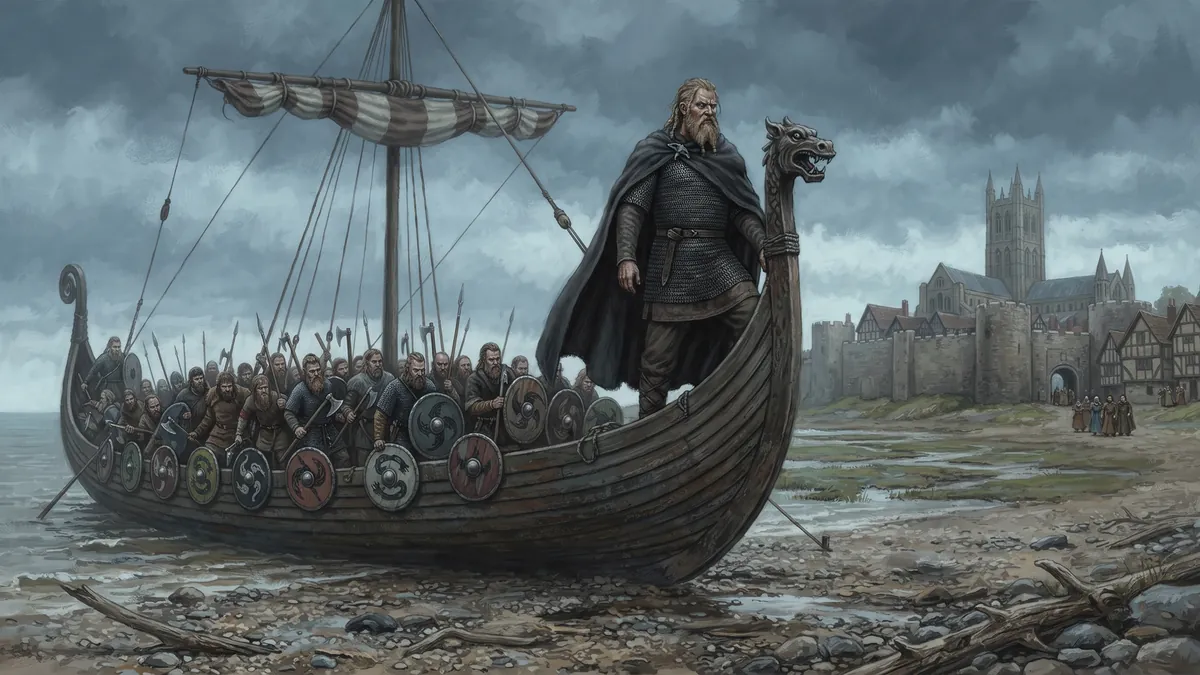
Thorkell the Tall was a Danish warlord active in the late 10th and early 11th centuries, and he is a historical figure. He appears at the siege of Canterbury, at the death of Archbishop Ælfheah and, later, in the service of two English kings of very different backgrounds. This piece uses two sources, an encyclopaedia in English and the Encyclopaedia Britannica, and separates what they state from what they leave open.
Origin and the Jomsvikings
According to the first source, Thorkell was a son of the Scanian chieftain Strut-Harald and a brother of Jarl Sigvaldi, Hemingr and Tófa. He is said to have been the chief of the Jomsvikings, the legendary order of warriors, and to have fought at the Battle of Hjörungavágr in 986, but the first source marks the link with the Jomsvikings as lacking a citation. Britannica says little is known of his youth and that he reportedly took part in the Battle of Hjörungavágr. The Jómsvíkinga saga and runestones mention him, among them the Orkesta stone (U 344), raised by Ulfr, who records having taken a danegeld in England with Thorkell.
1009: the arrival in Kent
In August 1009, a large Danish army led by Thorkell landed at Sandwich. The people of Kent paid 3,000 pounds of silver to keep the army from Canterbury. The army then tried several times to take London, met heavy resistance and gave up. Britannica adds that, in 1010, he attacked Ipswich and East Anglia and withdrew only after receiving a large danegeld.
1011: Canterbury and Ælfheah
On 8 September 1011, the army returned and besieged Canterbury for two weeks. The city fell through the treachery of a man named Ælfmaer, whose life Archbishop Ælfheah had once saved. The invaders took important hostages, among them Ælfheah, held for seven months. The army demanded another 3,000 pounds of silver for his release, and he refused to be ransomed. On 19 April 1012, at a drunken feast at Greenwich, his captors pelted him with cattle bones, and one man killed him with an axe blow. Thorkell, according to the source, tried to prevent the killing, offering everything he owned except his ship. The attacks ceased only after danegeld payments totalling 48,000 pounds of silver.
Changing sides
After this, Thorkell and his followers entered the service of King Æthelred, with 45 ships, and in 1013 fought against the invasion of Sweyn Forkbeard. Later, he allied with Cnut, Sweyn’s son, and fought against Edmund Ironside. In 1017, with Cnut king, Thorkell received the earldom of East Anglia, which the first source dates to 1017 to 1021.
Exile and disappearance
In 1021, for unknown reasons, Thorkell fell out with Cnut and was banished, and he returned to Denmark. In 1023, Cnut was reconciled with him, gave him the earldom of Denmark and the guardianship of his son Harthacnut. After 1023, his name vanishes from the records.
Terms
Danegeld is tribute paid to the Danes to stop their raids. A jarl is a Norse title, close to that of an earl. The Jomsvikings are an order of warriors linked, in the sagas, to the fortress of Jomsborg. An archbishop is the head of a province of the Church.
What remains uncertain
The sources differ on his birth: the first speaks of about 970, and Britannica of the late 950s, in southern Sweden. His leadership of the Jomsvikings appears as an attribution without citation. There is no record of him after 1023, and the date and manner of his death are unknown. The first source says he may have married Wulfhild, or Edith, a daughter of Æthelred, and that he had two sons whose identities are unknown. The historian Niels Lund called him “probably the leader of a gang of thugs” based in the Baltic, which shows that assessments of him vary.
To decipher silver seals into the right squares, with none repeated in a row, column or block, play The silver seals.
Sources.
- Wikipedia, "Thorkell the Tall" (life, Canterbury in 1009 and 1011, Ælfheah, Æthelred, Cnut, earldom of East Anglia, exile and 1023)
- Encyclopaedia Britannica, "Thorkell the Tall" (early life, invasions of England 1009 to 1011, service under Æthelred and Cnut)