The Battle of Brávellir: Sigurd Ring, Harald Wartooth and a legendary army
The Battle of Brávellir, fought, according to the sagas, around 770, pitted Sigurd Ring against his uncle, Harald Wartooth. See what the sources tell, the legendary numbers and why historians hesitate to call it a fact.
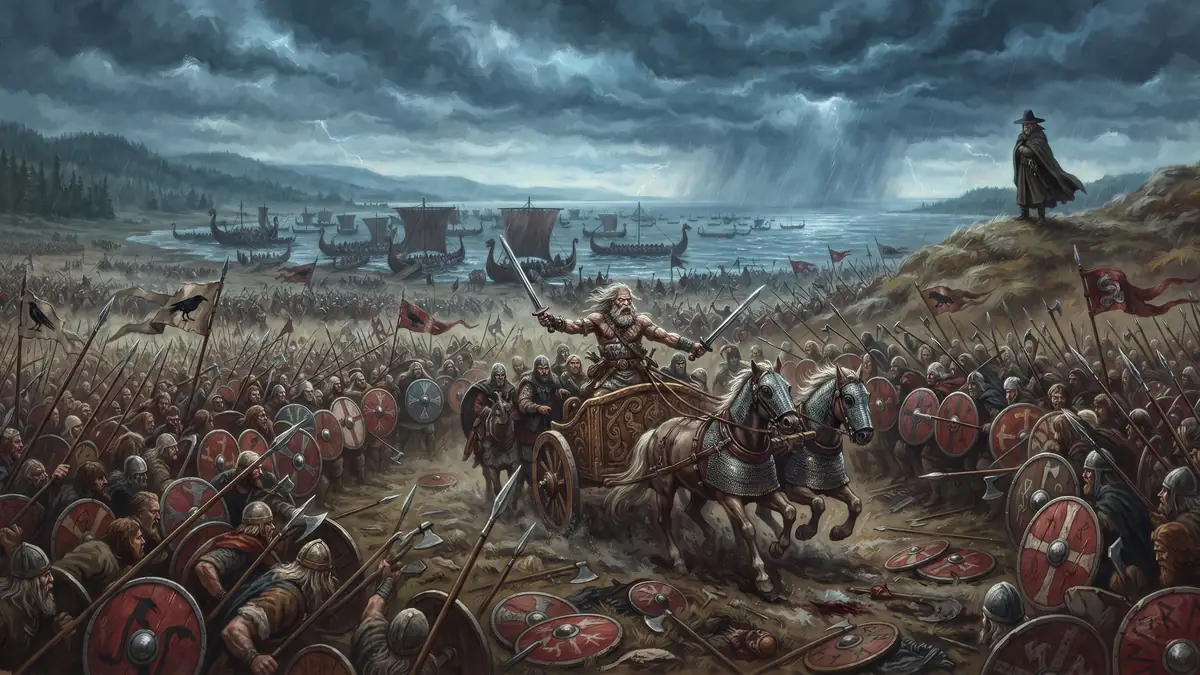
The Battle of Brávellir is a legendary battle of Scandinavia, which the sagas place around 770. On one side stood Sigurd Ring, king of Sweden, and on the other his uncle, Harald Wartooth, king of Denmark. This piece uses two sources, two entries of an encyclopaedia in English, and separates what they state from what they leave open.
Saxo’s account
The Gesta Danorum, by Saxo Grammaticus, around 1200, gives the fullest account. Both sides prepare for seven years and muster about 200,000 men each. Harald, an old man, asks Sigurd to let him die gloriously in battle, to enter Valhalla, and Odin is also shown to be involved. Ubbe and Starkad appear among the fighters. Harald fights from a chariot until Bruni kills him with a club. Sigurd wins.
The other accounts
The Sögubrot tells essentially the same. It places the battle south of Kolmården, at Bråviken, and gives about 40,000 warriors dead. The Hervarar saga speaks of “Brávellir in East Götaland”. Sigurd is the son of Randver or of Ingjald, according to the sources, and the father of Ragnar Lodbrok.
Legendary numbers
The reference sources list as legendary the 200,000 men per army, the 3,000 ships said to have carried the Swedes and the crossing of the Danes over the Øresund on ships.
How to read the sources
The main accounts, that of Saxo, around 1200, and the Sögubrot and the Hervarar saga, are much later than the date of about 770 that the sagas give for the battle, a distance of some four centuries. They agree on the outline: an old Danish king dies in an enormous battle, and Sigurd Ring wins. They differ in details such as the number of dead, the site and the part of Odin. For that reason this piece treats the numbers and the episodes as part of the legend, and not as a count of a verified event.
Terms
Gesta Danorum is the history of the Danes written in Latin by Saxo. Historicity is the degree to which something really happened. The Sögubrot is a saga fragment about ancient kings.
What remains uncertain
The site is mostly placed near Bråviken, in Östergötland, but there is a minority position that takes it to Småland, at Lake Åsnen. The sagas give about 770, and one hypothesis links the battle to the year 827, around Harald Klak. Some propose a real Swedish king who won a battle in the 8th century, others consider it only legend, and the Nationalencyklopedin, in 1990, says the historical basis is impossible to verify. One theory sees the origin in a civil war over the Danish throne after the death of Hemming, in 812. The second source warns that the sources differ on Sigurd’s parents, that a saga about him cited in the Bósa saga has been lost and that the Sögubrot breaks off before the end.
To find, from numbers on the edges, where ships are hidden on a map, play The fleet of Brávellir.
Sources.
- Wikipedia, "Battle of Brávellir" (accounts of Saxo, Sögubrot and Hervarar saga, numbers, site, historicity)
- Wikipedia, "Sigurd Ring" (family, reign, relation to Ragnar Lodbrok, uncertainties)