Starkad: the hero of three lifetimes, Odin's lot and Thor's curses
Starkad appears in the sagas and in Saxo as a long-lived warrior, aided by Odin and cursed by Thor, and the lot that makes Vikar a victim. See what two sources say and where they differ.
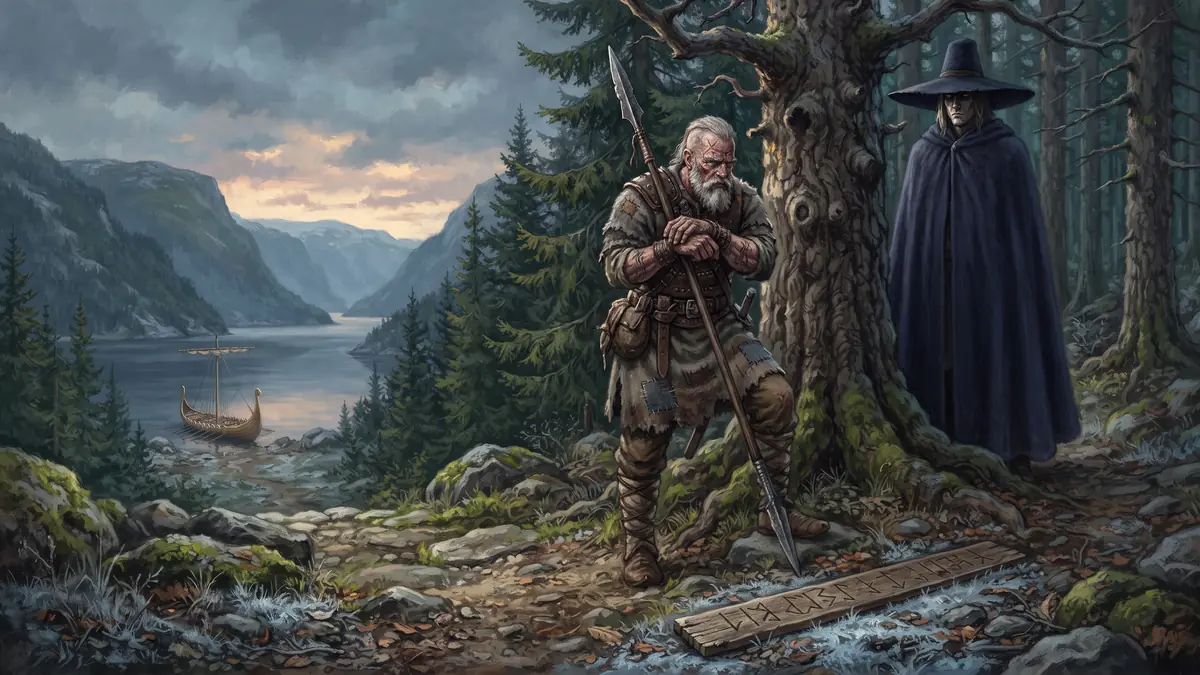
Starkad, in Old Norse Starkaðr, is a hero of the sagas and of the history of the Danes by Saxo, a long-lived warrior protected by Odin and persecuted by Thor. This piece uses two sources, an entry of an encyclopaedia in English and the one of the Danmarks Nationalleksikon on the Gautreks saga, and separates what they state from what they leave open.
Two Starkads
The first source distinguishes two characters with the same name. The first is an eight-armed giant, described in the Hervarar saga, in the version of the Hauksbók manuscript. The second source confirms this: in the Gautreks saga there is an eight-armed giant, Starkad, who abducts Alfhild and is killed by Thor. The second, Starkad the Younger, is the grandson of the first and is the one who appears in Saxo.
The upbringing and the lot
According to the Gautreks saga, this Starkad is raised alongside Vikar. At one point Odin draws lots, and the lot falls on Vikar. Vikar is sacrificed by hanging and with a spear. The first source says that in Saxo it is Starkad himself who kills Vikar, with a willow noose.
Odin’s gifts and Thor’s curses
Odin gives Starkad three lifetimes, weapons, wealth, victory and the gift of poetry. Thor answers with curses: he will have no children, will commit a crime in each life, will have no land, will never be satisfied, will have dangerous wounds, will forget the poems he makes and will be hated by the common people.
The end
In Saxo, Starkad lives his three lives and ends at Roliung, where he asks to be killed and is killed by Hather, who does so at his request. The first source lists other appearances: the Ynglinga saga, in which he kills Áli, the Sögubrot, in which he is at Brávellir, and the Norna-Gests þáttr, in which he meets Sigurd. The source also cites Olaus Magnus and the Annales Ryenses.
Terms
A lot is a choice made by chance, here attributed to Odin. The Hauksbók is a medieval Icelandic manuscript. A jotun or giant is a being of a mythical race, rival to the gods. A curse is a sentence that binds someone to a penalty.
What remains uncertain
The sources do not say how the two figures of the same name relate beyond the kinship of grandfather and grandson. The identity and the period of the hero vary from source to source, and the first source acknowledges that the explanation of what Saxo calls the “three evil deeds” is not clear. The sacrifice of Vikar is told differently in the saga and in Saxo, since in the saga he is sacrificed and in Saxo Starkad kills him. There is also no way to know whether the eight-armed giant is an older memory of the same hero or a separate character.
To follow the right cup after Odin shuffles the lot, play Odin’s lots.
Sources.
- Wikipedia, "Starkad" (the two Starkads, Odin and Thor, Vikar, Saxo, other sources)
- Danmarks Nationalleksikon (lex.dk), "Gautreks Saga" (plot, the eight-armed giant, the sacrifice of Vikar)