The Överhogdal tapestries: Viking Age textiles found in a Swedish church
The Överhogdal tapestries, found in 1909 in a church in Härjedalen, Sweden, show hundreds of human and animal figures. See what two sources say about the date, the counts and the interpretation.
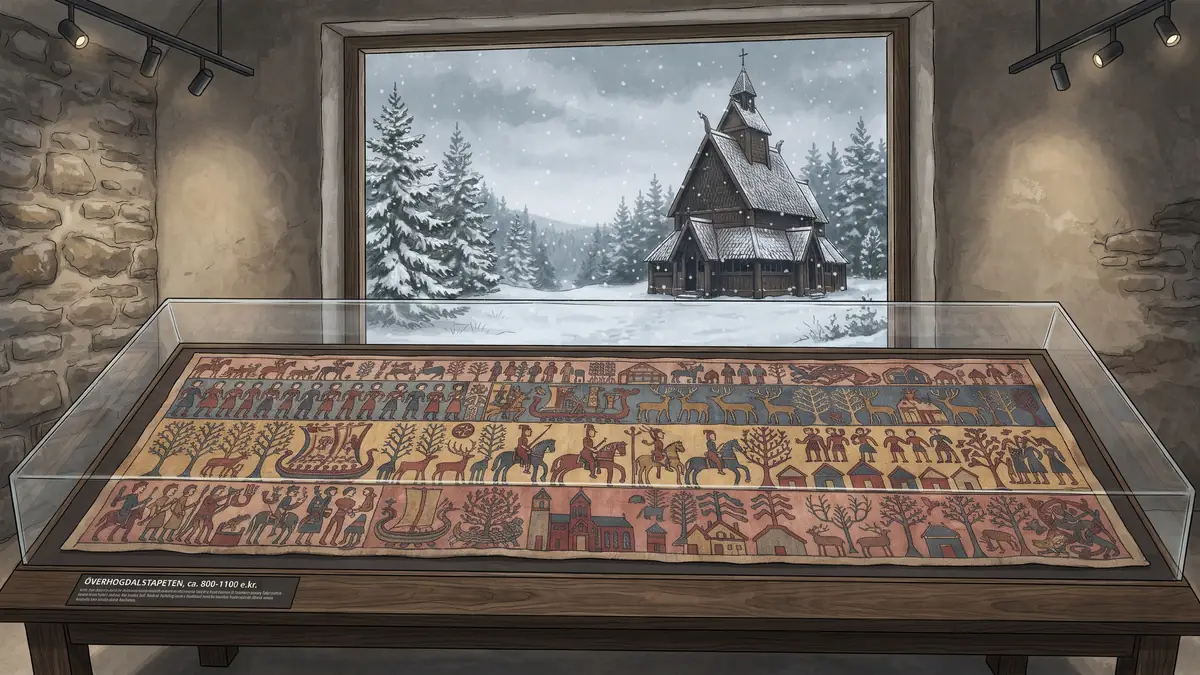
The Överhogdal tapestries are woven textiles found in Sweden, in Härjedalen, and are among the most important textiles of the Viking Age. This piece uses two sources, an entry of an encyclopaedia in English and a text from the site medieval.eu, and separates what they state from what they leave open.
The find
According to the first source, the textiles were found in 1909, in the vestry of the church of Överhogdal, in Härjedalen, by Jonas Holm. In 1910 they were taken to Östersund. The set has four sections. Today the pieces are kept in the Jamtli museum.
What is shown
The textiles show human figures and animals in bands. The first source counts 323 human figures, 146 animals and 3 partial animals. The second source gives 323 humans and 149 animals. The numbers are compatible, since 146 whole plus 3 partial add up to 149.
The dating
A radiocarbon dating of 1991 reached the range of 800 to 1100, according to the first source. The second source, and the more recent tests cited in the first, give the range of 1040 to 1170. The difference is large, and the later range runs into the Christian period.
The material
The wool was dyed with plants and woven with linen. A 2013 study cited in the first source speaks of hemp or flax as the fibre. The sources do not indicate in what workshop or place they were made.
How they are read
The dominant interpretation sees in the images Ragnarök, the Norse end of the world, with trees, horses and figures on the march. Another reading relates them to Christianization. The sources present both readings as hypotheses.
In brief
The Överhogdal textiles were found in 1909 and taken to Östersund in 1910. They have four sections and show 323 human figures and between 146 and 149 animals, depending on whether the partial ones are counted. The dating gives now 800 to 1100, now 1040 to 1170. Today they are in the Jamtli museum, and the most cited reading sees Ragnarök in them.
Terms
Radiocarbon is a technique for dating organic materials. A vestry is the room of a church where objects of worship are kept. A textile is a woven cloth. Ragnarök is the end of the world in Norse mythology.
What remains uncertain
The date varies between the range of 800 to 1100 and that of 1040 to 1170, depending on the test. The count of animals changes from 146 to 149, and the difference, as can be worked out, comes from the 3 partial animals. The interpretation, between Ragnarök and Christianization, is not settled, and the two sources do not say who made the textiles or why they ended up in a church.
To rebuild the bands of a cloth by sliding rows and columns until the picture returns to its place, as on a loom, play The Överhogdal loom.
Sources.
- Wikipedia, "Överhogdal tapestries" (find, sections, count of figures, dating, materials, interpretations)
- medieval.eu, "Viking textiles from Overhogdal" (count of figures, dating, interpretation)