The Hoen treasure: gold, Arab coins and beads found in Buskerud
The Hoen treasure, found in 1834 in Buskerud, Norway, brings together jewellery, coins and beads of very different origins, deposited in the late 9th century. See what two sources say and where the counts differ.
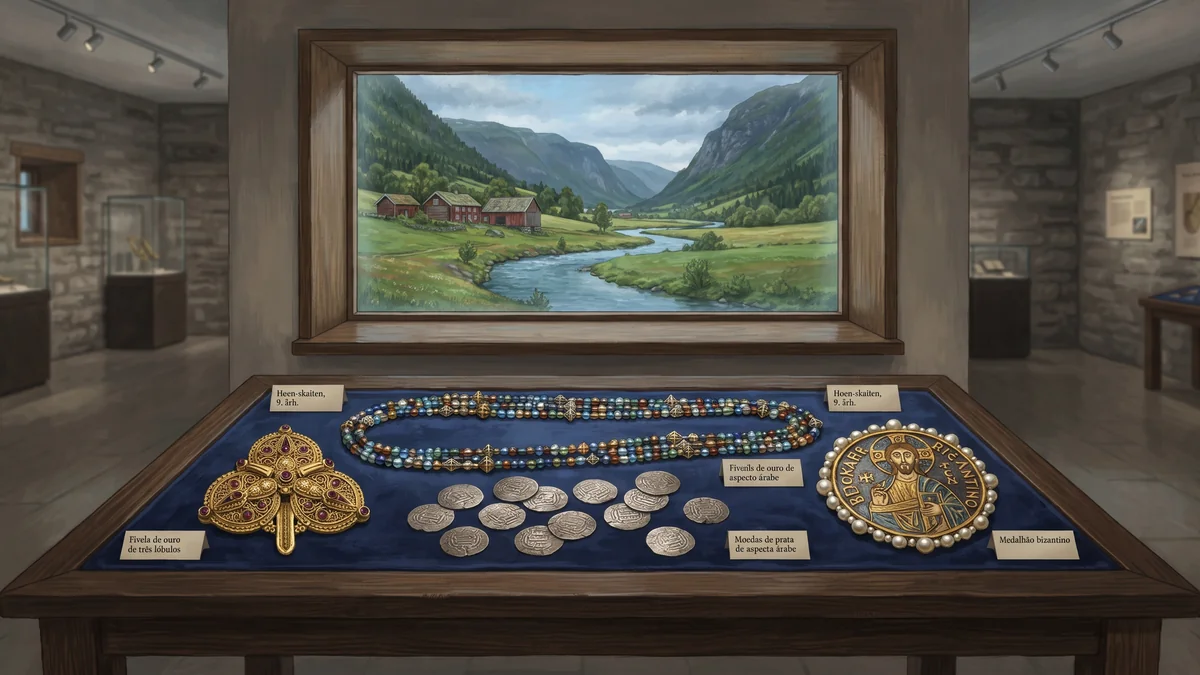
The Hoen treasure is a set of jewellery, coins and beads of the Viking Age, found in 1834 in Norway. This piece uses two sources, an entry of an encyclopaedia in English and the one of the Store norske leksikon, and separates what they state from what they leave open.
The find
According to the first source, the treasure was found in 1834, at Hokksund, in Buskerud, by a farm worker. The second source places the find on the farm Nedre Hoen, in Øvre Eiker, near the river Drammenselva. During the Second World War, the treasure was hidden at Fagernes. Today it is in the Museum of Cultural History, in Oslo.
What is in the set
The first source speaks of 207 pieces: 54 objects of gold or silver-gilt, 20 coins and 132 beads. The second gives 20 coins, 50 items of jewellery and 125 beads, with about 2.5 kilograms of gold. The two counts differ, and the first’s sum, which gives 206, does not match the total of 207 that it cites itself.
Origins of the objects
The pieces come from very diverse places. The second source lists a three-lobed gold strap distributor, a Byzantine medallion, an English gold ring and two reliquary containers of Mediterranean origin. The oldest coin is a Roman solidus of 364 to 367, and most of the coins are Kufic, that is, Arabic, of the 9th century.
The date
The set was deposited around 875 to 900, according to the second source, and the first speaks of the late 9th century.
The numbers in brief
In brief, what the sources give is this: the find dates from 1834. The first source counts 207 pieces, with 54 of gold or silver-gilt, 20 coins and 132 beads. The second counts 20 coins, 50 items of jewellery and 125 beads and gives about 2.5 kilograms of gold. The oldest coin is from 364 to 367, and the deposit is from about 875 to 900.
Terms
A Kufic coin is an Arabic coin with Kufic script. A solidus is a Roman gold coin. A reliquary is a container for relics. A deposit is the act of burying or keeping a set of objects.
What remains uncertain
The two sources differ in their counts. It is not known how the owner gathered objects from so far apart, whether by plunder, trade or gift. The reason for the deposit is also debated, between a religious offering and a hiding place, and the sources do not settle it. The first source treats the place as Hokksund and the second as Nedre Hoen, in Øvre Eiker, and this place-name detail is not explained by either.
To link beads in a single line without repeating any, as on a necklace, play The Hoen necklace.
Sources.
- Wikipedia, "Hoen treasure" (find, wartime hiding place, count, museum)
- Store norske leksikon (snl.no), "Hoenskatten" (composition, origins, date of deposit, hypotheses)