Seiðr: the Norse magic of the thread, the ritual distaff and the seeresses, the völur
Seiðr was a magic practice of the Viking Age tied to prophecy and curses, to a kind of distaff and to women seers, the völur. See what two sources say about the word, the account of Eiríks saga rauða and what is not known.
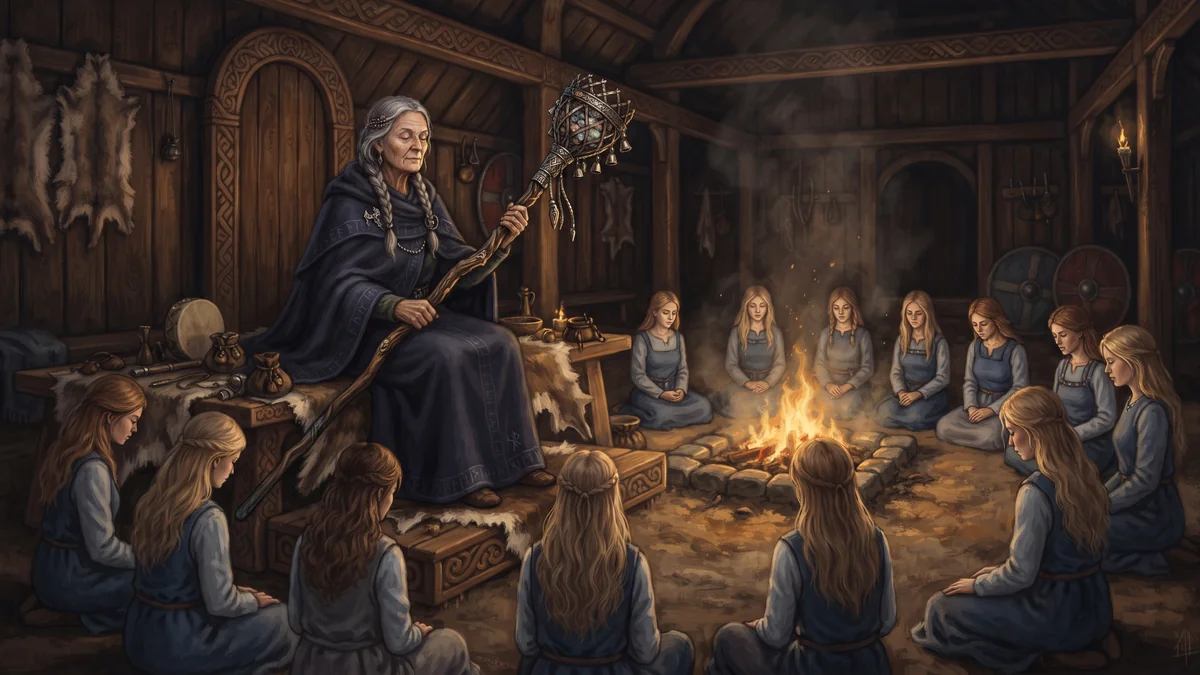
Seiðr was a magic practice of the Norse world, and whoever practised it, in the picture given by the sources, entered a trance with a ritual object in hand. This piece uses two sources, an entry of the site norse-mythology.org and an entry of HandWiki on the völur, the seeresses. The old sources on the subject are few, and the doubts are marked.
The word and the practice
Seiðr means “cord, string, snare”. According to the first entry, whoever practised it held a ritual distaff and entered a trance. Seiðr served for prophecy, blessing, cursing, healing and control of the weather, and the source cites Neil Price, from 2002, on this. HandWiki presents the origin of the name, the thread spun with a distaff, only as a theory.
Freyja, Odin and the charge of ergi
Freyja is the model of the seeress, the völva, and Odin is the best-known male practitioner. Men who practised it could be called argr, that is, “unmanly”, and the word comes with the idea of ergi. In the Lokasenna, stanza 24, Odin is accused of this.
The völva Þorbjörg
The most detailed account is in Eiríks saga rauða, chapter 4. Around the year 1000, during a famine in Greenland, the völva Þorbjörg is summoned, and the household prepares to receive her. According to HandWiki, she carries a staff adorned with brass and gems and wears a blue or black cloak. She sits on a raised platform while young women sing to summon the powers. The saga says that she foresees the future and that the famine ends.
The staff and the graves
The word völva is read as “wand carrier”. The staff was the seiðstafr. HandWiki tells that staffs have been found in about 40 graves of women, usually rich ones. Many have the top in the shape of a basket, like that of a distaff, and some cannot be linked to a distaff and may be phallic. Among the finds cited are Fyrkat, in Denmark, Oseberg, in Norway, Köpingsvik, on Öland, and Hagebyhöga, in Sweden.
In brief
Seiðr joins a thread, a staff and a trance. The texts show the practice through the eyes of those who wrote centuries later, and the graves show objects, not beliefs. When the two meet, as in the staff and the saga, the picture grows stronger, but not complete.
Terms
Seiðr is the Norse magic practice. Völva is the seeress. A distaff is the rod on which wool is held for spinning. A trance is an altered state of consciousness. Argr is a word of insult tied to “unmanly”.
What remains uncertain
The sources are sparse, and almost everything comes from texts written after the Viking Age. The origin of the name, the link to the distaff, is only a theory. HandWiki says that Harald Bluetooth “apparently” kept a völva at Fyrkat, and the text also marks parts as lacking a citation. It is not known how the ritual really took place, and the graves do not show what people did with the staffs.
To follow a thread of beads and end up with the last one, play The thread of seiðr.
Sources.
- norse-mythology.org, "Seiðr" (the word, the practice, Eiríks saga rauða, Freyja, Odin, argr, Neil Price)
- HandWiki, "Völva" (the word völva, the staff, Eiríks saga rauða, Völuspá, archaeological finds, uncertainties)