The Mammen grave: an axe with silver, a candle and a chamber dated to 970
In a mound near Viborg, in Denmark, there was a wooden chamber with a man in a coffin, an embroidered cloak, two axes and a large wax candle. The timber was felled in the winter of 970 to 971. See what two sources say and what is only a hypothesis.
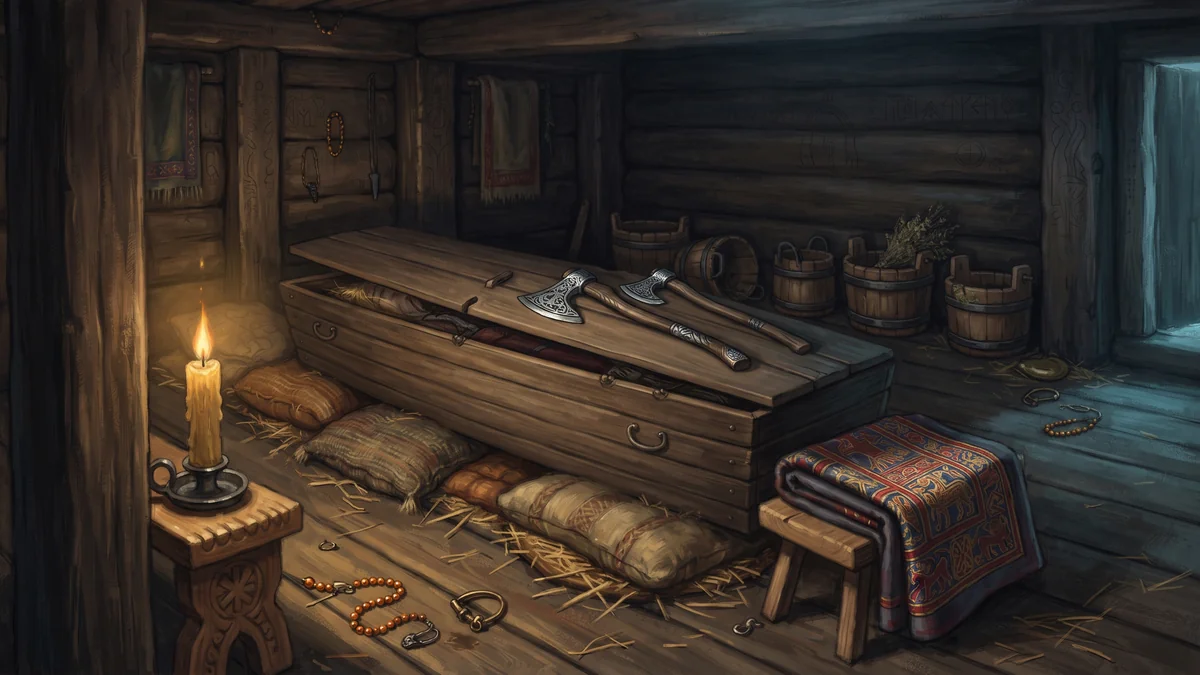
The Mammen grave is one of the best-known finds of Viking Age Denmark. This piece uses two sources, a page of the National Museum of Denmark and a text of the Viking Ship Museum, in Roskilde. What is a hypothesis is said to be a hypothesis.
The mound
The grave is in the mound Bjerringhøj, near Viborg. In 1868, the mound was opened. The timber of the chamber was felled in 970 or 971, and the date comes from dendrochronology, the study of tree rings. The samples come from the new excavation of 1986, and not from that of 1868.
What was inside
In the chamber there was a slender man, in a coffin of 3.20 metres, with an embroidered wool cloak, with silk, on cushions of down. There were two axes, and one of them had inlays of silver. There was also a large wax candle, probably a Christian symbol, a bronze pot and two wooden buckets. Less than a kilometre away, in 1871, a hoard of objects was found.
The Mammen style
The axe with silver inlay gave its name to a style of ornament, the Mammen style. This means that the grave serves as a reference for other objects decorated in a similar way.
Who the man was
It is not known whether he was Christian or pagan. The grave shows a member of the elite, and the source suggests that he may be King Harald Bluetooth, but this is only a suggestion. The closest parallel is the North Mound of Jelling.
How the sources complete each other
The two sources agree on the essentials: the chamber, the man, the axes and the date. Anyone who wants the details of the timber samples and of the full list of objects should consult the pages of the museums, which are the origin of what was summarised here.
In brief
There is a chamber dated with precision, to 970 or 971, with a man, a cloak of wool and silk, two axes and a candle. The date comes from dendrochronology, and the rest is interpretation. The most famous object is the axe with silver, which gives its name to a style.
Terms
Dendrochronology is dating by the growth rings of trees. A burial chamber is a space of wood or stone where a dead person is placed. An inlay is a design made with one metal set into another. A hoard is a set of objects kept together.
What remains uncertain
The sources do not say whether the man was Christian or pagan. It is also not known who he was. The idea that he is Harald Bluetooth is only a suggestion. The wax candle is described as “probably” a Christian symbol, and that is an interpretation. The relation of the hoard of 1871 to the grave is not explained beyond the distance.
To place the axes on the board without their attacking each other, play The axes of Mammen.
Sources.
- Nationalmuseet (natmus.dk), page on the Mammen grave (find, dendrochronology, objects, Harald Bluetooth)
- Vikingeskibsmuseet (vikingeskibsmuseet.dk), text on the Mammen grave (contents of the chamber, Mammen style)