Eketorp: the ring fort of Öland, in Sweden, from the Iron Age to the 13th century
On Öland, in Sweden, the ring fort of Eketorp was used in three periods and then abandoned. See what two sources say about the phases, the buildings, the finds and what the dates leave open.
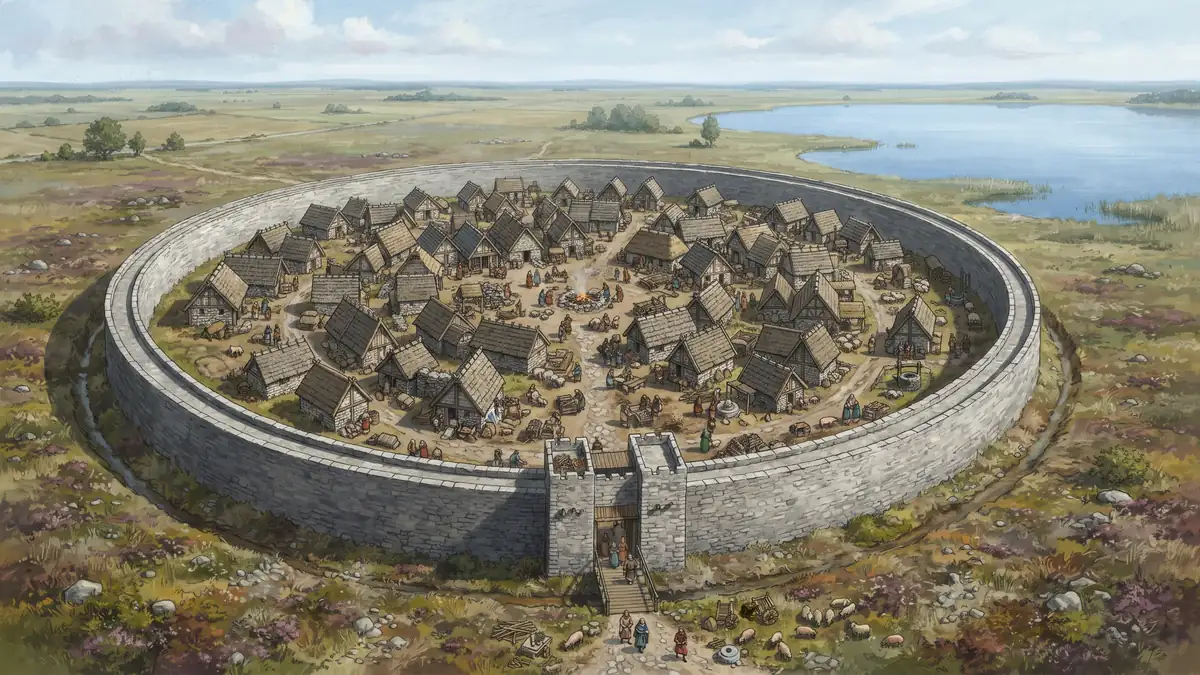
Eketorp is an Iron Age ring fort in southeastern Öland, in Sweden. This piece uses two sources, an entry of an encyclopaedia in English and an article of the magazine Expedition, of the museum of the University of Pennsylvania, written by two archaeologists. The dates of the two sources do not coincide in everything, and this is marked.
Where it is and how it was excavated
The fort is in southeastern Öland, and the whole area of the south of the island is a UNESCO World Heritage Site. Eketorp is the only one of the 19 known prehistoric forts on Öland that has been fully excavated. The excavation was done between 1964 and 1974 and yielded more than 24,000 artefacts. In the 20th century, the site was reconstructed for visitors.
Eketorp I
According to the Expedition article, the first fort, from about 300 to 400, was built near a lake that had been used for animal sacrifices since the birth of Christ. Shelters with the opening toward the centre were built along the wall. Few had a fireplace, and few objects were found. The article says the use was probably occasional, for sacrifices to the gods or as a refuge in times of unrest. The entry reads the original fort as from about 400, of stone, 57 m in diameter, and says it is thought to have served for religious ceremonies and as a refuge.
Eketorp II
Around 400, after the first fort was torn down, a fortified hamlet was built, with a permanent farming population, 80 m in diameter. The article counts 53 stone buildings, among them 22 dwellings, 12 storehouses, 12 byres and a forge, and estimates about seven people per household, close to 150 in all. The inhabitants were not particularly rich or poor compared with the society of Öland. Finds include weapons, tools, jewellery and many bones of cows, sheep, goats, horses, pigs, cats, dogs, hens and geese. The entry speaks of about fifty small structures, “cells”, and gives no number of houses.
The 5th century and the abandonment
The article says the 5th century was a relatively wealthy time on Öland, with many Roman gold solidi, probably earned by warriors of the island as mercenaries. If the north gate had a portcullis sliding down grooves, it would be a unique example of Roman technology in northern Europe. Around 650, Eketorp and the other forts of Öland were abandoned, which suggests a relatively peaceful period, and the fort stood empty for about 500 years. The lake remained a place of sacrifice until about 1000.
Eketorp III
Around 1170, according to the article, the fort was occupied again as a military garrison of heavy cavalry, during the formation of the Kingdom of Sweden. Eketorp II was rebuilt and given an outer wall. There were wooden buildings, a large kitchen and six forges between the two walls, which made weapons and boat rivets. The finds include spears, swords, shields, arrows and iron spiked traps against horses. Around 1240, when the Sverker family gained the throne, the fort was abandoned for good. The entry, instead, says the reuse was in the early 11th century.
In brief
Eketorp had three phases: an occasional refuge, a hamlet of about 150 people, from 400 to 650, and a cavalry garrison at the end of the 12th century. It was fully excavated between 1964 and 1974.
Terms
Ring fort is a fortification in a ring. Garrison is the troop that lives in a fort to defend it. Solidus is a Roman gold coin. Mercenary is a soldier paid to serve a foreigner.
What remains uncertain
The two sources differ in parts: the article gives Eketorp I as from 300 to 400 and the reuse at about 1170, and the entry gives the original fort as from about 400 and the reuse in the early 11th century. The reason for the abandonment around 650 is inferred, and the purpose of Eketorp I is deduced from few finds. The gate’s portcullis is a possibility, and the populations are estimates.
To turn three rings until the gates of the fort are in line, play The gates of Eketorp.
Sources.
- Wikipedia, "Eketorp" (place, phases, measurements, finds, excavation, theories of use, reconstruction)
- Jan Olofsson and Egil Josefson, "The Development of Eketorp Fort", Expedition Magazine, Penn Museum, March 2007 (phases I, II and III, buildings, population, abandonment)