Gjellestad: the Viking ship found by georadar in Halden, Norway
In Halden, in eastern Norway, a georadar showed a Viking ship buried beside a great mound. See what three sources say about the discovery, the excavation, the measurements and what is still uncertain.
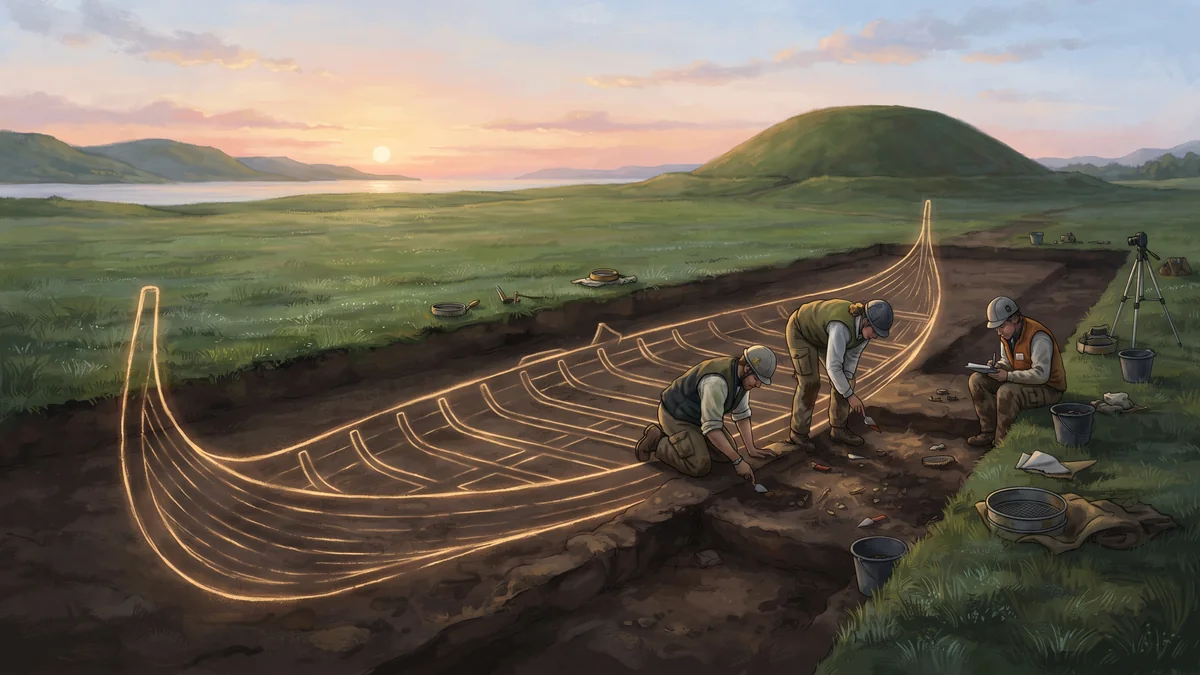
At Gjellestad, near Halden, in Østfold county, in eastern Norway, archaeologists found a Viking ship buried without touching the soil: it was the georadar that showed it. This piece uses three sources, texts of the Norwegian institute for cultural heritage research NIKU, of the museum of cultural history of the University of Oslo and of the site The Past. The numbers change from one source to another, and this is marked.
Where it is and how it was found
The site is on the Viksletta plain, beside the great mound Jellhaugen. According to The Past, the plain covers 7 km², and Jellhaugen is an Iron Age funerary monument, dated to the 6th century. NIKU published the discovery on 15 October 2018. Archaeologists of the institute used a motorized high-resolution georadar, with technique and software developed by the Ludwig Boltzmann Institute for Archaeological Prospection and Virtual Archaeology. Lars Gustavsen was the project leader at NIKU.
What the radar showed
The ship lay about 50 cm below the topsoil, inside a burial mound. The digital images showed a well-defined ship-shaped structure about 20 m long. The data indicated that the lower part of the ship was still preserved, with the keel and the floor timbers. NIKU also found at least eight previously unknown mounds, destroyed by ploughing, and five longhouses, some of them quite large, compared with the site of Borre, on the other side of the Oslo fjord. Gustavsen said that the ship is part of a cemetery clearly designed to display power and influence.
The 2019 excavation
The museum of the University of Oslo and the cultural heritage section of Østfold carried out an excavation in 2019, with financial support from the Directorate for Cultural Heritage. The museum says that, before this discovery, no buried Viking ship had been found in Norway for more than a hundred years. The plan was not to excavate the ship, but to open two trenches toward its middle to see in what condition it was. The soil was removed in layers of 10 cm, sifted and checked with a metal detector.
On 27 August two rows of ship nails appeared, less than 30 cm below the surface, with no trace of wood. On 2 September, shovel marks in the support material confirmed that the ship had been looted. On 5 September, the keel was found preserved. The archaeologist Christian Rødsrud, the project manager, said that the wood of the keel was in as good condition as hoped. The keel is 4.5 cm wide and 11 cm deep, narrower and thinner than those of other Viking ships. This led to the idea that the ship was built for rowing more than for sailing, but the team said it was too early to confirm.
What The Past adds
The text of The Past, on the article in the journal Antiquity, calls the burial M13. It says that georadar surveys and trial excavations in 2018 and 2019 showed that Jellhaugen is part of a larger complex, with 15 other monumental mounds and at least five buildings, flattened by ploughing. The main excavation began in June 2020. The radar showed a shape 19 to 20 m long and 4 m wide, the lower part of the hull. With the stem and stern, the original length would be close to 21 m. The wood of the keel was felled after 732, and the burial would date from between the late 700s and the early 900s, in line with other ship burials in the Oslo fjord region.
In brief
Gjellestad is a ship burial, found by georadar beside the Jellhaugen mound, in a larger cemetery. The ship is about 20 m long, was looted at some point, but the keel is still preserved. Its wood was felled after 732.
Terms
Georadar is a radar that shows what is under the ground without digging. Keel is the bottom beam of the ship, from bow to stern. Ship burial is a burial with a ship as the tomb. Radiocarbon dating measures the age of wood and soil.
What remains uncertain
The sources give different counts of mounds: at least eight, at least ten and 15 other monumental mounds, which seems to reflect fuller surveys over time. The upper part of the ship and the total length are estimated. The museum says there is as yet no evidence of the sex of human remains, and the date of the looting is unknown. The chronology of the site still needs more work.
To cross the sea with a ship, gather runes and dodge rocks and ice, play The ship crossing.
Sources.
- NIKU (Norwegian Institute for Cultural Heritage Research), "Georadar detects a Viking ship in Norway" (October 2018)
- Museum of Cultural History, University of Oslo, "We are digging after a new Viking ship" (August and September 2019)
- The Past, "Ship shape: Viking burial found" (news on the article published in the journal Antiquity)