Skíðblaðnir: Freyr’s ship that folds like cloth and fits in a pocket
Norse mythology speaks of Skíðblaðnir, the best of ships, which carries all the gods and folds like cloth. See what the Poetic Edda, the Prose Edda and Heimskringla say about who made it and who owned it.
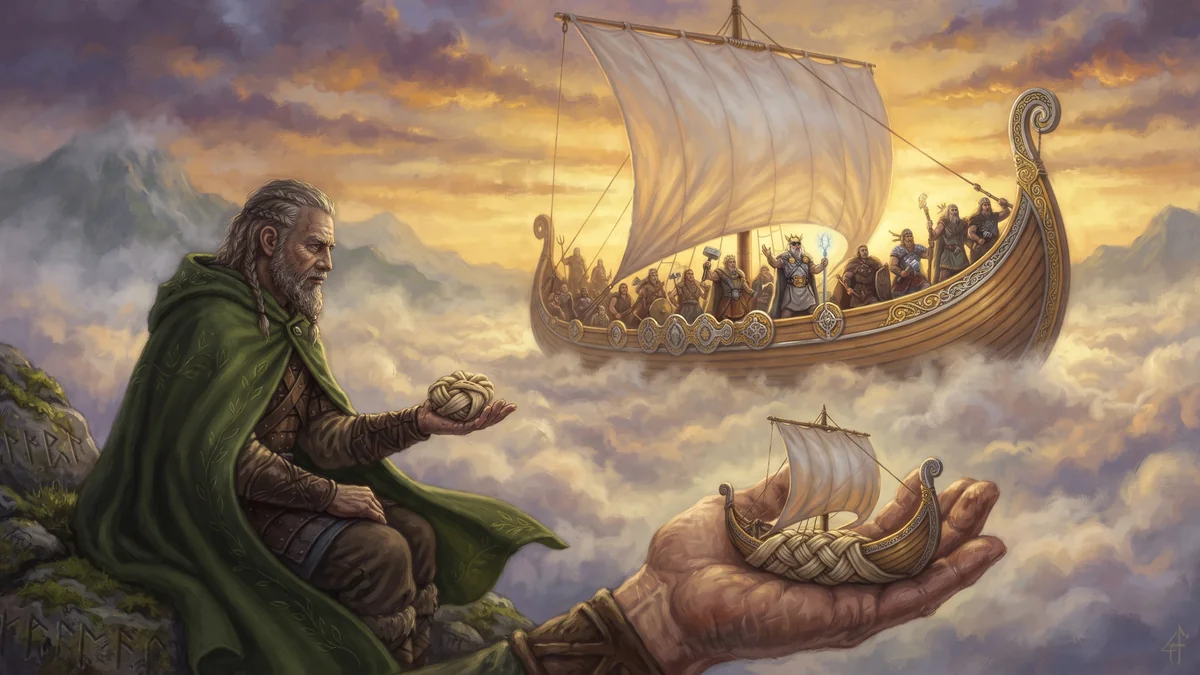
Skíðblaðnir is a ship of Norse mythology. This piece uses one source, an entry of an encyclopaedia in English, which gathers what the Poetic Edda, the Prose Edda and Heimskringla say about it. When the sources differ, the piece points out the difference.
The name and the sources
The Old Norse name is glossed as “assembled from thin pieces of wood”. It is also written Skidbladnir or Skithblathnir. The ship is mentioned in the Poetic Edda, compiled in the 13th century from older traditions, in the Prose Edda and in Heimskringla, the last two written by Snorri Sturluson in the 13th century. All the sources call it the best of ships.
Who made it and for whom
In the Poetic Edda, Skíðblaðnir appears twice, both times in the poem Grímnismál. In it, Odin, disguised as Grímnir, is tortured, starved and thirsty, and passes knowledge of the cosmos to the young Agnar. In one stanza, the sons of Ivaldi make the ship, in ancient times, as the best of ships for the bright Freyr, son of Njörðr. In another stanza, the poem lists superlatives: Yggdrasil is the best tree, Skíðblaðnir the best ship, Odin the greatest of the gods, Sleipnir the best horse and Bifröst the best bridge.
What the ship does
In the Gylfaginning, part of the Prose Edda, Gangleri, who is King Gylfi in disguise, asks whether any ship is as good or as large. High, the speaker, answers that Skíðblaðnir is the best and the most ingeniously made, but that the largest is Naglfar, owned by Muspell. According to him, the sons of Ivaldi, described as dwarfs, built it and gave it to Freyr. The ship is big enough to carry all the gods with their weapons and wargear. When the sail is raised, it finds a fair wind and goes wherever is needed, on wind and on water. And it is made with so much art that it can be folded like cloth and kept in a pocket when it is not needed at sea.
The ship in the story of Loki and Sif
In the Skáldskaparmál, also of the Prose Edda, Freyr is called “possessor of Skidbladnir and of the boar Gullinbursti”. In a longer passage, Loki cuts off Sif’s hair as a prank, and Thor, furious, threatens to break his bones. Loki promises that the Svartálfar will make new golden hair for Sif, which will grow like real hair. He goes to the sons of Ivaldi, who make Sif’s hair, Skíðblaðnir and the spear Gungnir. Later Loki also gets Mjöllnir, Draupnir and Gullinbursti, and his wit saves his head, although his lips end up stitched together. The dwarfs share the objects among Sif, Thor, Odin and Freyr, and Freyr receives Gullinbursti and Skíðblaðnir.
Odin and the Ynglinga saga
In the Ynglinga saga, part of Heimskringla, the ship has a different origin, in the form of a human explanation of the legend. Odin is described with magical powers: he puts out fires, calms the sea and changes the wind with words. According to the saga, he had a ship called Skíthblathnir, on which he crossed great seas, and which could be folded like cloth. Here the owner is Odin, not Freyr.
In brief
Skíðblaðnir is the best of ships: it holds all the gods, finds wind wherever it is needed and folds like cloth. In the Eddas it belongs to Freyr and was made by the sons of Ivaldi. In Heimskringla it belongs to Odin and comes from his magic.
Terms
Skíðblaðnir is the name of the ship. Edda is the name of two sets of medieval texts from Iceland about the gods. Dwarfs are the craftsmen of the myth. Euhemerized describes an origin in which a god becomes a human character, with an explanation without miracle.
What remains uncertain
The sources differ on the owner of the ship: Freyr in the Eddas, Odin in Heimskringla. The entry also does not say whether the dwarfs of Grímnismál are the same as those of the Prose Edda, although it presents them as the same group. The sources cited do not explain how the ship folds. All of this is narrative of tradition, written centuries after the time in which it was believed.
To fit a whole ship in a pocket by placing the right pieces, play The ship in the pocket.
Sources.
- Wikipedia, "Skíðblaðnir" (name, Grímnismál, Gylfaginning, Skáldskaparmál, Ynglinga saga, owners and makers)