Canute IV of Denmark: the fleet that never sailed and the death in Odense in 1086
In 1085, Canute IV called the fleet to the Limfjord to invade England, but it never sailed. On 10 July 1086, he died in St. Alban's church in Odense. See what is known and what is uncertain.
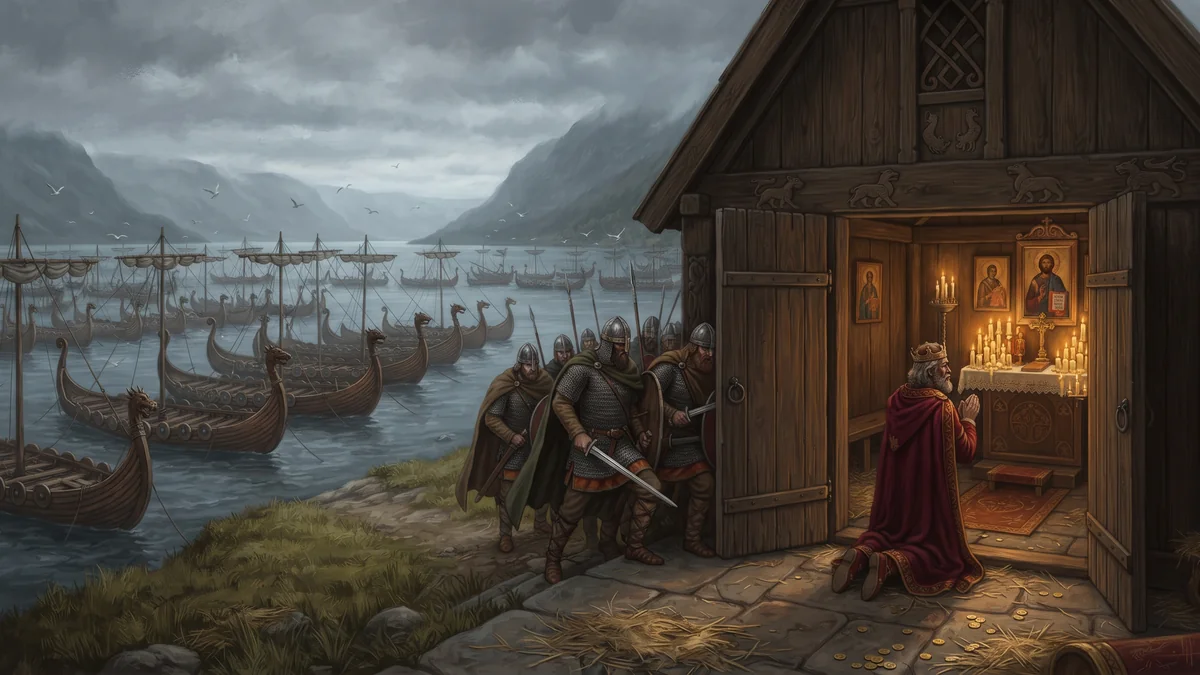
Canute IV was born around 1042 and died on 10 July 1086. He was king of Denmark from 1080 until his death. This piece follows the article “Canute IV of Denmark”, which relies on sources such as Ælnoth of Canterbury, author of his biography.
A king of great ambition
Canute was one of the many sons of Sweyn II Estridsson, by a mistress whose name is not known. When Sweyn died, his brother Harald III was elected king. Canute went to Sweden. Harald died on 17 April 1080, and Canute took the throne. He married Adela of Flanders, daughter of Count Robert I, and had with her Charles, born in 1084, and twin daughters. He was a devout king, strengthened the Church and gave gifts to churches, above all to Lund. In May 1085 he issued a letter of donation to Lund Cathedral and founded the cathedral school. He also claimed common land, shipwreck goods and the inheritance of foreigners and of people without kin, which caused discontent.
The invasion that did not happen
Canute thought the English crown was his by right, as grandnephew of Canute the Great, and saw William the Conqueror as a usurper. In 1085, with support from his father-in-law and from Olaf III of Norway, he planned an invasion and called the fleet to the Limfjord. The fleet never sailed. Canute stayed in Schleswig, worried about Emperor Henry IV. The warriors, mostly peasants who were needed for the harvest, grew weary, and elected Canute’s brother Olaf to speak for them. Canute had Olaf arrested and sent him to Flanders. The fleet dispersed.
The death in Odense
In early 1086 a peasant revolt broke out in Vendsyssel, where Canute was staying. He fled to Schleswig and then to Odense. On 10 July 1086, Canute and his men took refuge in the wooden church of St. Alban. The rebels came in and killed Canute, his brother Benedict and seventeen followers before the altar. Ælnoth says the king died of a lance thrust in the flank. Olaf succeeded him as Olaf I.
After the death
The harvest failed in Olaf’s reign, which was seen as punishment, and miracles were reported at the grave. On 19 April 1101, Pope Paschal II confirmed the cult, and Canute was canonized, the first Dane to become a saint. His feast day is 10 July. In 1300, his remains and those of Benedict were moved to Saint Canute’s Cathedral in Odense, where they are displayed.
In short
Canute wanted to take the crown of England, but the fleet dissolved before sailing. Months later, peasants killed him in a church. In 1101, he became a saint.
Terms
Leding was the defence and attack fleet called out by the king. Canonization is the recognition of someone as a saint. Limfjord is an inlet of the sea in northern Jutland.
What remains uncertain
The cause of the revolt is unknown: the article cites the fines after the 1085 call-up and the tithe policy. Ælnoth speaks of a lance in the flank, but CT scans in 2008 indicated a thrust to the sacrum, through the abdomen, without signs of a fight against many. The year of birth is approximate. Some see in him a violent tyrant, others a strict but just king.
To gather the fleet of the Limfjord, repeating the order in which the ships light up, play The fleet of the Limfjord.
Sources.
- Wikipedia article "Canute IV of Denmark"
- Ælnoth of Canterbury, biography of Canute, as cited in the article
- Chronicon Roskildense, as cited in the article