Helgö: the Buddha statuette found on an island in Lake Mälaren, Sweden
In 1954, an excavation at Helgö, in Sweden, turned up a small bronze statuette of the Buddha, in North Indian style and from the 6th century. See what is known of the piece, of the site and what remains open.
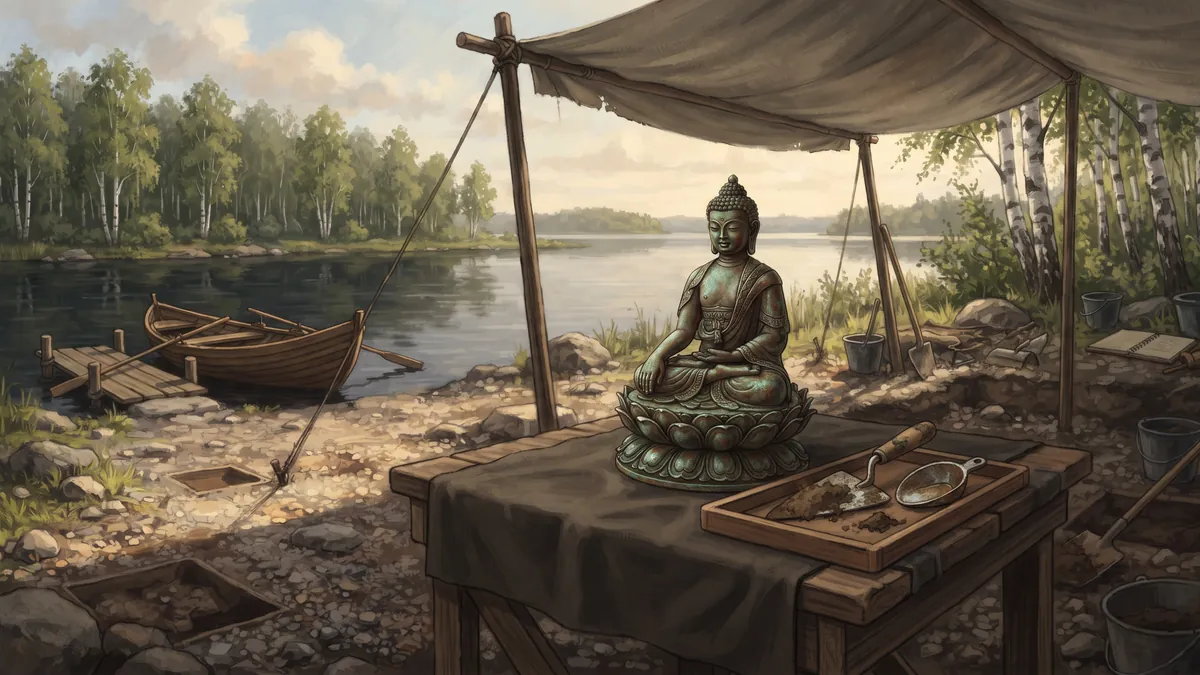
Helgö is an island in Lake Mälaren, in Ekerö municipality, Stockholm County, Sweden. It is about 5 km long, up to 1.5 km wide and covers 48 hectares. This piece uses two articles: the one on the site and the one on the Buddha statuette found there.
The site
The article says the old trading settlement of Helgö began to emerge around the year 200, some 500 years before Birka, on Björkö. The first excavation, in 1954, revealed remains of the settlement and a workshop area that drew international attention. Among the finds are a small Buddha statuette from North India, a Coptic piece from Egypt and an Irish crozier head. The article on the statuette also lists Roman gold coins, a Frisian coin and jewellery from the eastern Baltic. The results came out in a series of the Royal Swedish Academy of Letters, History and Antiquities, whose volume 18, the last, is from 2011.
The statuette
It is a small bronze figure, 8.4 cm high, of the Buddha seated on a lotus throne. There is a gold mark, the urna, on the forehead, and the forehead, eyebrows and mouth have inlay of a dark metal, perhaps silver or niello. Two rivet holes suggest it was once fixed to something. It dates to the 6th century, the Gupta Empire period, and is North Indian in style. The exact origin is uncertain: the article suggests the Kashmir Valley or the Swat Valley, today in Pakistan. It is believed to have reached the North by the Silk Road.
How it was found
It was found in July 1954, in the third excavation season, in an area called House Group 2, together with other Migration Period objects. According to the article, it had a leather strap around the neck and right arm, which suggests it was worn as a talisman. It is quite damaged, and probably no longer had religious meaning when it arrived. Today it is on display at the Swedish History Museum in Stockholm.
In short
A small image of the Buddha, made in North India in the 6th century, ended up on a Swedish island where trade went on from the year 200, near the end of a long-distance route. The article calls it unique in the Nordic Iron Age context.
Terms
Urna is the mark on the Buddha’s forehead. Niello is a dark alloy used in inlay. Silk Road is the network of trade routes between Asia and Europe.
What remains uncertain
The article says the statuette is believed to have come to Helgö in the Viking Age, which sits awkwardly with the 6th-century date and the chronology of the site, and it does not settle the point. Another text cited speaks of a copper torque on the neck, not a leather strap. The article also gives two dates for the settlement: from 200, and from the 3rd to the 8th century. The sources describe the Coptic piece in different ways.
To find the hidden statuette after the pots are shuffled, play Where is the Buddha?.
Sources.
- Wikipedia article "Helgö"
- Wikipedia article "Helgö Buddha"
- Swedish History Museum, Stockholm, where the piece is displayed, as cited in the articles