Hliðskjálf: Odin's seat from which all worlds are seen
Hliðskjálf is the high seat from which Odin sees and hears the worlds. The Poetic Edda and the Prose Edda mention it in episodes with Frigg, Freyr and Loki. See what the sources say and what stays open.
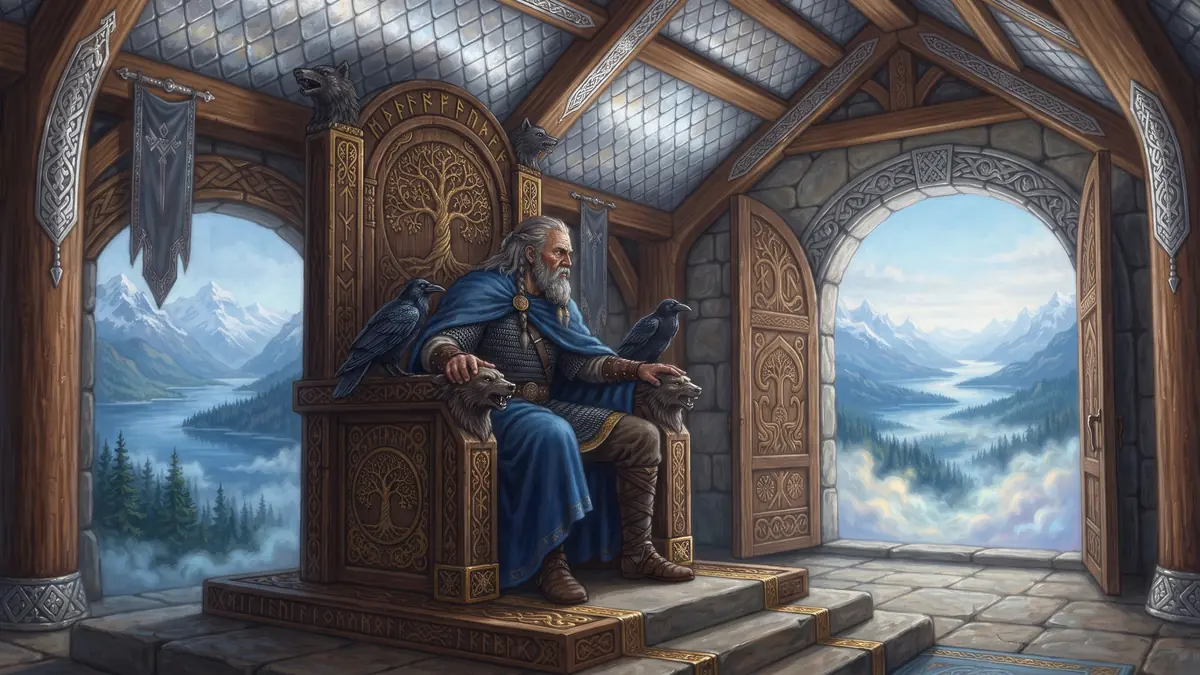
Hliðskjálf is a high seat in Norse mythology. According to the article that serves as the base for this piece, whoever sits in it sees all the worlds and hears what happens in them. The name is translated as “the high seat with an expansive view”. The main texts are two poems of the Poetic Edda, Grímnismál and Skírnismál, and the Prose Edda of Snorri Sturluson.
Odin and Frigg watch the world
In Grímnismál, Odin and Frigg sit in Hliðskjálf and look at their two foster sons. Agnarr lives in a cave with a giantess. Geirröðr is a king. Frigg accuses Geirröðr of being stingy and of treating guests badly. The two make a wager about it, and Odin goes to the king’s house to settle the question. The article does not tell how the wager ends, and the episode serves only to show the seat in use.
Freyr in the seat
In Skírnismál, it is Freyr who steps into Hliðskjálf, looking toward Jötunheimr. There he sees the giantess Gerðr and falls in love at once. The poem goes on with the marriage request. What the episode shows is that the seat is not only Odin’s: whoever sits in it sees things he perhaps should not see.
What Snorri adds
In Gylfaginning, Snorri mentions the seat four times. First as a dwelling, from which the Allfather sees the deeds of every person and understands everything he sees. Then as the high seat inside Valaskjálf, Odin’s hall, which the gods made and thatched with silver. When the Allfather sits there, he sees all lands. Snorri also retells the wooing of Gerðr, quoting Skírnismál, and shows Odin using the seat to find Loki, who had fled after the murder of Baldr.
A link with magic
The article offers one idea: Odin practised seiðr, a magic often done from a raised platform, the seiðhjallr. According to Rudolf Simek, Hliðskjálf may have been the model that these platforms tried to imitate. No source says this outright.
In short
Hliðskjálf is the gods’ lookout. Odin uses it to watch, Frigg uses it beside him, Freyr uses it out of curiosity and loses his calm. The sources are short, but they appear in poems and in prose.
Terms
Valaskjálf is Odin’s hall. Jötunheimr is the land of the giants. Allfather is a title of Odin in Gylfaginning.
What remains uncertain
The article does not explain the origin of the name beyond the translation. The link with the seiðhjallr is a hypothesis of Simek. Who may actually sit in the seat is a point the sources do not settle.
To watch the world from above and find the light that turns on among the huts, play The high seat.
Sources.
- Wikipedia article "Hlidskjalf" (Grímnismál, Skírnismál, Gylfaginning)
- Snorri Sturluson, Prose Edda (Gylfaginning)
- Poetic Edda (Grímnismál and Skírnismál)