Magnus the Good and the battle of Lyrskov Heath, in 1043, against the Wends
On 28 September 1043, Magnus the Good faced an army of Wends near Hedeby. The sources speak of a dream of Saint Olaf, a bell and the axe Hel. See what is told and what may be legend.
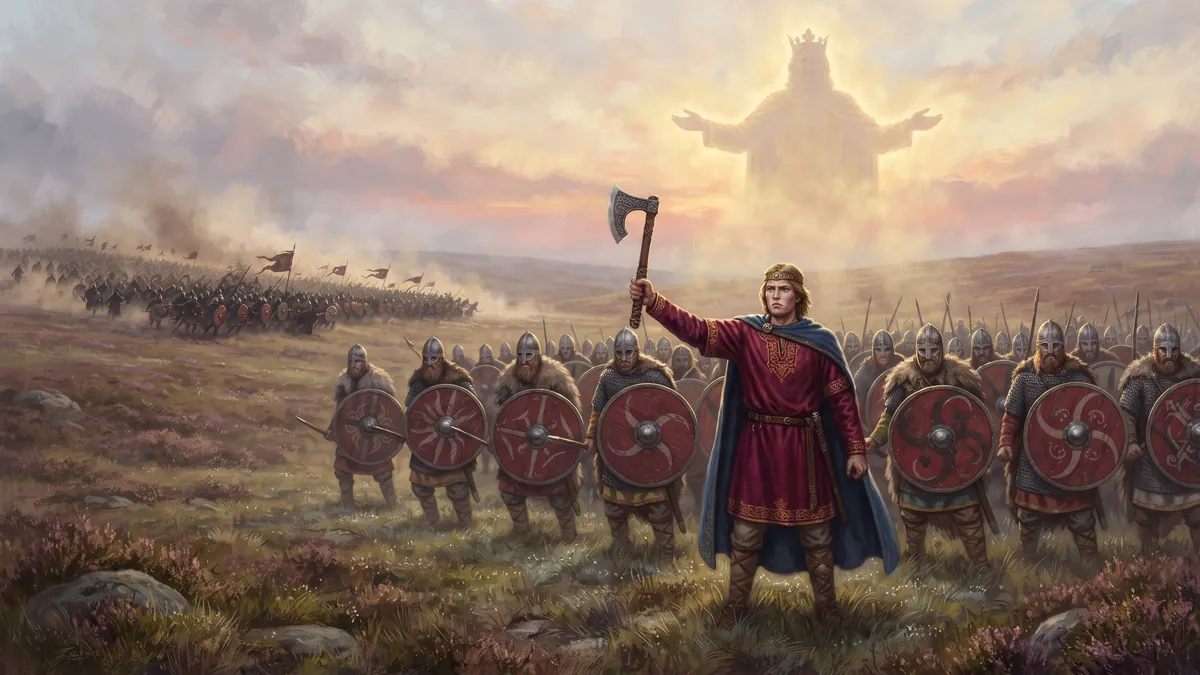
On 28 September 1043, a Dano-Norwegian army, led by Magnus the Good, faced an army of Wends at Lyrskov Heath, about 5 or 6 km northwest of Hedeby, where Schleswig stands today. This piece uses the article on the battle and the article on Magnus, which cite the Heimskringla of Snorri Sturluson, written around 1230.
Who Magnus was
Magnus was the son of Olaf Haraldsson, the future Saint Olaf, and an English concubine. When Cnut the Great deposed Olaf in 1028, the family fled. Magnus was raised in Kievan Rus’, at the court of Yaroslav the Wise. He returned in 1035, still a boy, and was acclaimed king of Norway. When Harthacnut, who ruled Denmark, died in 1042, Magnus also became king of Denmark, although Sweyn Estridsson had a claim to the throne.
What led to the battle
According to the article, the Wends invaded southern Jutland and plundered as far as Ribe. Palle Lauring argues that it was a migration of Wends in search of land. Magnus was returning from Wendland, where he had destroyed the Viking fort of Jomsborg, perhaps to remove Danish rivals. Shortly before, Danes had killed the Wendish prince Ratibor and his sons.
The dream, the bell and the axe
In the Heimskringla, Magnus dreamed of his father, Saint Olaf, who promised to follow him into battle. At dawn, men heard a bell that some recognized as Glad, given by Olaf to Nidaros. The article on Magnus speaks of a bell given to the church of St. Clement, in Kaupang. Snorri says the Wends came from the south, across a river. Magnus took off his chain mail, put on a red silk shirt and took up Olaf’s axe, called Hel. The battle was short.
The result
The Wendish army was crushed. About 15,000 Wends are believed to have died, a number that comes from Gwyn Jones. Saxo Grammaticus says Magnus earned the nickname “the Good” for killing so many Wends. Silver coins minted in Hedeby, probably shortly after, are the first to show Saint Olaf. Theodoricus Monachus wrote that the axe Hel was destroyed in the battle and kept in Nidaros. In 1898, Niels Skovgaard made the Magnus Stone monument at Skibelund Krat. Magnus died on 25 October 1047, suddenly, and the accounts of the cause vary.
In short
It was a short battle on open ground, with a victory that gained a reputation as a miracle. The basic facts, date, place and winner, are clear. The rest comes from accounts written almost 200 years later.
Terms
Wends were Slavic peoples of the southern Baltic. Jomsborg is a Viking fort mentioned in the sagas. Heimskringla is Snorri’s history of the kings of Norway.
What remains uncertain
The size of the Wendish army is unknown, and the sources speak of 60 Wends for every Dane. The count of 15,000 dead is an estimate. The two articles do not agree on the church of the bell. The motive for Magnus’s campaign in Wendland is described as “possibly” political. Faith in Saint Olaf on the battlefield comes from late texts.
To defend the battle line with the axe Hel, striking each warrior at the right moment, play The axe Hel.
Sources.
- Wikipedia article "Battle of Lyrskov Heath"
- Wikipedia article "Magnus the Good"
- Snorri Sturluson, Heimskringla, as cited in the articles