Scar: the Viking boat burial on the island of Sanday, in Orkney
On Sanday, in Orkney, a 6.5 m boat held the remains of a man, an elderly woman and a child, with a sword, arrows, a comb and a whalebone plaque. See what the 1991 excavation showed and what is not known.
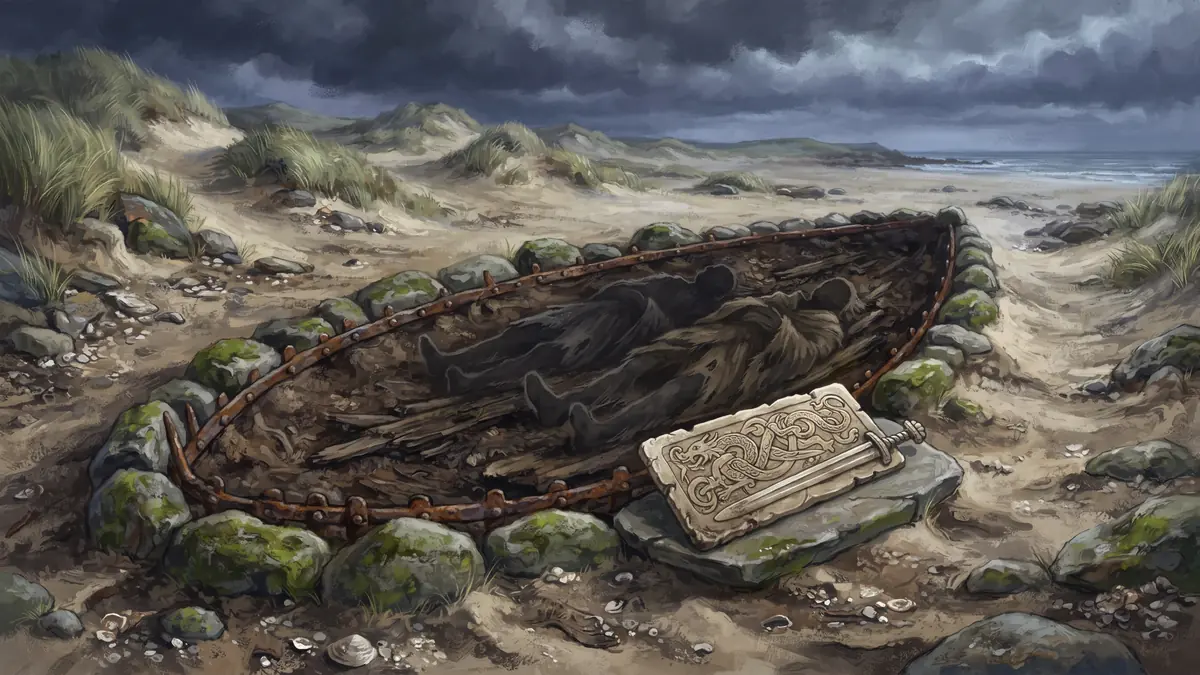
The Scar boat burial lies near the village of Scar, on the island of Sanday, in Orkney, Scotland, on The Crook beach, about 1 km northeast of the village. This piece follows the article “Scar boat burial”, which gives few numbers, but quite precise ones.
How it was found
In 1985, the Sanday farmer John Dearness saw bones sticking out of the ground and a small lead object. He thought it was the resting place of a sailor and died before the value of the site was realized. In 1991, the county archaeologist, Julie Gibson, who had heard of the bones six years earlier, took the object to Kirkwall, where it proved to be a lead weight for measuring precious metal. She and Dr Raymond Lamb began to investigate. The site was exposed and wearing away, threatened by erosion, and bad weather added to the urgency.
The excavation
Historic Scotland assembled a team led by the Norwegian specialist Magnar Dalland. The excavation took place in November and December 1991, in a hurry, because of the erosion. The boat was 6.5 m long and 1.5 m wide. The wood had rotted away and more than 300 iron rivets remained. It lay in a boat-shaped stone enclosure, packed with more stones. Inside the boat, a walled enclosure of stones held the remains of three bodies.
The three people
A man of about 30, who may have rowed when younger. A woman of about 70, who seems to have habitually sat cross-legged and perhaps spun flax. And a child, of unknown sex, of 10 or 11. No evidence was found of how any of the three died.
The objects
Next to the man were a sword, a quiver with arrows, a bone comb and gaming pieces. Next to the woman, a whalebone plaque, known as the Scar Dragon Plaque, a gilded brooch, a comb, shears, a sickle and two spindle whorls. The article dates the burial between 875 and 950. The sand in the boat’s lining did not match that of Orkney, Shetland or the Scottish mainland, which suggests the boat was not made in Scotland. In 2010, the plaque was briefly loaned to the Jorvik Viking Centre in York.
In short
It was a burial of three people in a short boat, with objects of daily life and of fighting. The few numbers that exist show a 6.5 m boat, three bodies and a date between 875 and 950.
Terms
Rivet is the iron nail that held the hull planks. Quiver is the case for arrows. Spindle whorl is the piece used for spinning.
What remains uncertain
The origin of the boat and its occupants is uncertain: the article says only that they may have come from Norway or elsewhere. The causes of death are unknown, and so is the sex of the child. The article does not say where the finds are kept today, and does not list objects beside the child. The relationship among the three people is not known.
To raise, layer by layer, the stone enclosure inside the boat, play The stone enclosure.
Sources.
- Wikipedia article "Scar boat burial"
- Julie Gibson, Orkney County archaeologist, as cited in the article
- Historic Scotland, 1991 excavation, as cited in the article