Absalon founds the castle of Havn in 1167, where Copenhagen began
According to Saxo, in 1167 Bishop Absalon founded a castle at Havn, on the island of Slotsholmen. See what the excavation found under Christiansborg Palace and how the fortress ended, almost two centuries later.
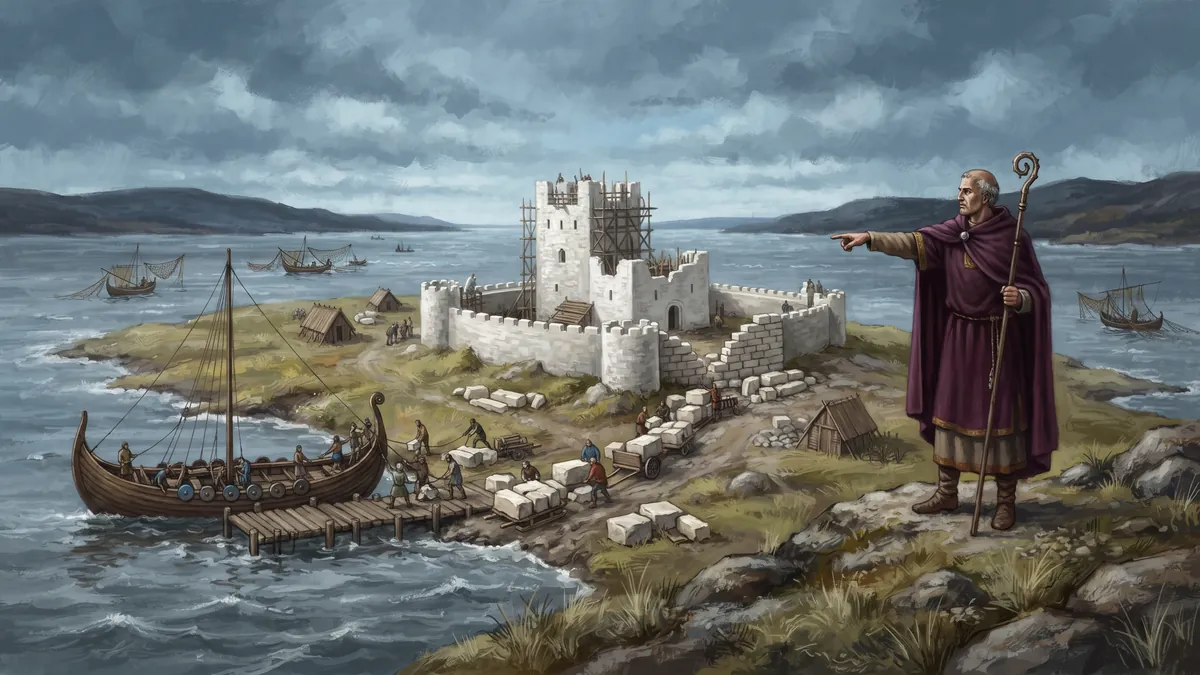
Copenhagen is today the capital of Denmark, but the first sentence of its history comes from a 12th-century chronicler: in 1167, he says, Bishop Absalon founded a castle there. Of that fortress only ruins remain, and they lie under a palace.
The bishop and the place
Saxo Grammaticus wrote the Gesta Danorum, the history of the Danes, at Absalon’s own request. It is Saxo who gives the year the castle was founded: 1167. He also says Absalon had received Copenhagen, then the small harbour of Havn, from King Valdemar I in 1157. The castle was built on the island of Slotsholmen, on the same spot where Copenhagen Castle and Christiansborg Palace later stood. Its purpose, according to the source, was to protect the emerging city.
What the excavation found
The ruins survive in subterranean excavations under Christiansborg Palace. Remains were found and excavated in 1907 and 1917. Among the finds are a limestone wall made of stone from the cliffs of Stevns, the foundations of houses and a well made of hollowed-out oak trunks. Inside the well were fragments of marble, perhaps from a church that stood inside the castle.
The end of the fortress
The castle lasted about two hundred years. The sources differ on its end: one speaks of conquest in 1368 by a coalition that included the Hanseatic League and demolition in 1369 under a peace treaty; another credits the League with occupying, plundering and demolishing it in 1369. In either case, Absalon’s castle vanished and the city remained.
Who Absalon was
Absalon was bishop of Roskilde and later archbishop of Lund, as well as adviser and military leader to King Valdemar I. He was a man of the Church who also commanded ships, which explains why the founding of a castle by the water came from his hand. The limestone of the wall was brought from the cliffs of Stevns, on Zealand itself. It is reasonable to suppose it came by sea, in boats, but the source does not say how the transport was done.
In short
Saxo gives 1167 as the year Bishop Absalon founded the castle of Havn, on Slotsholmen, which protected the rising town. What is left is what the excavation showed under Christiansborg: a limestone wall, houses and a well.
Terms
Slotsholmen is the island in central Copenhagen where the government palaces stand. Havn means “harbour”. The Hanseatic League was an alliance of trading cities in northern Europe. Gesta Danorum means “Deeds of the Danes”.
What remains uncertain
The modern account of the castle rests on few references and contradicts itself on the order of the fall, 1368 or 1369. The date 1167 comes from Saxo, who wrote in Absalon’s service, and the excavation shows the castle but does not confirm the year.
To steer a ship through a sound of shoals and bring the blocks to the quay, play Stones for Havn.
Sources.
- Saxo Grammaticus, Gesta Danorum (around 1200)
- Wikipedia, "Absalon's Castle"
- Excavations of 1907 and 1917 on Slotsholmen, under Christiansborg Palace, as summarized in the source above