Catoira: the Torres de Oeste and the Viking Pilgrimage of Galicia
At Catoira, in Galicia, the ruined Torres de Oeste guarded the Arousa estuary from attacks by sea. Since 1961, the Viking Pilgrimage has reenacted the landing, today on the first Sunday of August. See what is known.
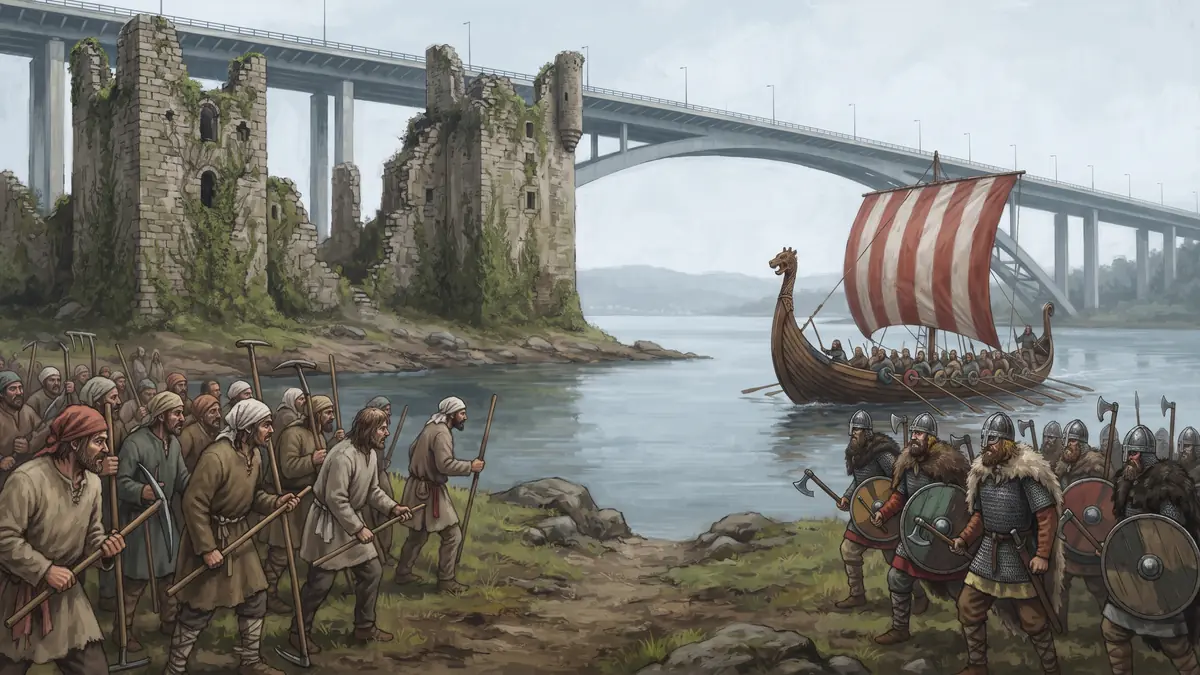
On the Arousa estuary in Galicia, there is one day a year when a high-prowed boat sails up the water toward two stone towers and the shore fills with people. It is a festival, and the story it enacts has a documented part and a part that is debated.
The attacks
According to the municipality of Catoira, in 850 the Normans sacked Iria Flavia, and the bishop and chapter had to flee to Compostela. There were further expeditions in 859 and 968, and the source says the pirates first had to face the men of the Castellum Honesti, the fortress of Oeste. The aim of the attacks, according to the text, was to reach “Jakobsland” and conquer Santiago de Compostela, believed to be rich. In 1112, after an attack by “English Normans”, Diego Xelmírez set up a shipyard, possibly at Catoira, near the Torres de Oeste, to build a small fleet.
The Torres de Oeste
They are the ruins of the old castellum honesti, at the head of the estuary where the river Ulla flows out. They stand under a modern viaduct. The sources differ on the origin: one says they were built in the 12th century on the order of Archbishop Gelmírez; another, that Alfonso III had the castle rebuilt in the 9th century and that the final 13th-century design had seven towers. Today parts of two of the great towers remain. The function was to stop Norman and Saracen armies from going up the Ulla. Later, the towers served as a quarry for the villages of the area. They are listed as an Asset of Cultural Interest.
The Viking Pilgrimage
The festival takes place on the first Sunday of August and begins at ten in the morning. The first was on 29 July 1961. The villagers dress as Vikings and as Galician peasants. The “Normans” arrive along the estuary in a replica of an 11th-century Viking boat to take the towers, and the others defend the town. It was declared of National Tourist Interest in 1988 and of International Tourist Interest in 2002.
In short
At Catoira, the ruins of the Torres de Oeste recall the defence of the estuary against attacks from the sea. The festival that recreates them has been held since 1961, always around the first Sunday of August.
Terms
A ría is an arm of the sea reaching inland, typical of Galicia. A romería is a popular festival, usually tied to a shrine. Castellum Honesti is the Latin name of the fortress of Oeste.
What remains uncertain
The dates of the towers’ construction vary from one source to another, and it is not certain that all the attacks mentioned reached the towers. The pilgrimage is a modern recreation, not an ancient fact.
To launch stones from the tower when the power gauge shows the right mark, play The defence of the towers.
Sources.
- Concello de Catoira, "Historia" (catoira.gal)
- Turismo de Galicia, "Torres de Oeste"
- Wikipedia (hispanopedia), "Romería vikinga de Catoira"