Tissø, the lake of Tyr, in Denmark: offerings and amulets of the Viking Age
Tissø, on Zealand, is "Tyr's lake". Excavations found weapons and jewellery thrown into the water, Thor's hammers and valkyrie pendants near the hall of a great lord. See what the National Museum says.
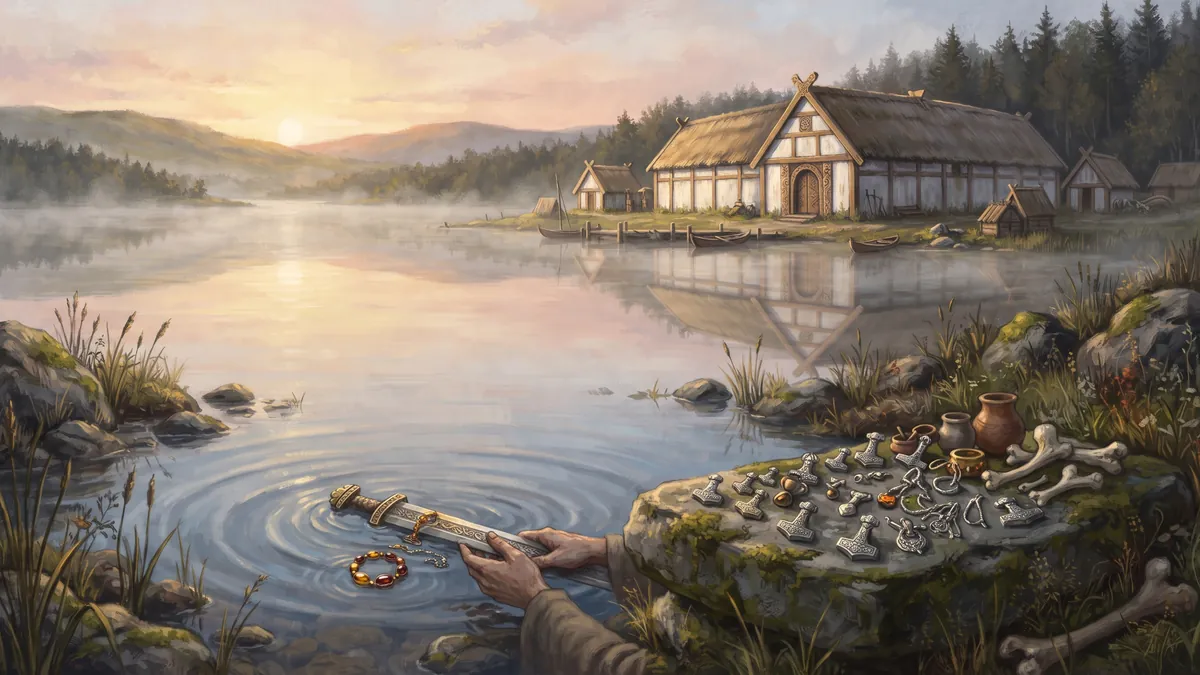
Some places of the Viking Age are known for what was written about them. Tissø is the opposite: the name says a great deal, and the ground says more. The lake lies in western Zealand, in Denmark, and is a site much studied by archaeologists.
The lake of Tyr
The name, according to the National Museum of Denmark, comes from Tyr, one of the main Norse gods: Tissø is “Tyr’s lake”. There have been offerings in the water since before the birth of Christ, but most of the weapons and jewellery date from the Late Iron Age and the Viking Age. Sacrifices of horses, of tools and possibly of people were also found scattered across the landscape.
The lord’s hall
Near the shore, a great lord had his residence. The first complex, at Bulbrogård, dates from about AD 550 to 650 and had a hall of some 38 metres, with whitewashed walls. About fifty years later the residence moved some 600 metres to the south, with a slightly shorter hall, a fenced area and a cult house. Systematic excavation took place between 1995 and 2003.
Amulets and sacrifices
The National Museum describes cult activity on land as well, near the lord’s house. Fenced buildings beside the great hall may have been cult buildings, hørg. The site yielded many amulets, among them Thor’s hammers and silver pendants and fibulae in the shape of valkyries. On a nearby hilltop, finds of animal bones, jewellery, silver and coins may mark an open-air sacrificial site. At the highest point there was a cache of burnt bones, coins, Carolingian jewellery and arrowheads that may be what Norse literature calls a hörgr. The whole combines a nature shrine with marks of organised cult.
Trade and contacts
The finds also speak of trade: jewellery, sword belts and coins show contact with Insular, Frankish and Germanic peoples. Grape seeds point to imported wine, although local production is possible.
In short
Tissø is the lake of Tyr, with offerings in the water, a great lord’s hall and amulets such as Thor’s hammers and valkyries. It shows, in objects, a religion practised next to the house of power.
Terms
Hørg or hörgr is a place of sacrifice, in Old Norse. A fibula is a brooch that fastens clothing. Carolingian means from the Frankish realm of Charlemagne.
What remains uncertain
The National Museum writes “may have been” cult buildings and “may mark” an open-air sacrifice. Not everything found is proof of cult, and linking the lake to Tyr depends on the name being old and really coming from him. Human sacrifice is only a possibility.
To find the pairs of offering objects lying face down on the table, play The lake amulets.
Sources.
- National Museum of Denmark (Nationalmuseet), "Sacrifices to the Norse god Tyr"
- Medievalhistories, "Tissø: a cultural, commercial and elite centre from the Viking Age"
- Wikipedia, "Tissø"