Ægir: the sea giant who brews ale for the gods and the feast of the Lokasenna
Ægir is the sea giant who gives feasts for the gods. See the cauldron of Hymiskviða, the servants Eldir and Fimafeng, the wife Rán and the nine wave daughters, and what scholars still debate.
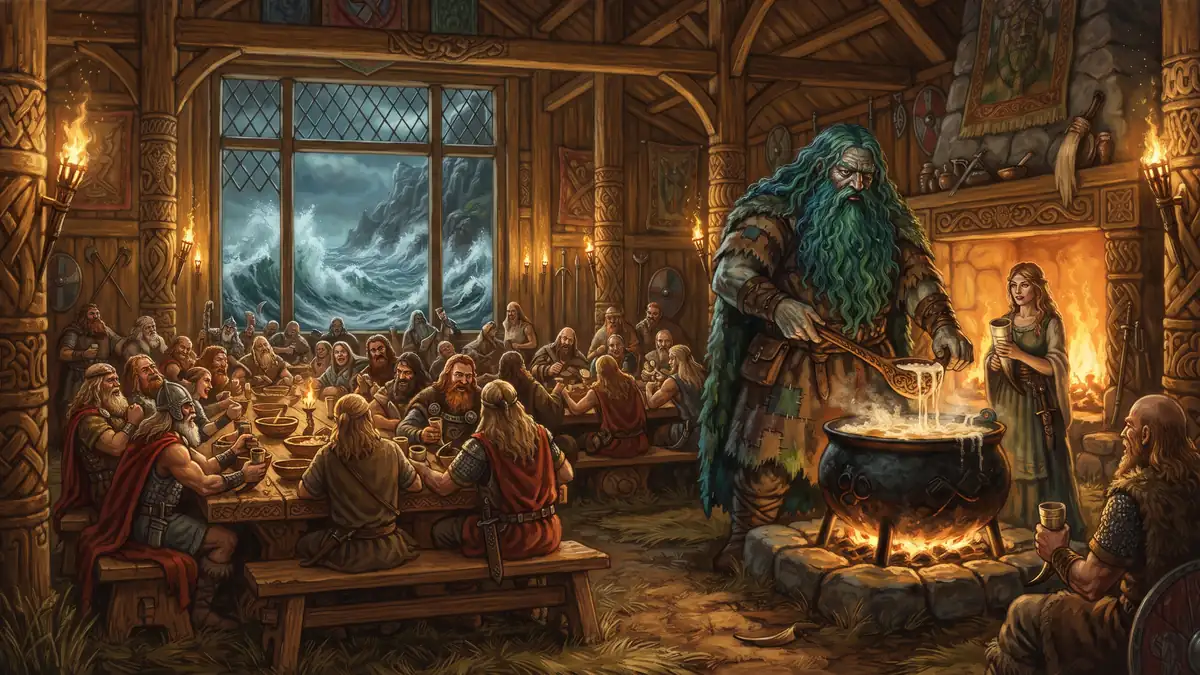
When the Norse gods wanted a drink, they went to the house of the sea. Ægir is the host of the feasts in the Poetic Edda, the maker of ale and the owner of a cauldron too big for anyone else. He is also the name of the sea itself in poetry, which makes the figure hard to classify.
The host and the ale
In Hymiskviða, the gods return thirsty from a hunt and find that Ægir has plenty of cauldrons. The giant is annoyed and asks Thor to bring an enormous cauldron so that he can brew ale for everyone. Týr points to one that is far away, and the search for that cauldron is the subject of the poem. In Grímnismál, Odin says the gods will learn of his revelations “on Ægir’s benches, at Ægir’s feast”.
The feast of the Lokasenna
The prose introduction to the Lokasenna describes the feast: the hall is lit by gold, and the ale serves itself. Ægir’s servants, Eldir and Fimafeng, are praised by the gods. Loki, out of envy, kills Fimafeng, and the gods drive him out. He comes back and insults those present one by one, which gives the poem its name. In the introduction, Ægir is also called Gymir.
Rán and the waves
Ægir is married to Rán, the goddess of the sea, and together they have nine daughters, who are the waves. In Helgakviða Hundingsbana I, a great wave is called “Ægir’s terrible daughter”. In poetry a ship is “Ægir’s horse” and gold is “Ægir’s fire”, a name Snorri explains with a story in which Ægir’s gold shone like light. In the poem Sonatorrek, by the Icelander Egill Skallagrímsson, Ægir is called an ale-smith and Rán is named as his wife.
God or giant?
In Skáldskaparmál, Ægir, also called Hlér, lives on an island now called Hléysey, knows magic and visits Asgard, where he is well received. The island is identified with Læsø, in Denmark. Some texts make him a son of Fornjót, together with Logi, fire, and Kári, wind. Scholars disagree about what he is: Faulkes notes that the Prose Edda never calls him a god, and Lindow questions his classification as a giant, given his friendship with the Æsir.
In short
Ægir is the sea giant, host of the gods’ feast and brewer of ale, married to Rán and father of the waves. He is in Hymiskviða, Lokasenna, Grímnismál and in Snorri.
Terms
Hlér and Gymir are other names of Ægir. A kenning is an indirect name in poetry, such as “Ægir’s horse” for a ship. A jötunn is a giant.
What remains uncertain
We do not know whether Gymir, the father of Gerðr, is the same being as Ægir or another with the same name. It is also unclear whether Ægir was a worshipped sea god or rather a figure of poetry and myth, and the sources about him are all medieval.
To serve the ale to the gods at the right moment, play The gods’ ale.
Sources.
- Poetic Edda, Lokasenna, Hymiskviða and Grímnismál
- Snorri Sturluson, Prose Edda (Skáldskaparmál)
- Egill Skallagrímsson, Sonatorrek
- Wikipedia, "Ægir"