Draupnir: Odin's ring that drips eight rings every nine nights
Draupnir is Odin's gold ring, made by dwarves. See the wager of Loki that created it, what Snorri says about the dripping rings and the ring's fate on Baldr's pyre, and what remains uncertain.
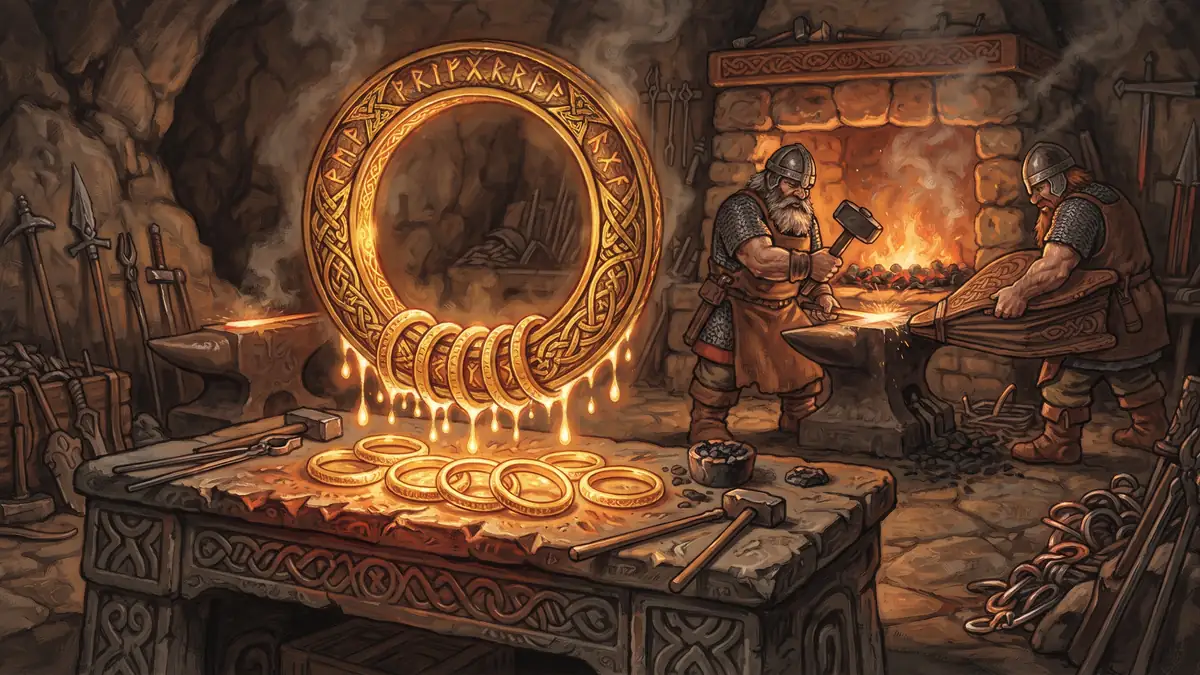
Among the objects of the Norse gods, Draupnir is perhaps the easiest to explain: it is a gold ring that produces other gold rings. Its name means “the dripper”. It comes from a quarrel between dwarves and Loki, passes through the pyre of one of Odin’s sons and still appears in an attempt to win a giantess.
The ring that drips
According to Snorri, every ninth night eight gold rings of equal weight fall from Draupnir. The ring belongs to Odin. This detail of eight rings every nine nights is what sets it apart from a mere treasure: it never runs out.
Loki’s wager
In Skáldskaparmál, Draupnir is part of a forging story. The dwarves Brokkr and Eitri, also called Sindri, make three gifts for the gods: the hammer Mjölnir, the boar Gullinbursti and the ring Draupnir. Loki wagers his own head that the dwarves could not make better gifts than those of the sons of Ivaldi. The gods judge, and Thor’s hammer gives the victory to the dwarves. Loki escapes losing his head by saying the cut would hurt the neck, which was not part of the bargain, and Brokkr then sews his mouth shut with a cord.
On Baldr’s pyre
In Gylfaginning, when Baldr dies, Odin lays Draupnir on his son’s pyre. The ring burns with the body, but it does not stay there: Baldr sends it back to Odin by way of Hermóðr, who rides to the realm of Hel in an attempt to rescue the god. So the ring returns to the one who had it. In Skírnismál, the servant Skírnir offers Draupnir to the giantess Gerðr, on behalf of Freyr, to persuade her to marry him. She refuses the ring.
A ring passed from hand to hand
In the sources, Draupnir is less an object of use than an object of exchange. The dwarves make it to settle a wager, Odin receives it, gives it to his dead son, gets it back and, in Skírnismál, the ring is offered as a wooing gift. In each scene it serves to link two parties, whether gods and dwarves, father and son, or a god and a giantess.
In short
Draupnir is Odin’s gold ring, forged by dwarves after a wager of Loki, which drips eight rings every nine nights, burns on Baldr’s pyre and returns to its owner. It is in Snorri and in the Poetic Edda.
Terms
A kenning is an indirect name, such as “drop of Draupnir” for gold. Dwarves are the craftsmen of the underground world. A pyre is a funeral fire.
What remains uncertain
The texts that mention the ring were written down in the thirteenth century, long after the time when the stories are thought to have arisen. We do not know what the ring was like in an older version, nor whether the idea of an object that multiplies comes from an earlier belief or was developed by poets.
To count the nights and let the rings fall on the ninth, play The ninth night.
Sources.
- Snorri Sturluson, Prose Edda (Gylfaginning and Skáldskaparmál)
- Poetic Edda, Skírnismál
- Wikipedia, "Draupnir"