Fanitullen: the devil's tune and the wedding fight in Hol in 1724
Fanitullen is the "devil's tune" of the Norwegian fiddle. See the legend of the wedding in Hol, Hallingdal, in 1724, the fiddler on the barrel and the hoof, the fight the courts recorded, and what remains uncertain.
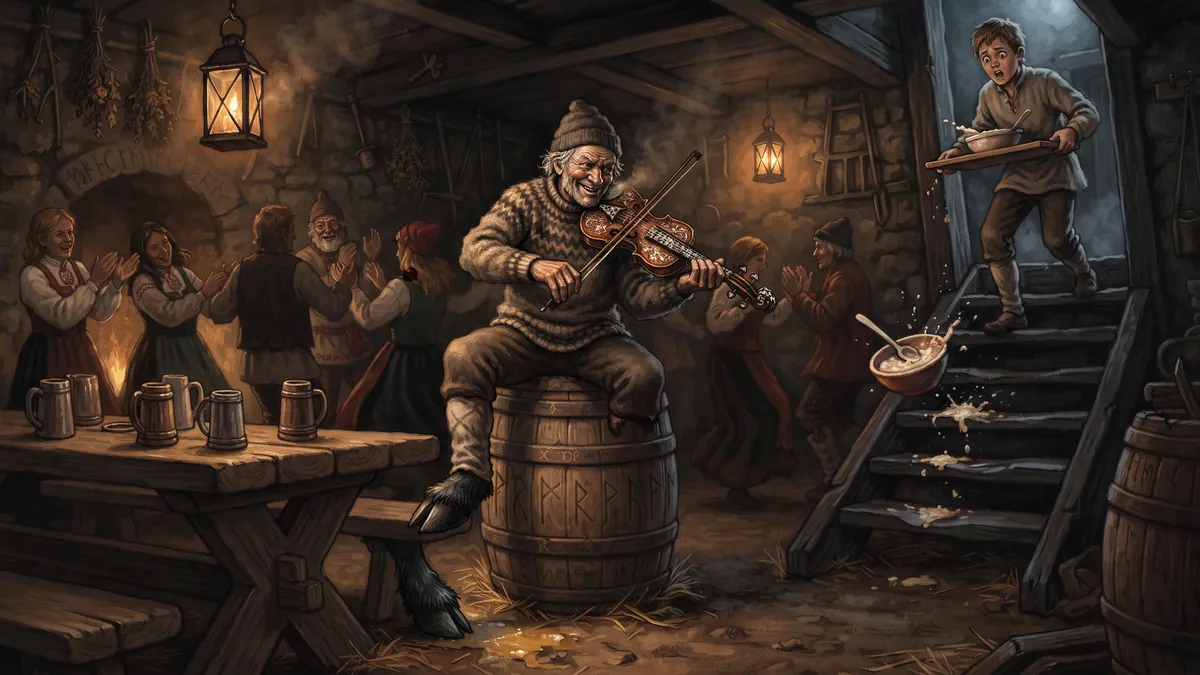
Some tunes seem to have a life of their own, and the Norwegian Fanitullen, the “devil’s tune”, is one of them. The tradition of the fiddle, the hardingfele, says it provoked fights in those who heard it. Behind the legend there is a wedding, a fight and, it seems, court documents.
The wedding of 1724
The legend is set in Hol, in Hallingdal, in eastern Norway, at a wedding in 1724. At that time feasts lasted several days and used hundreds of litres of strong home-brewed beer. Two young men, Levord Person Haga and Ådne Knutson Sindrol, argued and took the fight outside. That part, according to the festival article, is supported by court documents.
The fiddler on the barrel
The toastmaster, responsible for the toasts and the beer, went down to the cellar to fill the winner’s bowl. There he found a fiddler sitting on a barrel, tuning his fiddle in a backwards way. The music he played sounded like anger, fists pounding tables, weeping, cheering and, at the end, the sound of death. The fiddler said it did not matter where he had learned it, but that he should not forget it. When the toastmaster bent down, he saw that the musician was keeping time with a hoof. He dropped the bowl and ran out, and outside he found that one of the young men had killed the other with a knife.
Playing with care
According to the same article, the tune was used with care, because it could provoke violence. A fiddler could play it to stir up two furious men, or play another tune, Meklaren, “the negotiator”, to calm them. The preferred tuning for Fanitullen is A-E-A-C sharp, called “troll tuning”.
The Hardanger fiddle
The hardingfele is the Norwegian fiddle with sympathetic strings, which resonate under the played strings, and it is closely tied to the dances and weddings of the countryside. Many different tunings, which players call troll tunings, give each tune a sound of its own.
In short
Fanitullen is a tune of the Norwegian fiddle linked, by legend, to a devilish fiddler at a wedding in 1724 in Hol, in Hallingdal, while a real fight, cited in court documents, led to the death of one of the young men.
Terms
Hardingfele is the Hardanger fiddle. A slått is a traditional Norwegian dance tune. Meklaren is “the negotiator”, a tune used to calm.
What remains uncertain
The court documents support the fight between the two young men, but not the devilish fiddler, who belongs to the legend. We do not know when the legend was tied to this wedding or how much of it is older than 1724.
To play the strings in time and keep the fight away from the wedding, play The fiddle strings.
Sources.
- Norsk Kornølfestival, "Fanitullen" (article of 18 June 2019)
- Wikipedia, "Hardanger fiddle"