Harald Gille and the nine glowing ploughshares: the ordeal of Magnus Barefoot's son
A man from Ireland says he is the son of King Magnus Barefoot and proves it by walking over nine glowing ploughshares. See the ordeal in Heimskringla, the deal with Sigurd, Harald's end and what remains uncertain.
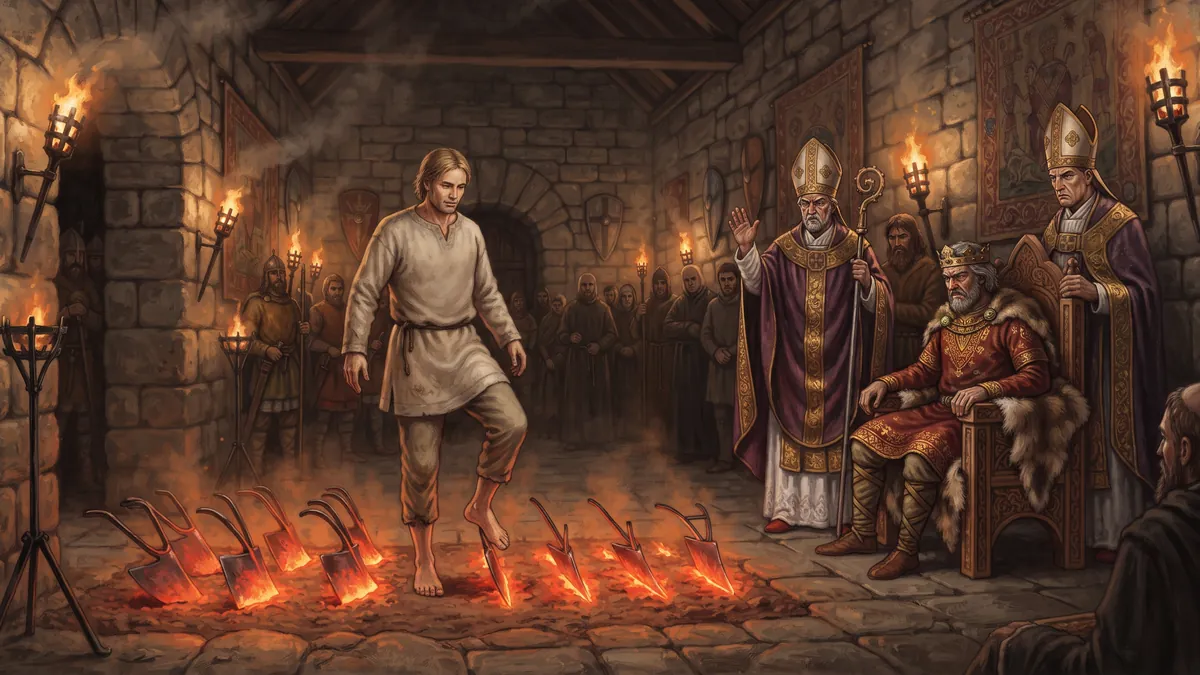
In 1128, a man arrived in Norway from Ireland saying he was the son of a dead king. He had no documents, and the only way to prove it was a trial by fire. What he did next, according to Heimskringla, became one of the most famous scenes in Norwegian history.
The man from the west
In Snorri Sturluson’s Heimskringla, a man from Ireland called Gillikrist claims to be a son of King Magnus Barefoot. His mother says his other name is Harald. Halkel Huk, son of Jon Smiorbalte, a great lord of Møre, meets him in the West Sea and brings him to Norway. Halkel goes straight to King Sigurd with Harald and his mother.
The ordeal of the ploughshares
King Sigurd offers an ordeal to confirm the paternity, with one condition: if he succeeded, Harald could not desire the kingdom while Sigurd or Magnus lived. Harald swears. He chooses the iron ordeal and walks barefoot over nine glowing ploughshares, attended by two bishops. Three days later, the feet are examined and found unburnt. Sigurd acknowledges him as a relative.
The broken agreement
The Encyclopaedia Britannica summarises the rest. Harald was born around 1103 in Ireland and was king of Norway from 1130 to 1136. When Sigurd died in 1130, Harald broke the agreement and was accepted as king of half the kingdom, while Magnus, later called the Blind, ruled the rest. Hostilities began in 1134. Harald was defeated at Fyrileif and withdrew to Denmark for reinforcements. On his return, in 1135, he captured Magnus, maimed and blinded him and put him in a monastery.
The king’s end
Harald ruled alone until 1136, when a pretender, Sigurd Slembi, killed him. Slembi also claimed to be a son of Magnus Barefoot. The dispute between the two kings began the Norwegian civil wars of 1130 to 1240, a period in which the right to rule was constantly disputed.
In short
Harald Gille proved, according to Heimskringla, that he was the son of Magnus Barefoot by walking over nine glowing ploughshares. He was king of Norway from 1130 to 1136 and was murdered, after breaking the agreement made with Sigurd.
Terms
A ploughshare is the iron part of the plough that cuts the soil. An ordeal by iron is a trial in which the person carries or walks on hot iron. Heimskringla is the history of the kings of Norway written by Snorri.
What remains uncertain
The scene is told by Snorri, writing about a century later, and there is no way to know whether the ordeal happened this way. We also do not know whether Harald’s paternity was true, and Heimskringla itself reports a version that may have been shaped by the winner.
To cross the nine ploughshares without stepping on a glowing one, play The nine ploughshares.
Sources.
- Snorri Sturluson, Heimskringla (sagas of Magnus Barefoot and Harald Gille)
- Encyclopaedia Britannica, "Harald IV"
- Wikipedia, "Harald Gille"