Ale's Stones: the stone ship of Sweden and the debate over its age
At Kåseberga, in Scania, 59 boulders form the outline of a 67-metre ship facing the Baltic. See what archaeology says about the age, the solar calendar debate and the legend of King Ale.
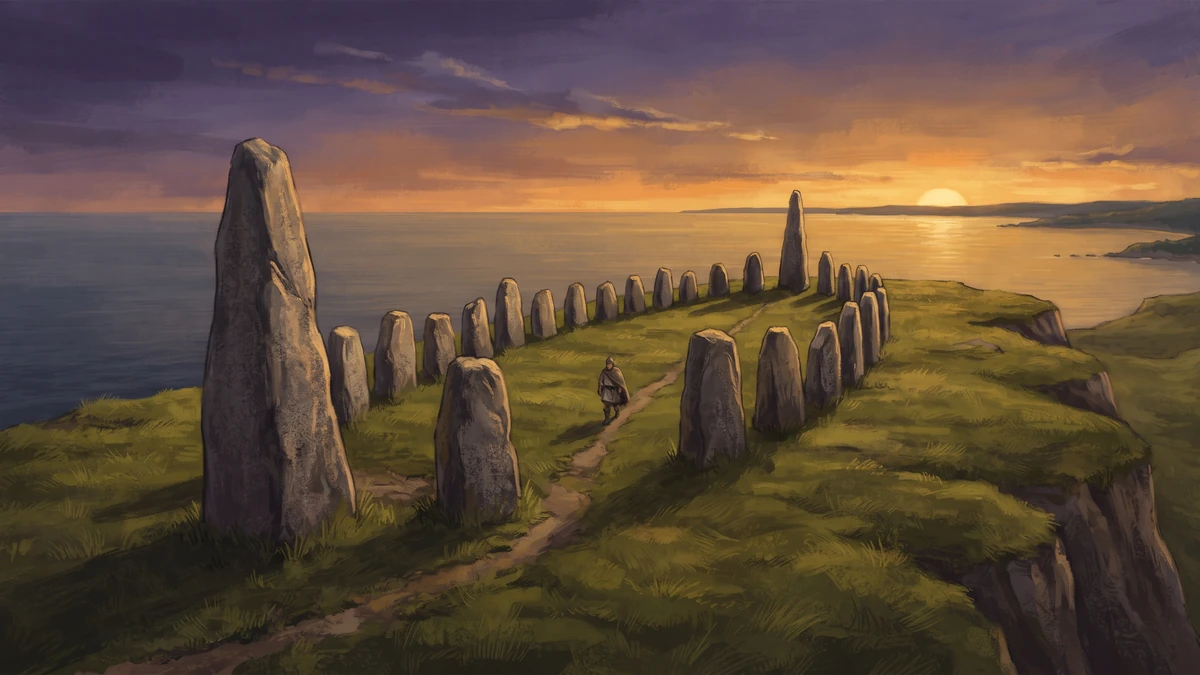
On a hilltop by the Baltic, at Kåseberga, in Scania, 59 large stone blocks form the outline of a ship. It is the largest surviving stone ship in Sweden, and almost every question about it turns around one: how old is it?
The stone ship
The 59 blocks weigh up to 1,800 kilograms each and draw a ship 67 metres long, on a cliff above the sea. A local legend says that King Ale is buried there. The monument has been restored twice, which complicates the reading.
The age by radiocarbon
According to reports from 2012, radiocarbon dating indicates about 1,400 years, the end of the Iron Age. Archaeologists generally agree that the ship is a burial monument. The archaeologist Martin Rundkvist is one of those who comment on the study, and the radiocarbon dating weighs in favour of the late Iron Age.
Recycled stones?
Märta Strömberg, of the University of Lund, points out that many stones bear cup-shaped marks, some near the base, well below ground level, so they were not visible to visitors. She suggests that the blocks were reused from older monuments, which would explain the hidden marks.
A Bronze Age calendar?
In 2012, a team including the geologist Nils-Axel Mörner published a different thesis: the monument would be about 2,500 years old, from the Bronze Age, and would serve as an astronomical calendar, since the Sun rises and sets at marked points at the solstices. Rundkvist answered that the idea “has no supporters among academic archaeologists”.
Visiting the site
The stones stand on a hilltop above the sea, and on a clear day the Baltic stretches out in front of the ship. Visitors walk between the blocks, which makes the outline easy to see.
Why the age matters
The answer changes who made the monument. If the ship is from the late Iron Age, it belongs to people who lived shortly before the Viking Age, around a burial. If it comes from the Bronze Age, as the calendar hypothesis holds, it would be the work of a people more than a thousand years earlier, with another use for the stones.
In short
Ale’s Stones is a stone ship of 59 blocks and 67 metres, which most archaeologists date to the late Iron Age and see as a tomb. The blocks may have come from older monuments, and the calendar hypothesis is rejected by academia.
Terms
The Iron Age is the period before the Viking Age. Cup marks are small round hollows carved into stone.
What remains uncertain
The reports do not say which material was dated or in which laboratory. Scholars differ between a date of about 600 and one of 2,500 years. Near the site, a survey and a trench (2006 and 2012) found a circle of 165 metres and a dolmen, and little is known of them. There is no proof that King Ale existed.
To line up the stones of Ale’s ship, play The stone ship.
Sources.
- Märta Strömberg, "Ale's Stones: A Monument of Recycled Boulders?", Lund Archaeological Review 7, pp. 77-87, University of Lund (published in 2003)
- Live Science report on the excavations near Ale's Stones, 22 October 2012
- Report on the study by Nils-Axel Mörner and colleagues in the International Journal of Astronomy and Astrophysics, 2012, with comment by Martin Rundkvist