Lejre: the great royal hall in Denmark and the sacrifices every nine years
At Lejre, on Zealand, archaeologists found a 48-metre hall on top of an older one. See what the excavation shows, what Bishop Thietmar wrote about sacrifices and what is not known.
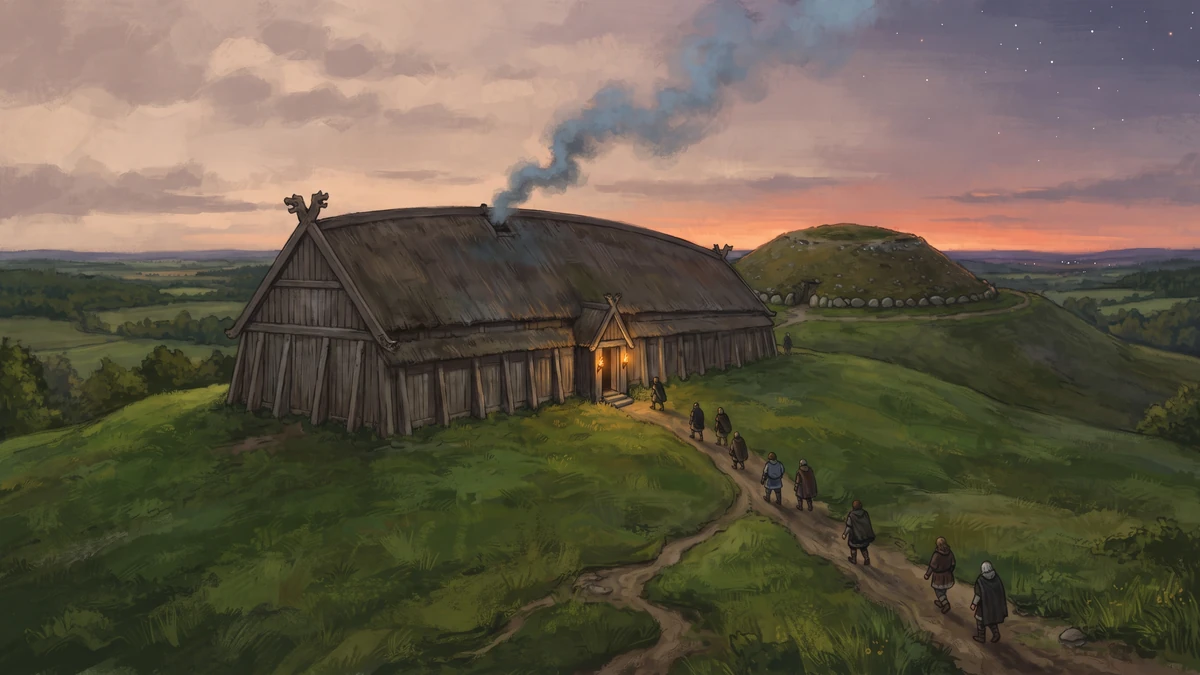
On Zealand, Denmark’s largest island, lies Lejre, which medieval sources call a seat of kings. Today it is a place of fields, but excavation has shown that a huge hall stood there, and two sources very distant in time speak of Lejre with respect: the saga of Hrólfr Kraki and the chronicle of a German bishop.
The Hleidargard of the saga
The Saga of Hrólfr Kraki places the seat of the Skjöldung dynasty at Hleidargard. The UCLA page links this name to Lejre.
The 48-metre hall
Between 1986 and 1988, an excavation led by the Danish archaeologist Tom Christensen uncovered a large Viking Age hall, possibly royal, 48.3 metres long and 11.5 wide. According to the page I consulted, radiocarbon dates the hall to the mid tenth century. It stands partly on an older hall of similar size, dated to about 660. Nearby, the Grydehøj burial mound, of about 550, held gold threads and bronze pieces.
Heorot, perhaps
These halls have been compared to Heorot in Beowulf, the hall attacked by the monster Grendel. The page notes that the oldest hall is slightly too young to be Heorot or Hleidargard, although an even older building may have stood nearby. Linking Hleidr and Heorot is possible, but it is not proven.
Thietmar’s account
Thietmar, bishop of Merseburg, wrote in 1015 based on information from 934, when King Henry I invaded Denmark. He describes Lejre as the capital of the kingdom and a centre of pagan cult. According to him, everyone gathered every nine years, in January, to offer ninety-nine men and the same number of horses, as well as dogs and hawks.
Two times in the same place
What stands out at Lejre is the overlap: a tenth-century hall built over another of about 660, on the same ground. This suggests that the place kept its importance for centuries, and it is this continuity, more than any saga name, that the excavation allows one to state.
In short
Lejre is the place that joins a saga, an English poem and an excavation. There is a great hall, possibly royal, on top of an older one. And there is a bishop who describes a cult with sacrifices there, an account that the page I consulted does not confirm with finds.
Terms
Skjöldungs is the legendary dynasty of Danish kings. Radiocarbon is a technique for dating organic material.
What remains uncertain
The dates given on the page do not fit together perfectly: the hall is from the mid tenth century, and the artefacts place the halls and the settlement between about 600 and 900, so I treat the dates as approximate. Thietmar wrote about eighty years after the events and was a Christian, and the page does not mention traces of the sacrifices. The link with Heorot and with Hrólfr Kraki is a hypothesis.
To collect the gold threads and the bronze of the prince of Grydehøj, play The Grydehøj mound.
Sources.
- "Archaeology and the Legendary Hleidargard", page on Lejre and the saga of Hrólfr Kraki, University of California, Los Angeles (viking.ucla.edu), referring to Tom Christensen's excavations in 1986-1988
- Thietmar of Merseburg, Chronicon (account of 1015 about Lejre, from information of 934)