Vardøger: the spirit heard before the person arrives, in Norwegian belief
In Norway, some say they heard someone’s steps on the stairs before the person arrived. See what the Store norske leksikon says about the vardøger, its names and its Nordic relatives.
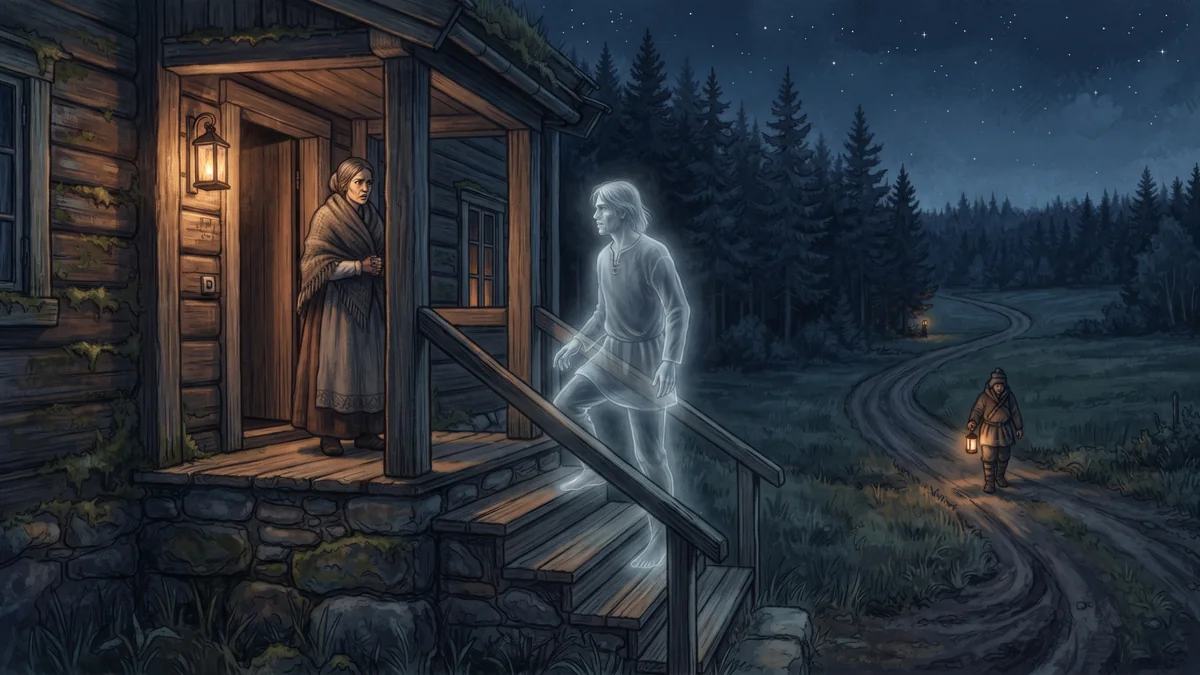
In Norwegian homes, tradition says, one sometimes hears the door creak and steps on the stairs, and nobody appears. Shortly afterwards, the person who was expected really arrives. The belief has a name: vardøger. For this text, I used an entry by a Norwegian encyclopedia author and the two books it lists.
What a vardøger is
The Store norske leksikon defines the vardøger as “a spirit that announces and that is heard, more rarely seen, before the person it belongs to appears”. The same text brings it close to a protective spirit, like the fylgje, and recalls that it can be understood as a kind of guardian angel. The word comes from Old Norse and may be related to “watcher” or “guardian”. Other names are vardyvle, vardyger and føreferd.
How it shows itself
According to the text, the presence is usually noticed through sounds: the creak of a door, noise on the stairs, footsteps. Sometimes one hears sounds characteristic of the person who owns the vardøger, such as a cough. The stories exist “from the whole country”, and some people still believe them.
Nordic relatives
The article cites similar beliefs in other countries. In Finland, the etiäinen is a double that does the same things the person will do later. In Iceland, the fylgja is the spirit of a dead person of the same family, which goes ahead of a descendant. In Ireland, the fetch is often tied to a warning of death or illness. In Sweden, the equivalent expression is something like “comes before they come”.
A belief that warns and draws near
What stands out in the article is that the vardøger does not frighten: it only anticipates. Whoever hears the door or the cough knows, by what is told, that the person is already on the way, and the house has time to get ready to receive them. That is why the belief is described as a kind of warning, closer to a sign of arrival than to a haunting. The article also notes that there are accounts from many parts of the country.
In short
The vardøger is the sound, and more rarely the image, of someone who arrives before appearing. It is a spirit that warns, a relative of the fylgje, known in almost all of Norway and with equivalents in neighbouring countries.
Terms
Fylgje is, in the north, the spirit that accompanies a person or a family. Etiäinen is the double of Finnish belief. An entry is an encyclopedia text on a subject.
What remains uncertain
The text I read does not say who collected the oldest accounts of vardøger. The leksikon itself notes, in reply to a reader, that scientific language cannot confirm such experiences as facts, and so it describes them as belief. I also do not know, from these sources, whether the idea of a spirit that walks ahead already existed in the Viking Age.
To recognize the door where the steps arrive before the person, play The steps before the person.
Sources.
- Anne-Sofie Schjøtner Skaar, "vardøger", Store norske leksikon (snl.no), updated 8 June 2026
- Georg Hygen, Vardøger: vårt paranormale nasjonalfenomen, Cappelen, 1987
- Birger Sivertsen, For noen troll: vesener og uvesener i folketroen, Andersen & Butenschøn, 2000