 MMXXVI
Engelbrekt Engelbrektsson: the mine owner who led the Swedish revolt against the king's bailiff
Engelbrekt owned a mine and ironworks in Bergslagen and carried the miners' complaints to King Erik of Pomerania. The revolt he led ended with his death, on 4 May 1436, on an islet in Lake Hjälmaren.
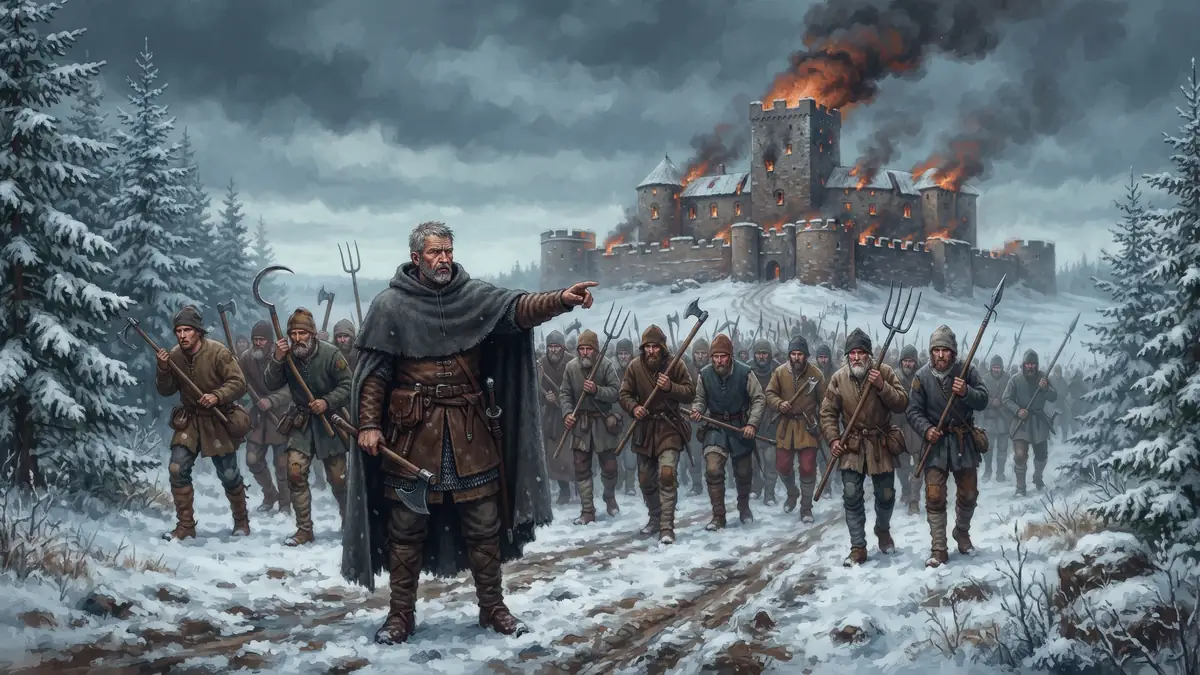
Engelbrekt Engelbrektsson (1390s – 4 May 1436) was a Swedish nobleman and military leader of German descent. According to the sources, he owned a mine and ironworks in Bergslagen and came from the parish of Norberg, in Västmanland. His family had arrived in Sweden in the 1360s.
The miners’ complaints
The discontent had a target, Jösse Eriksson, the king’s bailiff in Västerås, whom the miners blamed for their hardship. Engelbrekt lodged formal complaints on their behalf. An inquiry under King Erik of Pomerania found Jösse’s conduct criminal, but he was not removed.
The revolt
Protests followed, and in spring 1433 the people of Dalarna besieged the bailiff’s castle. The Council of the Realm dismissed Jösse and appointed Hans von Eberstein, but Engelbrekt objected that Jösse had not been prosecuted. The rebels destroyed the castles of Borganäs and Köpingshus, and many nobles joined. The article says Engelbrekt began the revolt in 1434, but it describes the start of the escalation in 1433, and does not resolve the difference.
Arboga and the death
In 1435, at an assembly in Arboga, often regarded as Sweden’s first Riksdag, Engelbrekt was named commander in chief, the rikshövitsman. The nobility gradually sidelined him, and in 1436 the nobility and clergy backed Karl Knutsson Bonde, who replaced him in the post.
On 4 May 1436, Måns Bengtsson, of the Natt och Dag family, killed Engelbrekt on the islet of Engelbrektsholmen, in Lake Hjälmaren. Måns lived at nearby Göksholm Castle, and his father had a legal dispute with Engelbrekt over a burned ship. Some historians see the case as an assassination, and a 2023 novel by the descendant Niklas Natt och Dag proposes a sudden quarrel.
The memory
Engelbrekt was buried in St Nicholas Church, in Örebro. He became a national hero, seen as a defender of the people and an opponent of the Kalmar Union, although the article says he probably did not hold such ideas. There is a bronze statue of him in Örebro, from 1865, and another on a pillar beside Stockholm City Hall.
To pop the towers of the bailiffs’ castles and spare the miners’ houses, play The towers of the bailiffs’ castles.
Sources.
- Reference work in English, article "Engelbrekt Engelbrektsson"