 MMXXVI
Eystein Erlendsson, the archbishop of Nidaros: the student from Paris who crowned the boy Magnus in 1163 and wrote the Passion of Saint Olaf
Eystein Erlendsson, from Verdalen, studied in Paris, served King Inge and was archbishop of Nidaros from 1161 to 1188. In 1163 he crowned the boy Magnus, in an agreement that changed the succession. See what is known and what is attributed to him.
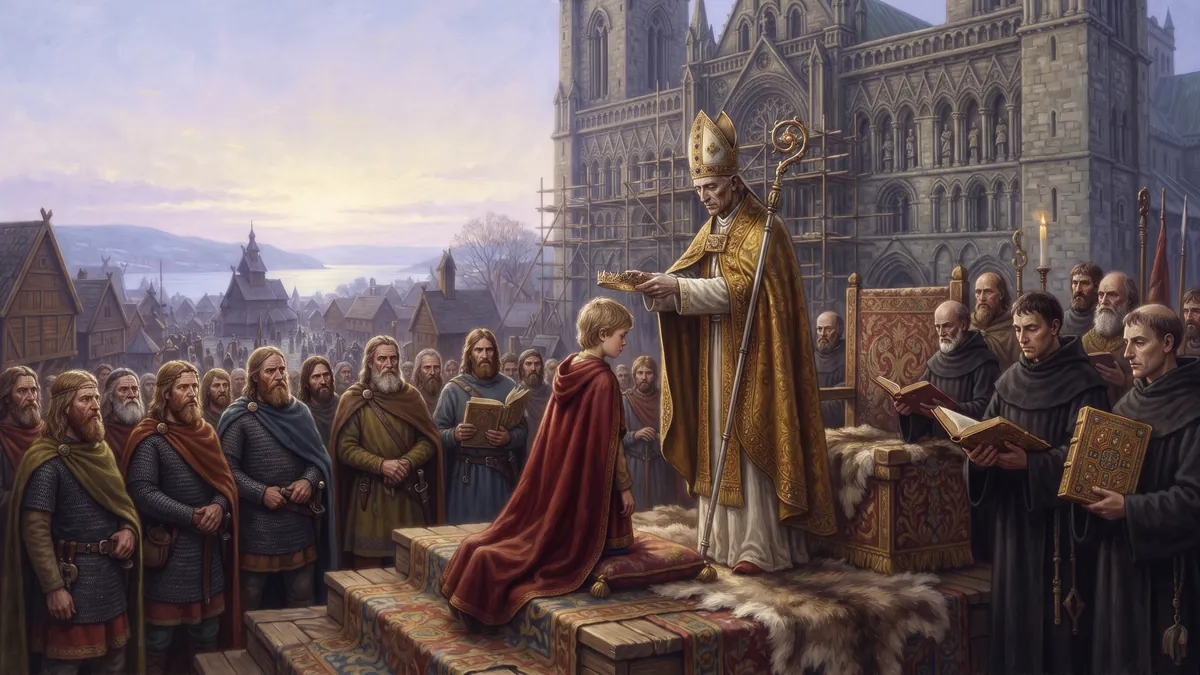
Eystein Erlendsson, in Old Norse Eysteinn, also called Øystein or Augustinus Nidrosiensis, was archbishop of Nidaros from 1161 until his death on 26 January 1188. He was born between 1120 and 1130, probably at the Råsvoll farm, north of Trondheim, in the Verdalen valley. His father, Erlend Himalde, descended from important men. His great-grandfather, Ulv Uspaksson, was a councillor of King Harald Hardrada.
From Paris to the court
He studied at Saint-Victor in Paris, and served as steward to King Inge Hunchback when he was a priest. When Archbishop Jon Birgersson died, on 24 February 1157, Inge named him as successor. Pope Alexander III confirmed the choice in 1161, and Eystein returned to Norway that year. He strengthened the ties between Rome and the Norwegian Church, installed Augustinian canons regular and consecrated Saint Thorlak, the future saint of Iceland.
A dead king and a boy heir
Inge, who had named him, had already died in 1161, in battle against the supporters of Haakon Herdebrei, son of Sigurd Munn. Haakon was defeated and killed in 1162. Erling Skakke led Inge’s supporters and backed his son, Magnus. Erling was married to Kristin, daughter of Sigurd the Crusader.
The agreement of 1163
Eystein and Erling became allies. The Church wanted to end the custom of several kings at the same time, and Eystein wanted only legitimate sons to be eligible as kings. In 1163 a new law of succession was introduced, along the male line. That year, Eystein crowned Magnus, the first act of its kind in Norway.
The Passion of Saint Olaf
Eystein is credited with the Passio et Miracula beati Olavi, a Latin hagiography of Olaf II, which stresses the king’s missionary work. The Church recognises him as a saint, and the Roman Martyrology commemorates him on 27 January, although another source gives the 26th.
The cathedral of Nidaros
The archbishop’s seat was the church of the Holy Trinity in Nidaros, raised over the grave of Saint Olaf. In 1152 it became the cathedral of the archbishopric, and today it is built of soapstone, a soft rock. The oldest parts of the present building are the octagon and its ambulatory, where the high altar and the saint’s reliquary stood. The choir shows English influence, reminiscent of the Angel Choir of Lincoln Cathedral. Fires in 1327 and 1531 destroyed the nave, which was only rebuilt in the early twentieth century.
What remains
What is not in the sources consulted, such as his exact role in the cathedral works, should not be taken as certain. What is recorded is that a son of a family from the Trondheim region, trained in Paris, was the one who crowned a boy king and made the Church a weighty partner in the country’s politics.
To mark the rhythm of the chisel on the soapstone blocks of Nidaros cathedral, play The chisel on the soapstone.
Sources.
- Passio et miracula beati Olavi, 1995 edition (attributed to Eystein)
- Gunnes (1996), Vandvik (1961) and Bagge (2005), cited in reference works
- reference works (English), entry "Eysteinn Erlendsson", with the sources cited