 MMXXVI
Eystein Meyla, the "maiden" king of the Birkebeiners: from the proclamation in Trondheim to the defeat at Re in 1177
Eystein Meyla, son of King Eystein II, was proclaimed king in Trondheim in 1176 by the Birkebeiners and died after the defeat at Re, in Vestfold, in 1177. See what the sources say and how his end opened the way to Sverre.
Eystein Meyla, in Old Norse Øystein Øysteinsson Møyla, was a pretender to the Norwegian throne during the civil wars. The nickname, Møyla, means “maiden” or “girl”. He was the son of King Eystein II Haraldsson, who ruled between 1142 and 1157 jointly with his brothers Inge Haraldsson and Sigurd II Munn.
After his father’s death
His father died in 1157, in a power struggle with Inge. After that, Eystein II’s supporters first backed Haakon II Herdebrei, son of Sigurd Munn and nephew of Eystein Meyla. Earl Erling Skakke defeated and killed Haakon at Sekken, near Veøya, in Romsdalen, in 1162.
The Birkebeiners in 1174
The Birkebeiners formed around Eystein in 1174. They took Trondheim and proclaimed him king at the Øretinget, by the mouth of the Nidelva, in 1176. They then rose against Erling Skakke and his son, Magnus Erlingsson, who reigned as Magnus V from 1161 to 1184.
The battle of Re
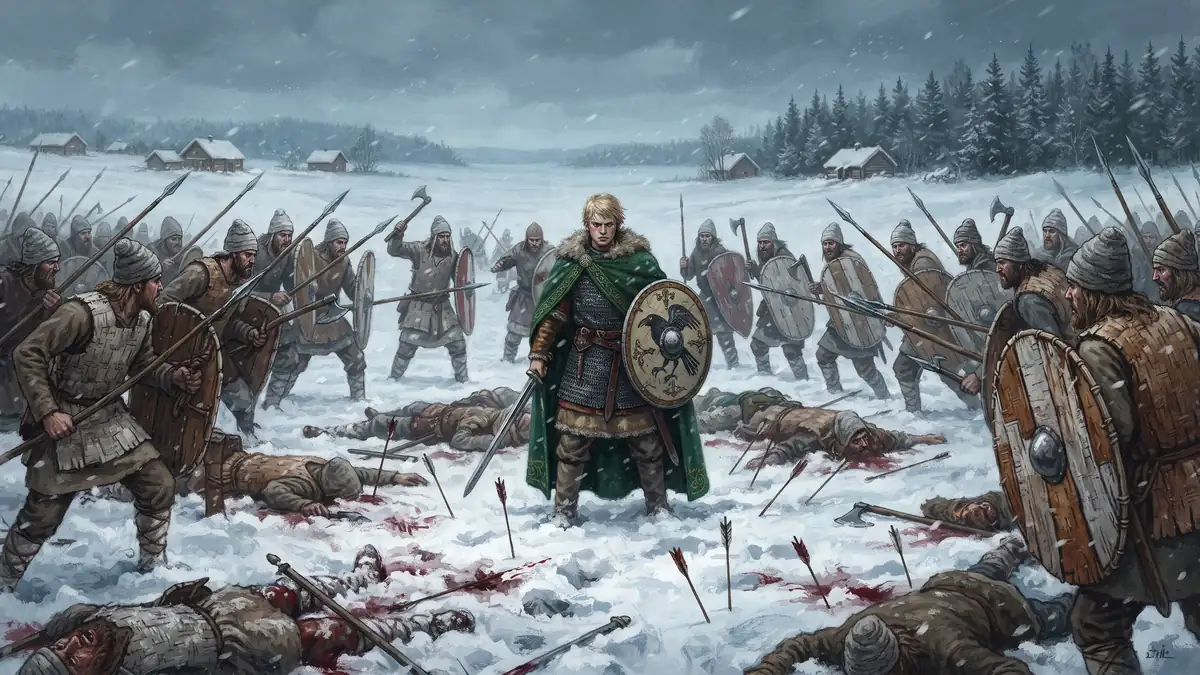
In January 1177, the Birkebeiners suffered a crushing defeat at Re, in Vestfold. Eystein escaped the battle, but was killed by a farmer when he asked for grið, the peace the law gave to someone who surrendered. Snorri Sturluson’s Heimskringla is the last source to mention this battle.
After Re
The survivors chose a new leader. Sverre Sigurdsson became head of the Birkebeiners and, as Sverre I, ruled Norway from 1184 until his death in 1202. The age of the civil wars lasted from 1130 to 1240, and the two main parties were the Bagler and the Birkebeiners.
What can be said
The main sources are Fagrskinna, Heimskringla and Sverris saga. They say what the king did and how it ended, but not what he thought. The nickname, “maiden”, is all we know of how others saw him, and it does not say why.
To parry with the shield the arrows and spears that come over the snow of Re, play The battle of Re.
Sources.
- Fagrskinna, Heimskringla and Sverris saga
- Fagrskinna, a Catalogue of the Kings of Norway, ed. and trans. Alison Finlay (Brill, 2004)
- Hollander (trans. of Heimskringla, 1991), Gathorne-Hardy (1956) and Store norske leksikon, cited in reference works