 MMXXVI
Fastelavn: the Nordic festival of the cat barrel, the twig that woke the parents and the sweet bun
Fastelavn falls seven weeks before Easter. In Denmark, children dress up and strike a barrel of sweets painted with a cat, and the winner becomes king or queen of the cats.
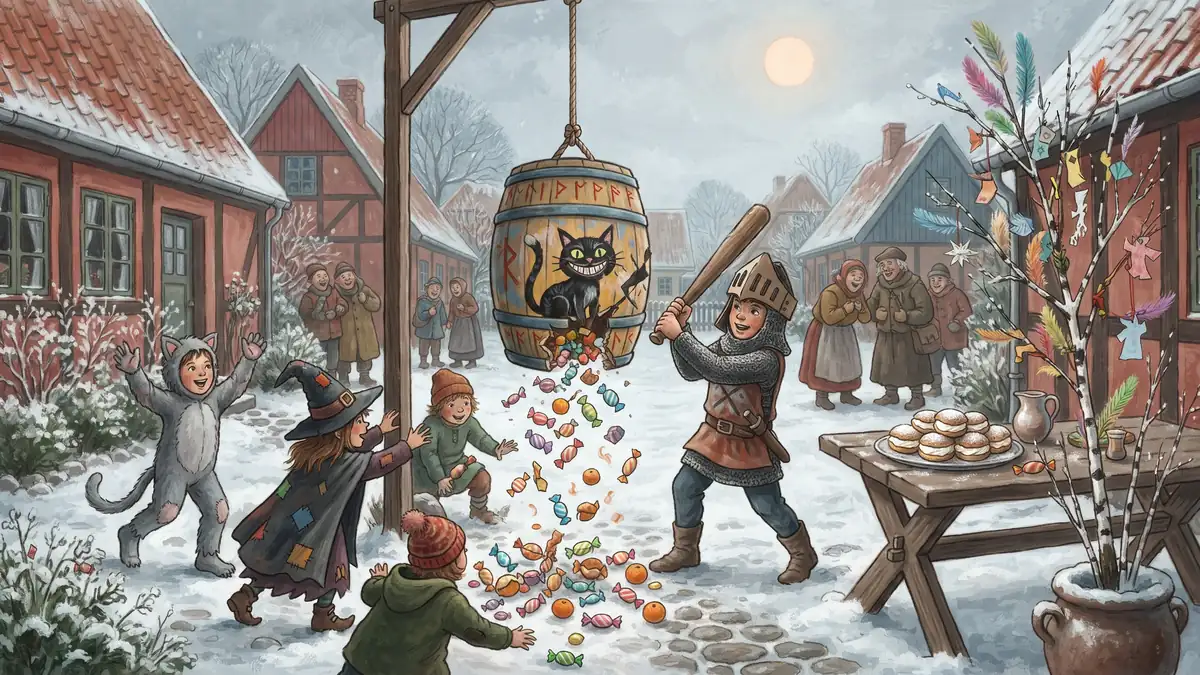
Fastelavn is a Nordic festival of the week before Lent. According to the sources, it always falls on a Sunday between 1 February and 7 March, seven weeks before Easter Sunday, and climaxes on Shrove Tuesday, the day before Ash Wednesday.
The name
The word comes from Old Danish fastelaghen, borrowed from Middle Low German vastel-avent, “fast-evening”, that is, the day before Lent. The festival exists in Denmark, Norway, Sweden, Latvia, Estonia, Iceland, the Faroe Islands and Greenland. In Finland the equivalent is Laskiainen.
The cat barrel
The best-known custom is slå katten af tønden, “hitting the cat out of the barrel”. A barrel of sweets, sometimes with oranges, is hung up, painted with a cat, and each player hits it with a club until it breaks. Whoever knocks out the bottom becomes kattedronning, “queen of the cats”, and whoever breaks the last piece becomes kattekonge, “king of the cats”. In the Faroe Islands the title is kattakongur, and the barrel is usually empty.
According to the article, the tradition has existed for centuries in Denmark and in Scania, in southern Sweden, once Danish. It may have been brought to Copenhagen by Dutch immigrants in the early 16th century, in the reign of Christian II. Originally there was a real cat in the barrel, which was not killed and went free when the barrel broke. The last known event with a live cat was in the 1880s. Today the cat has been replaced by sweets.
The twig and the sweet bun
On Sunday morning, children traditionally tap their parents lightly with decorated twigs, the fastelavnsris, to wake them. The twig was once used by young men on young women they met, and later became the children’s right. The reward was a fastelavnsbolle, the Fastelavn sweet bun, popular in Denmark, Iceland, Sweden (where there are semlor) and Norway. The twigs vary: bundles of fruit-tree branches decorated with feathers, eggshells and figures, or bent willow branches wound with crepe paper.
Costumes
Today children dress up and go door to door singing, to collect treats. Formerly, unmarried adults dressed up and visited houses to tease, dance and ask for food and money. The Danish authorities banned this in 1683, but the people carried on. In Denmark wooden boats on wheels were also pulled through the streets of coastal towns to collect money for charity, and the last ones disappeared in the 1970s.
In Norway
Students who had seen the festivities of Paris brought Carnival processions and masked balls to Christiania, now Oslo, in the 1840s and 1850s. From 1863, the Kunstnerforeningen held annual Carnival balls, which inspired works by Johan Svendsen and Edvard Grieg’s Aus dem Karneval.
To catch the sweets and oranges that fall from the broken barrel, play The sweets from the cat barrel.
Sources.
- Reference work in English, article "Fastelavn"