 MMXXVI
Fimreite, 1184: the naval battle of the Sognefjord in which Sverre's ship Mariusud beat Magnus Erlingsson's lashed fleet
On 15 June 1184, in the Sognefjord, Sverre's fleet faced Magnus Erlingsson's. The king's lashed ships were trapped, many sank and Magnus died. See what is known about the battle of Fimreite.
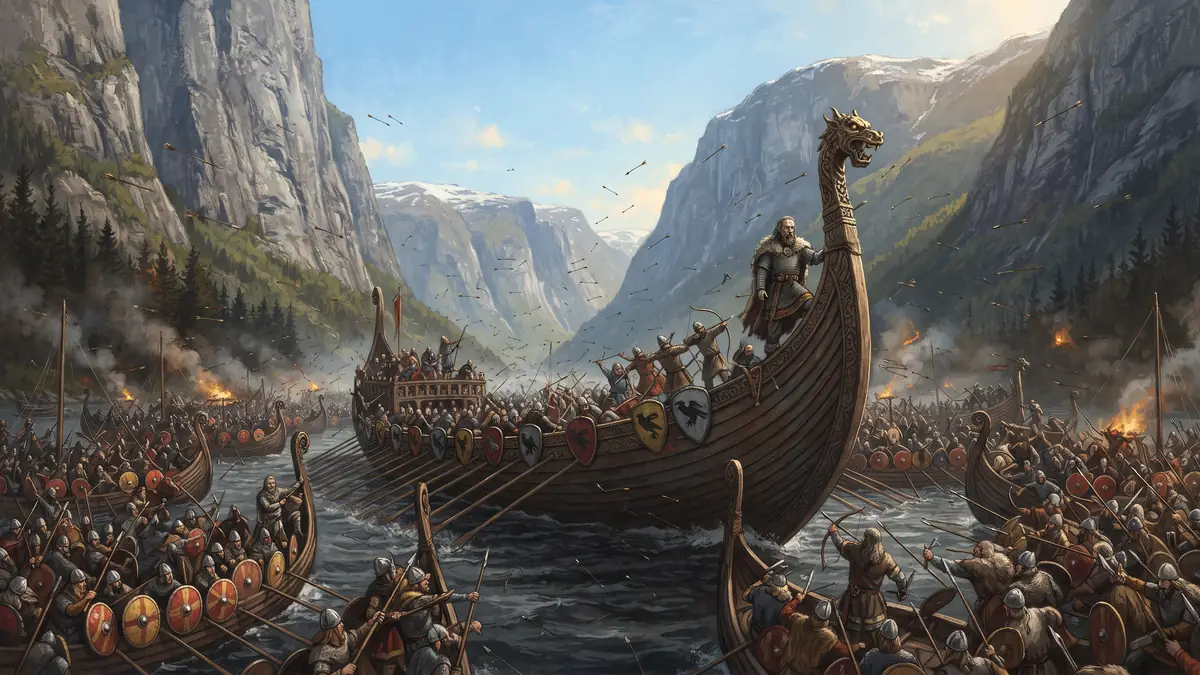
The battle of Fimreite was fought on 15 June 1184, near the hamlet of Fimreite, in the Sognefjord, today in the municipality of Sogndal, in Vestland. It was a naval battle, and it decided the war between Magnus Erlingsson and Sverre Sigurdsson.
Two sides, two fleets
On King Magnus’s side there were about 26 ships, according to the estimate on the page consulted. On Sverre’s side, leader of the Birkebeiners, about 14. Sverre’s ship was the Mariusud, with about 30 benches. It was one of the largest warships built in Norway at the time, but it handled badly, and was useful only in narrow fjords.
The watchmen’s warning
Watchmen warned Sverre that Magnus’s fleet was coming from the mouth of the fjord. He sent for two ships that were farther along. Both sides prepared with bulwarks, armour and missile weapons: stones, bows and arrows.
The lashed fleet
Magnus followed tradition and lashed many of his ships together, forming one large fleet. It cost him dearly. The Mariusud, lying across, trapped most of the royal ships, which could not manoeuvre. Sverre left the Mariusud to attack the loose ships at the edges.
Ship by ship
A man named Eirik attacked the outermost lashed ship and passed from one to another. The remaining ships, crowded with people, grew too heavy and sank.
After the battle
Losses on Magnus’s side were heavy, and on Sverre’s side, low. Magnus died in the battle. Accounts say he drowned, from the weight of his armour or while going down from one of the last ships. Sverre became the sole ruler of Norway and reigned from 1184 to 1202. The pretenders Sigurd Magnusson, Inge Magnusson and Erling Steinvegg said they were sons of Magnus, and Sverre fought these and other uprisings.
What can be said
The number of dead that some texts quote should not be taken as certain, since the page consulted does not confirm it. What is recorded is the manoeuvre: one large ship, lying across, and a lashed fleet that could not move.
To row at the right rhythm, like the crew of the Mariusud in the narrow fjord, play The oars of the Mariusud.
Sources.
- Helle, Knut, "Sverre Sigurdsson" and "Magnus 5 Erlingsson", Norsk biografisk leksikon
- Elortza (2018), Medieval Warfare 8(4); Jakobsson (2015), Medium Ævum 84(1); Krag (2005), Sverre – Norges største middelalderkonge
- Bandlien (2013), Scandinavian Studies 85(3), and Gjerset (1915), cited in reference works