 MMXXVI
Flugumýri, 22 October 1253: the wedding that ended in a fire, the barrel of sour whey where Gissur hid and the saga written by the bride's father
In 1253, Gissur Þorvaldsson married his son Hallr to a daughter of Sturla Þórðarson to make peace with the Sturlungar. Soon after, Eyjólfr ofsi burned the farm of Flugumýri, in Iceland. See what the sources say.
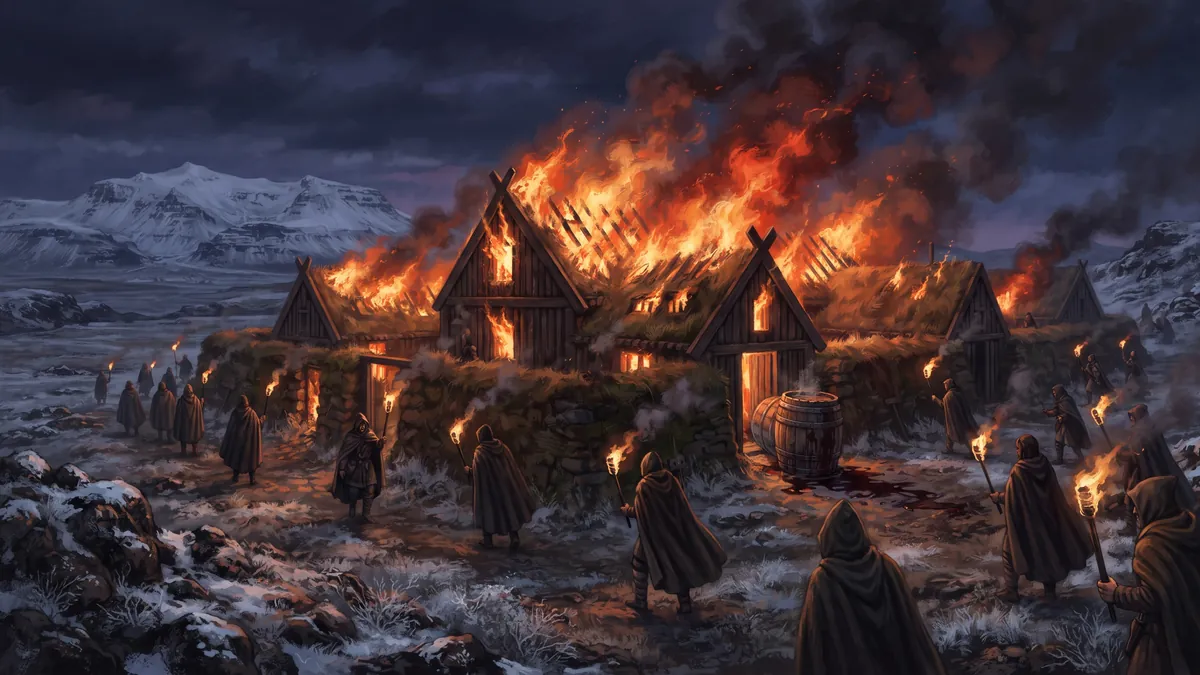
In 1253, the powerful Gissur Þorvaldsson, of the Haukdælir clan, wanted to end years of war with the Sturlungar. The means he chose was a wedding: his son Hallr would marry Ingibjörg, daughter of Sturla Þórðarson. The feast took place at Flugumýri, Gissur’s farm in Skagafjörður, in northern Iceland.
The night of the fire
On 22 October 1253, after the guests had gone, Eyjólfr ofsi Þorsteinsson reached the farm with an armed band. According to the saga there were about forty men. Eyjólfr wanted revenge for the death of his father-in-law, Sturla Sighvatsson, who had fallen at the battle of Örlygsstaðir in 1238, at the hands of Gissur’s men. Since they could not get into the house, the attackers set fire to it.
Who died and who escaped
According to the accounts, about 25 people died, among them Gissur’s wife and three of his sons. Hallr, the groom, still got out of the burning house and was wounded; he died the next day. Gissur survived by hiding in a barrel of sour whey, the sýra that Icelandic farms used to preserve food. Ingibjörg was saved by a kinsman who was among the attackers.
After the fire, Gissur went after those responsible. Eyjólfr ofsi escaped him for a while, but died in 1255, at the battle of Þverá.
The book that tells it all
The main source is Íslendinga saga, part of the Sturlunga saga, written by Sturla Þórðarson, who was in fact the bride’s father. The author, then, narrates a night on which his own daughter barely escaped. It is a close testimony, but from someone involved, and historians read it with that care.
Scholars also compare the episode with the burning of Bergþórshvoll in Njáls saga: it is not known which of the two accounts influenced the other, and some think Njáls saga may have drawn on events of the Age of the Sturlungs.
To put each sentence in the right stage of the story, play The night of Flugumýri.
Sources.
- Sturla Þórðarson, Íslendinga saga (13th century), part of the Sturlunga saga
- Sturlunga saga, in the English translation by Julia McGrew and R. George Thomas (Twayne, 1970–1974)
- Studies of the Flugumýri arson and the Age of the Sturlungs in Icelandic historiography