 MMXXVI
Fornjótr and the icy genealogy of Hversu Noregr byggðist: Hlér, Logi and Kári, King Þorri, the midwinter sacrifice and the origin of the name Norway
A text in the Flateyjarbók tells how Norway was settled, starting with the giant Fornjótr and his sons Sea, Fire and Wind. Snow, frost and a winter month enter the genealogy. See what the legend says and how it is read today.
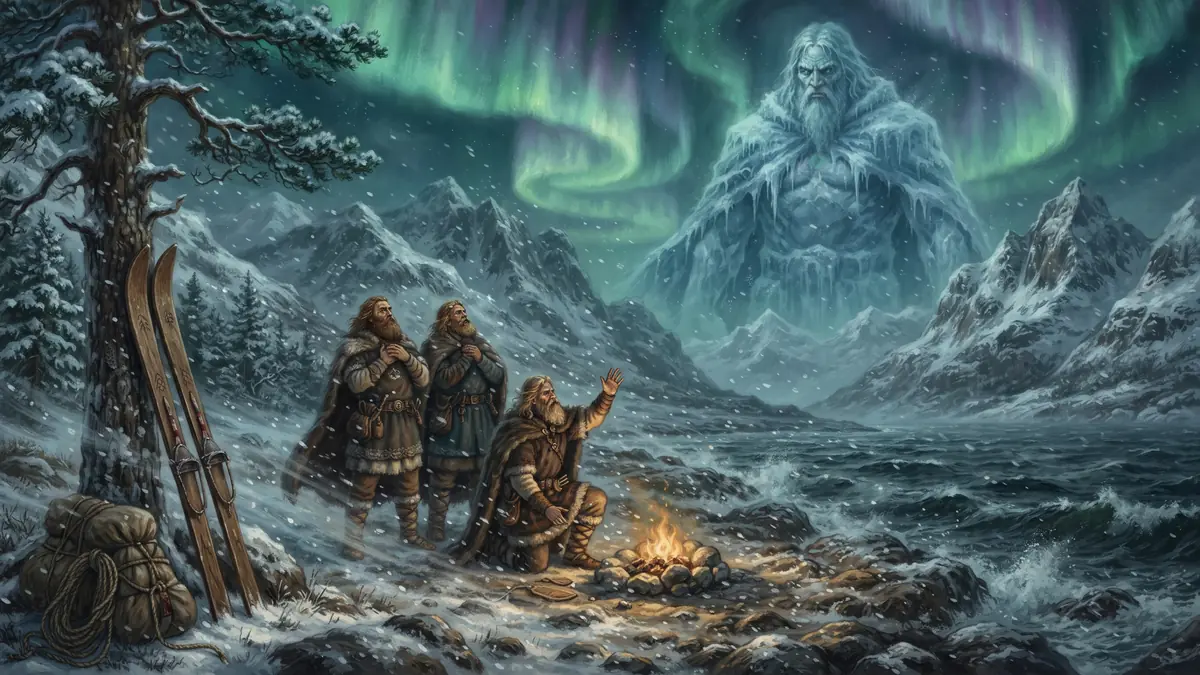
Norway, in its legends, has a genealogy that begins in ice. The text Hversu Noregr byggðist (“How Norway was settled”), preserved in the Flateyjarbók, narrates the origin of the Norwegian kings from the giant Fornjótr. A parallel account opens the Orkneyinga saga. It is mythology mixed with genealogy, and from it come names of months and of the country.
The sons of Fornjótr
Fornjótr had three sons: Hlér, who ruled the sea, Logi, fire, and Kári, the winds. Kári had a son, Jökull (“glacier”), and he had Snær (“snow”). The children of Snær were Þorri, Fönn, Drífa and Mjöll, names linked to snow, drift and cold.
In the Skáldskaparmál, Snorri says Hlér is another name of Ægir, lord of the sea.
King Þorri
Þorri ruled Gotland, Kvenland and Finland. According to the text, the Kvens held a midwinter sacrifice, asking for snow and good conditions for skiing and snowshoeing. Hence the name of the month of Þorri. His children were Nórr, Górr and a daughter, Gói.
When Gói vanished, the sacrifice was held a month later than usual, and the following month came to be called Gói.
Nórr and the name of the country
Nórr set out in search of his sister. He fought the kings Véi, Hunding and Hemingr and reached Heiðmörk, where Hrólfr of Berg had married Gói. Nórr married Hödd, daughter of the giant Svaði, and took the lands of the mainland, which came to be called “Noregr”. Górr took the islands. Of Górr’s sons, Beiti, Heiti, Meitir and Geitir, it is told that Beiti dragged his ship overland across the isthmus of Elliðaeiði.
How to read it
The text is medieval and mixes names of months, places and mythical figures with a genealogy of kings. The names of the winter months, Þorri and Gói, survived in the Nordic calendar, which explains the interest. No one knows whether there was a King Þorri; the text shows how the Norse explained the origin of the country and of the calendar.
The names of Snær’s children, Fönn, Drífa and Mjöll, all denote kinds of snow, as if the genealogy were a meteorology told in the form of a family. Þorri and Gói, for their part, are names of months of the old Icelandic calendar, still remembered today. The text thus mixes what looks like an explanation of the names of months with the legend of how the country got its name, and it is this mixture that makes it interesting to those who study how the Norse thought about time and territory.
To catch the snowflakes and flee Logi’s embers, play Snær’s snowflakes.
Sources.
- "Hversu Noregr byggðist" ("How Norway was settled"), in the Flateyjarbók
- Orkneyinga saga, genealogical opening (parallel, "Fundinn Noregr")
- Snorri Sturluson, Prose Edda, "Skáldskaparmál", on the name Hlér