 MMXXVI
Geitarlauf: the honeysuckle and the hazel, the secret meeting of Tristram and Ísönd in the forest in the Strengleikar
The Geitarlauf, from the Strengleikar, translates Marie de France's Chevrefoil, a short lai about a secret meeting of Tristan and Iseult in the forest, announced by a hazel branch with a name carved in it. See the plot, the meaning of the title and the place of the text.
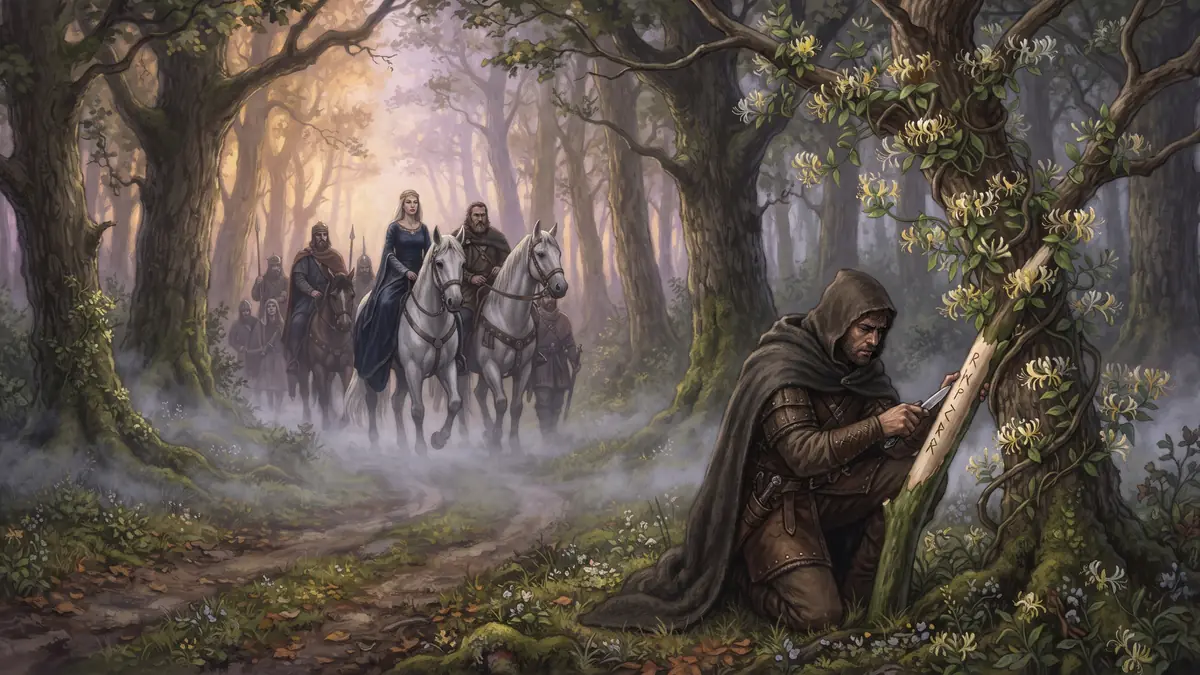
The Geitarlauf is one of the twenty-one texts of the Strengleikar, the collection of Breton lais rendered into Norse at the court of King Hákon Hákonarson. Its original is Marie de France’s Chevrefoil, a short lai set within the legend of Tristan and Iseult, the same legend Brother Robert had translated in 1226 as the Tristrams saga ok Ísöndar. The title is a literal translation: geitarlauf means “goat’s leaf,” like the French chèvrefeuille, the honeysuckle.
The exile and the meeting
Tristram has been banished from the court of the king of Cornwall, his uncle, because of his love for Ísönd, the queen. He came back to the region in secret and waited in the forest, by the road along which the queen’s retinue was to pass on the way to a great feast. The queen, for her part, knew he was nearby.
The hazel
To warn her, Tristram cut a hazel branch, carved his name on it and left it at the roadside. The sign had been agreed between the two: on seeing the branch, the queen would know he was there. As the retinue draws near, she sees the branch and recognises the message.
The honeysuckle
What the carved name said, according to the poem, was an image: the two were like the hazel and the honeysuckle. When the vine winds around the trunk, the two live together, but if anyone tries to part them, the hazel dies quickly and the honeysuckle with it. “So it is with us,” says the message: without you I cannot live, and without me, neither can you.
The meeting
The queen has the retinue stop, steps aside with her trusted maid and goes into the wood. She finds Tristram, they talk, he tells her how he lives, and the two speak of the hope that the king will call him back. The meeting is brief, and they part in pain. Afterward Tristram composes a lai about what happened. Marie says the English call it Gotelef and the French Chevrefoil, and the Norse lai keeps the name for its meaning: Geitarlauf.
The place of the text
The Geitarlauf is in the manuscript De la Gardie 4-7, of 1250 to 1270, in Uppsala. Like most of the Strengleikar, the translation follows the sense of the French closely. It also shows a familiar name, that of Tristram, in another form, more intimate than that of Robert’s saga.
To mark the letters on the hazel branch in the right rhythm, play The name on the hazel.
Sources.
- Robert Cook and Mats Malm (eds. and trans.), Strengleikar: An Old Norse Translation of Twenty-One Old French Lais (Uppsala, 2006)
- Marie de France, Chevrefoil, in Les Lais de Marie de France, ed. Karl Warnke (Halle, 1925), and in modern translations
- Marianne E. Kalinke and P. M. Mitchell, Bibliography of Old Norse-Icelandic Romances (Cornell University Press, 1985)