 MMXXVI
Geri and Freki: Odin's two wolves, who eat everything on the god's table while he lives on wine alone
In the Norse sources, Odin gives all the food from his table to two wolves, Geri and Freki, "the greedy one" and "the glutton", and lives on wine alone. The names became words for "wolf" in poetry and may appear on a Swedish runestone.
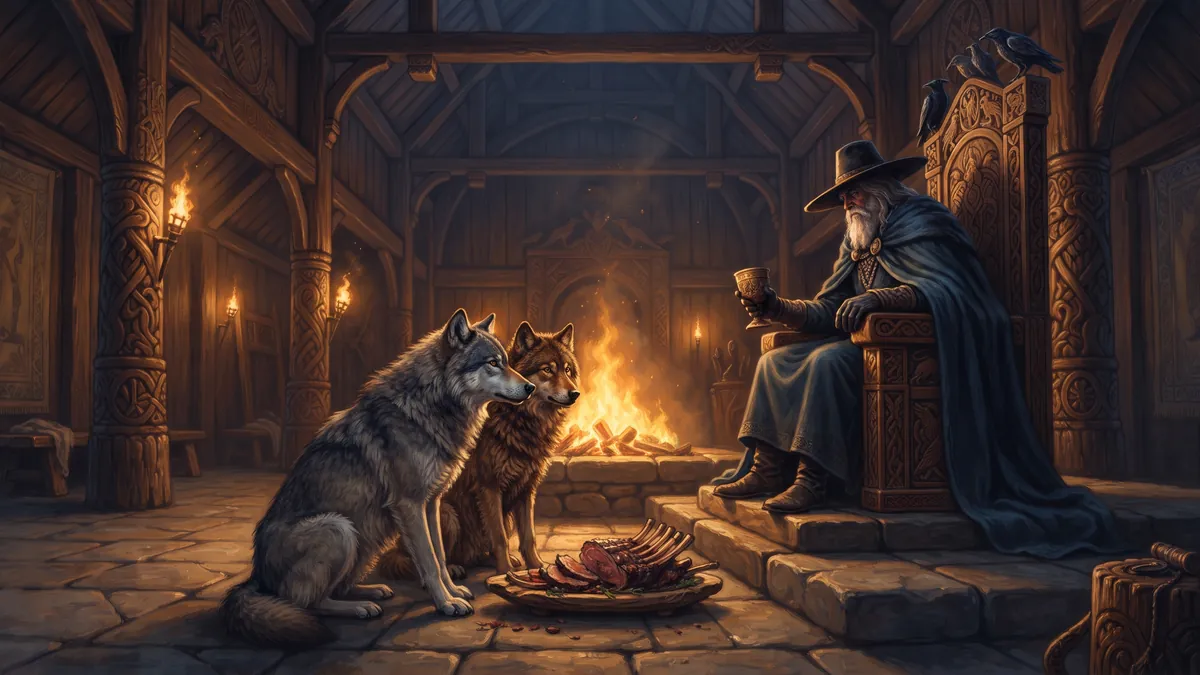
Geri and Freki are the two wolves that accompany Odin. The names are adjectives turned into nouns: Geri means roughly “the greedy one” or “the ravenous one”, from Proto-Germanic geraz, “greedy”; Freki comes from frekaz, with cognates such as Gothic faihufriks, “covetous”, and also covers the sense of “glutton”. In short, “Greed” and “Glutton”. John Lindow reads both as nominalized adjectives; Bruce Lincoln links Geri to the Proto-Indo-European root gher-, the same as in Garmr, the hound of Ragnarök.
What the sources say
The Grímnismál, in the Poetic Edda, has Odin disguised as Grímnir telling the young Agnarr that he feeds Geri and Freki, and that he himself lives on wine alone. Snorri repeats this in the Gylfaginning, ch. 38: Odin gives the wolves everything he is served at table, because wine is both food and drink for him, and he cites the poem as proof. In the Helgakviða Hundingsbana I (stanza 13), the wolves appear in a kenning, “Viðrir’s hounds”, that roam the battlefield hungry for the slain. In the Völuspá, Freki is also a name of the monstrous wolf Fenrir, and Lindow notes the irony: Odin feeds one Freki at his table and, at Ragnarök, will be devoured by another.
Words and kennings
In the Skáldskaparmál, Snorri uses Geri and Freki as common nouns for “wolf”, and lists both among the names of wolves and wargs. In skaldic poetry there are kennings such as “Geri’s ales” (blood), “Freki’s meal” (carrion) and “Geri’s morsel”, from poets such as Þórðr Kolbeinsson, Einarr Skúlason and Þórðr Sjáreksson.
What archaeology may show
On the Böksta runestone in Sweden, if the rider shown is Odin, the image shows Geri and Freki helping to hunt an elk. Michael Speidel links the wolves to figures of warriors in wolf pelts and to Germanic names containing “wolf”, such as Wulfhroc and Wolfram, and sees a cult of wolf-warriors tied to Odin, which would have faded with Christianization. Jacob Grimm, for his part, compared Odin’s wolves to Apollo, and Maurice Bloomfield compared them to the dogs of Yama in Vedic India. Bernd Heinrich proposes that Odin, the ravens Huginn and Muninn and the wolves reflect a real partnership among ravens, wolves and human hunters.
To feed the two wolves without giving them Odin’s wine, play The meat of the wolves.
Sources.
- *Grímnismál*, stanza 19, in the Poetic Edda (Codex Regius, c. 1270)
- Snorri Sturluson, *Prose Edda*: *Gylfaginning*, ch. 38, and *Skáldskaparmál*, chs. 58, 60 and 75; *Háttatal*, ch. 64
- *Helgakviða Hundingsbana I*, stanza 13; studies by John Lindow, Bruce Lincoln and Michael Speidel on Odin's wolves