 MMXXVI
Gilitrutt: the Icelandic tale of the lazy wife and the troll who wove wool, the sack of wool, the three guesses and the name found in a verse
In Gilitrutt, an Icelandic tale collected by Jón Árnason, a lazy young woman is given wool to weave and hands the work over to a troll, who demands that she guess her name. See the plot, the variants and what remains uncertain.
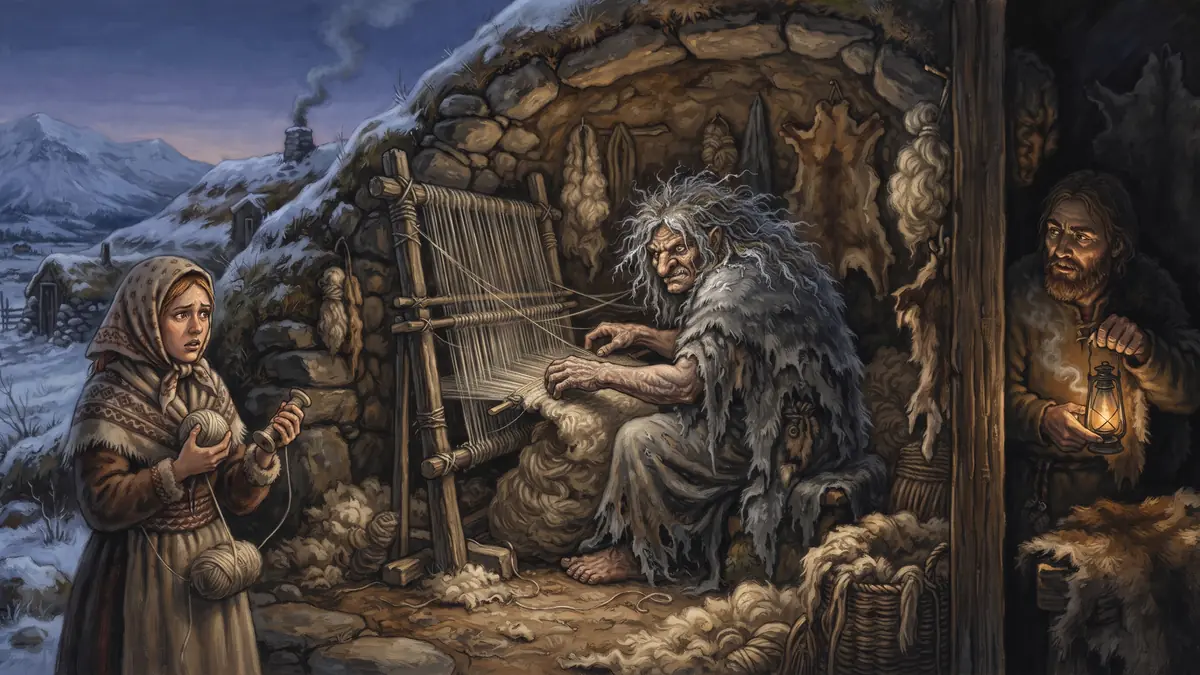
Among Iceland’s troll tales, Gilitrutt has a plot reminiscent of Rumpelstiltskin, but in a very local setting: work with wool. It is in Jón Árnason’s great collection, Íslenzkar þjóðsögur og æfintýri (1862–1864). As an oral tale, it changes from one version to another.
The sack of wool
A farmer and his young wife lived on a farm. The wife was lazy. In autumn, her husband gave her a sack of wool to weave by the end of winter. She put the work off, and time went by.
When the end of winter drew near, a skessa, a giant troll woman, appeared. She offered to do the work. She took the sack of wool and promised to return on the first day of summer. The wife would have to guess her name in three tries.
The name
The husband, worried, went looking. He found the troll inside a heap of stones, weaving, and heard her recite a verse in which she revealed her name. He wrote it down and took it to his wife.
On the first day of summer, the troll returned. The wife guessed wrong twice and on the third said: “Gilitrutt?” The troll fell to the floor and fled, and was never seen again. The young woman, after that, wove her own wool.
What varies
The versions differ. The wrong guesses change from one to another, and what the troll would win if the wife failed to guess is not clear in every one. The most cited version is Jón Árnason’s, but there are oral accounts that do not match it.
What it was for
The tale serves as a lesson in diligence. In Iceland, wool was one of the central winter tasks, and the tale gives a face to the fear of putting things off. The troll, who weaves better than the young woman, is both threat and help.
This kind of tale, in which the secret name of a supernatural helper becomes the key to getting rid of it, exists in many regions of Europe, and Rumpelstiltskin is only the best known. The Icelandic version stands out for its setting: wool, the loom, the turf farm and the winter that never ends.
It is common to associate tales like this with the long winter nights, when the family worked the wool while someone told stories. Whether that was so with Gilitrutt cannot be said for certain, but the plot, in which the time to finish the work runs out little by little, fits that setting well.
To catch the balls of wool in the basket and dodge the troll’s stones, play Gilitrutt’s balls of wool.
Sources.
- Jón Árnason, Íslenzkar þjóðsögur og æfintýri (1862–1864), tale "Gilitrutt"
- Records of variants of the tale in Icelandic oral tradition
- Store norske leksikon, entry "Island", section on folklore and oral tradition