 MMXXVI
Gísls þáttr Illugasonar: the young Icelander who disguised his face with wax, avenged his father in Niðarós and was saved by his countrymen and a priest
The Gísls þáttr Illugasonar tells how Gísl, aged seventeen, comes from Iceland to Norway to avenge his father, kills Gjafvaldr in Niðarós and escapes death thanks to a bell, the Icelanders in the town and a poem for the king. See the tale and what it says about law and honour.
The Gísls þáttr Illugasonar is a tale of revenge, but what makes it special is that the revenge happens in a foreign town and ends in negotiation and in a poem. It is set in Norway, in the time of a king called Magnús, and brings real characters, such as the Icelander Jón Ögmundarson, who would become bishop of Hólar.
The quiet lad of Forborði
Gísl, son of Illugi Þorvaldsson and nephew of Illugi the Black, arrives from Iceland at seventeen. He spends the winter at Forborði, in the house of a rich man, Hákon, always quiet and gloomy. When Hákon asks what troubles him, Gísl tells him: Gjafvaldr, a man of the king, killed his father with the help of Þormóðr Kollsson, and he has come to avenge him. Hákon warns that it will be hard, because Gjafvaldr is close to the king. Gísl has hot wax poured on his face, to be disfigured and hard to recognise, and waits for the hour.
The death of Gjafvaldr
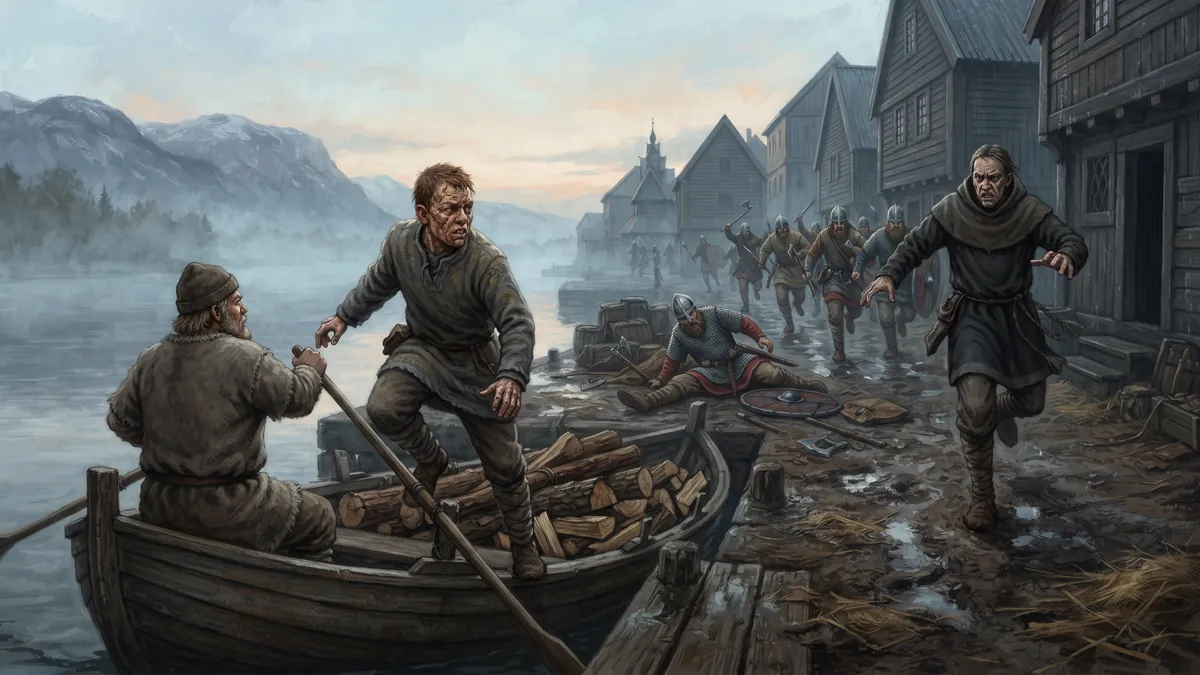
One morning, in Niðarós, Gísl sees the king ride out with his retinue and recognises Gjafvaldr. His wife, Helga Þormóðsdóttir, calls him aside with their child, and Gjafvaldr stops to speak with her. As he goes down the street with another man, Gísl attacks him and wounds him on both shoulders, and he falls. Gísl jumps into the boat of a small Icelander, Þorsteinn, full of firewood, and crosses the river. In the middle, he claims the killing aloud and says that in the morning he called himself Vígfúss, “eager for battle”, and in the evening he would call himself Ófeigr, “the one who is not doomed”.
Captured, and the bell
Gísl reaches the bank and hides, but he is found and brought back. The king’s men want to execute Þorsteinn for ferrying him, and Gísl defends him. He is chained, and the king orders him killed. The bell for the ninth hour rings, the king asks whether it is noon yet and has the sun checked. It was not yet, and the execution is delayed. There are many Icelanders in the town, among them Teitr, son of Bishop Gizurr, and the priest Jón Ögmundarson. The Icelanders do not reach agreement.
On Sunday, Gjafvaldr, at the point of death, asks the king to spare Gísl, speaking of his hope of salvation. The king agrees to say nothing and Gjafvaldr dies soon after. The next morning, Teitr gathers the Icelanders, who swear to follow him. They break into the house where Gísl is held, Teitr cuts the chain and they take him to the group.
The judgment and the poem
At the assembly, the king refuses to hear Teitr and threatens to cut out his tongue. The priest Jón speaks, and says that whoever judges without justice faces a harsher fire than whoever judges with justice. The king replies that he has spoken boldly. Then Gísl tells how his father was killed and says the bell saved him twice. He recites a poem for the king and lays his head on the king’s knee.
The king spares his life on conditions: he must take Gjafvaldr’s place in the royal household and serve as he served, and eight Icelanders must pay sixteen marks of gold as compensation. Half is paid at once. Jón and Teitr return to Iceland, and Jón becomes bishop of Hólar and is later considered a saint.
What remains uncertain
The text does not say what happened to Gísl after he entered the king’s service. Jón Ögmundarson, Teitr and Sigurðr ullstrengr are characters with parallels in other sources, but the whole scene, with the dialogues and the bell, belongs to the tale.
To take each fact of the tale to the right stage, play Gísl’s facts.
Sources.
- Gísls þáttr Illugasonar, Old Norse text available at heimskringla.no
- Ármann Jakobsson, "The life and death of the medieval Icelandic short story", Journal of English and Germanic Philology 112:3 (2013)