 MMXXVI
Gjallarhorn, the horn Heimdallr will blow at Ragnarök and from which Mímir drinks every day
In the Prose Edda, Gjallarhorn is Heimdallr's horn, which will warn the gods at Ragnarök. The same text says Mímir drinks from his well with that horn. See what the sources say and what scholars propose.
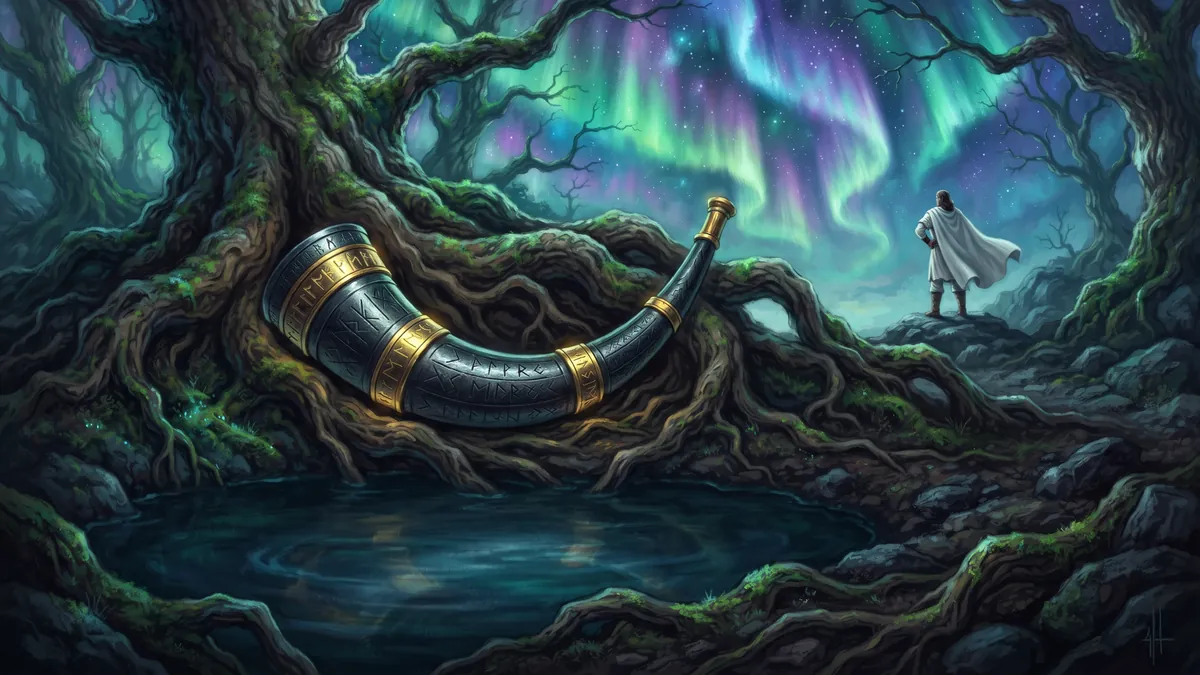
The name Gjallarhorn is usually glossed as “the resounding horn” or “the loud-sounding horn”. Lindow defines the term as a long brass instrument, something like an unvalved trumpet. In Norse mythology it belongs to Heimdallr, and its sound will be heard in all worlds.
Three mentions in the Prose Edda
Snorri Sturluson names the horn three times, always in the Gylfaginning. In chapter 15, describing the roots of the ash Yggdrasil, he says one of them reaches Mímir’s well, and that Mímir “is full of learning because he drinks of the well from the horn Gjallarhorn”. In chapter 27, Heimdallr appears as the owner of the horn, whose sound is heard in all worlds.
In chapter 51, the one on Ragnarök, the enemies of the gods gather on the plain of Vígríðr. Heimdallr stands and blows the horn mightily, and the gods awake and assemble at the thing.
What the poems say
The Poetic Edda is more economical. The Völuspá says that the horn, or, in another reading, Heimdallr’s “hearing” (the word hljóð can mean both), is hidden under the holy tree. The translation of the line is disputed for that reason.
A horn to drink from, a horn to blow
Rudolf Simek notes that a horn that serves as instrument and cup is not odd: Roland’s Olifant is a parallel. He adds that the horn is one of the oldest Germanic instruments, along with the lurs, and that finds like the 5th-century Golden Horns of Gallehus suggest sacral horns existed, perhaps the earthly versions of Gjallarhorn.
Some scholars read a figure on a stone from the Isle of Man and another on the Gosforth Cross, of the 9th and 10th centuries, as Heimdallr with the horn, but these identifications are hypotheses.
In short
In the sources Gjallarhorn does two things: it gives wisdom to whoever drinks from it, in this case Mímir, and it announces the end of the world. To play in the right rhythm, play Heimdallr’s blast.
Sources.
- Snorri Sturluson, Prose Edda, Gylfaginning, chapters 15, 27 and 51 (around 1220)
- Poetic Edda, Völuspá (13th-century manuscripts)
- English Wikipedia, articles "Gjallarhorn" and "Mímisbrunnr", with the citations of Rudolf Simek and John Lindow