 MMXXVI
Glíma: the Icelandic belt-and-trouser wrestling, the clockwise step that avoids a stalemate and the Belt of Grettir, contested since 1906
Glíma is Iceland's traditional wrestling. Wrestlers wear a belt at the waist and others on the thighs, circle clockwise and lose if they touch the ground between elbow and knee. It is the national sport.
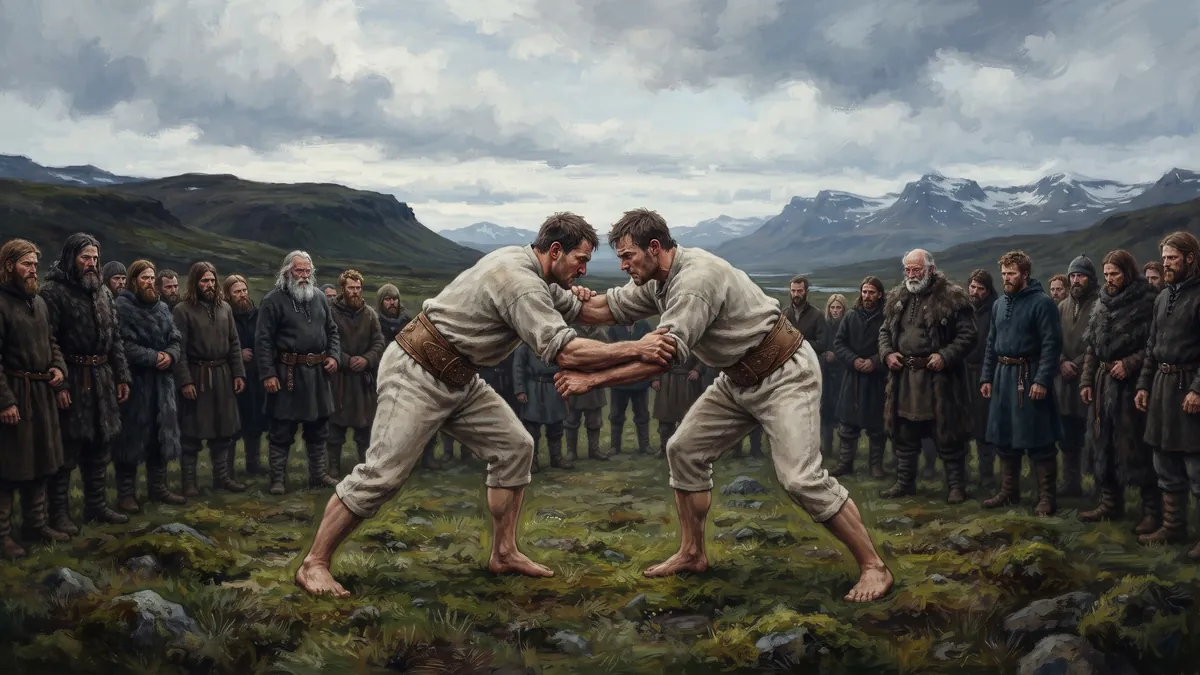
Glíma is Iceland’s traditional wrestling and the country’s national sport. The most widespread form is trouser-grip wrestling (brókartök). Each wrestler wears a belt at the waist and two more on the thighs, linked to the first. One hand grips the opponent’s waist belt; the other, the trousers at thigh height.
Upright, no pushing
Wrestlers must stay upright and step in a circle clockwise, a movement called stígandi, to avoid a stalemate. Pushing the opponent or falling on him is considered unsporting. A wrestler who is thrown and lands on feet and hands does not lose the fall. The first to make the opponent touch the ground with a part of the body between the elbow and the knee wins.
Eight main holds
The basic system has eight main techniques, which underpin about 50 throws. The wrestling is governed by drengskapur, a code of honour that preaches fairness and respect for training partners. There are other forms: hryggspenna, the backhold, in which whoever touches the ground with any part of the body other than the feet loses, and lausatök, the loose grip, which also has a defensive version.
From the sagas to the belt
It is said that the first settlers brought wrestling to the island, and the Icelandic sagas describe wrestling at feasts and games. The modern tradition, however, has dates: the first modern trouser-grip competition was in 1888, and it has been held almost every year since. In 1905 the belt was introduced, for a better grip, since before that wrestlers had grabbed one another’s trousers.
The Belt of Grettir
In 1906 the first Belt of Grettir (Grettisbeltið) was contested. Its winner is called the Glíma King. The women’s trophy is the Necklace of Freyja (Freyjumenið), and its winners are the Glíma Queens. In 1912, trouser-grip wrestling was shown at the Summer Olympics. There is also an application to put it on UNESCO’s list of intangible cultural heritage.
To keep the clockwise step without pushing, play The glíma step.
Sources.
- Rules and history of glíma, according to the Icelandic Glíma Association (Glímusamband Íslands)
- Studies of traditional Nordic wrestling and of Icelandic competitions of the 19th and early 20th centuries
- Icelandic sagas that describe wrestling at feasts and games, as context for the tradition