 MMXXVI
Göngu-Hrólfs saga: the giant who walked on foot, the horse Dúlcifal, Vilhjálmr's betrayal and the dwarf Möndull
Göngu-Hrólfs saga, an Icelandic legendary saga, tells how Hrólfr, so heavy that no horse could carry him, served a traitor in Garðaríki, lost his legs and had them restored by a dwarf. See what the text says and what remains uncertain.
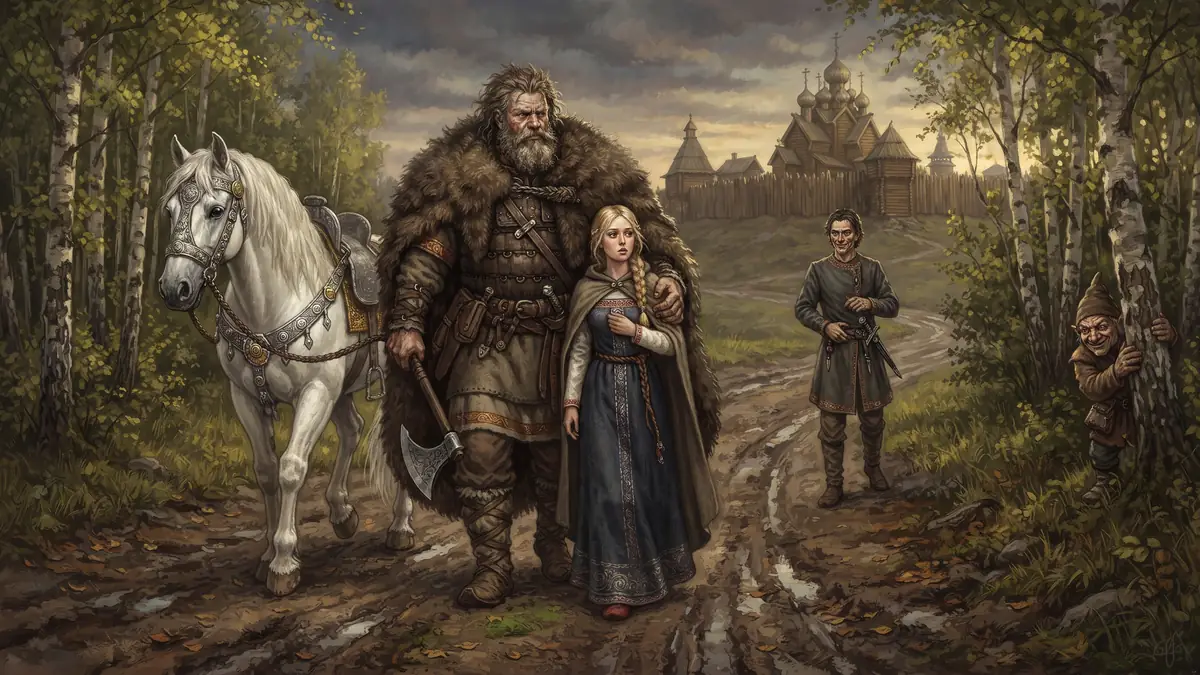
The Göngu-Hrólfs saga, “the saga of Hrólfr the Walker”, is one of the fornaldarsögur, and continues the Sturlaugs saga starfsama, since the hero is Sturlaugr’s son. His name recalls that of Rollo, the founder of Normandy, but the saga deals with an older legendary hero with no link to him. It is a long adventure, with betrayal, a dwarf and a magic horse.
The lad too heavy for horses
In Garðaríki, King Hreggviðr has a daughter, Ingigerðr, a horse called Dúlcifal and magic armour. Eiríkr, king of Gestrekaland, attacks with berserkers, among them Sörkvir, and with the sorcerer Grímr ægir. He kills Hreggviðr and accepts only Ingigerðr’s condition: she will have three years to find a champion to fight Sörkvir. Hreggviðr is buried with his armour.
In Norway, Hrólfr, son of Sturlaugr, is so heavy that no horse carries him, and so he always goes on foot. He quarrels with his father, takes his mother’s magic cloaks and leaves. He kills the outlaw Atli and the berserker Jólgeirr, and reaches the court of Þorgnýr, earl of Jutland, where he helps beat the raiders Tryggvi and Vazi. A swallow drops a strand of golden hair; Þorgnýr vows to marry its owner, and the counsellor Björn says it is Ingigerðr. Hrólfr offers to fetch her, with Þorgnýr’s daughter, Þóra, as a reward.
The traitor Vilhjálmr
On the way, Hrólfr meets Vilhjálmr, who wants Hreggviðr’s armour and offers to serve him. Hrólfr spares him, but Vilhjálmr ties him to a post over the fire, and Hrólfr swears to serve him to survive. At Eiríkr’s court, in Aldeigjuborg, Vilhjálmr boasts, and Hrólfr keeps quiet. Hrólfr captures a magic hart with the help of an elf-woman, who gives him a ring, and recovers the armour from the mound. When the giant Sóti, from Tattararíki, invades, Hrólfr kills him wearing Vilhjálmr’s equipment, and Vilhjálmr takes the credit and marries Gyða, the king’s sister.
Hrólfr abandons the service and, in a tournament, beats Sörkvir. He flees with Ingigerðr and the horse Dúlcifal. But Vilhjálmr finds him asleep, cuts off Hrólfr’s feet and takes Ingigerðr to Jutland, saying he has died.
The dwarf
In Jutland, a dwarf called Möndull has won Þorgnýr’s trust, accused Björn of stealing a belt and taken his post, his wife and his goods. Hrólfr reaches Björn’s house. The dwarf heals him with salve. Hrólfr goes to the hall, unmasks Vilhjálmr, who confesses and is executed. Later, Hrólfr leads an army to Russia. Tryggvi kills Þorgnýr, but is beaten, and Hrólfr kills Eiríkr and his monstrous warriors. One of the strangers who helped is Hrafn, really Haraldr, son of King Edgar of England, and Hrólfr promises to help him regain the throne. Hrólfr marries Ingigerðr and they rule in Russia.
What is uncertain
The summary above follows the Icelandic text, and the explanation of the nickname Göngu, “walker”, is a reading: the saga says no horse carried him and he was always on foot. Garðaríki and Hólmgarðaríki appear as interchangeable names in several narratives, which Marika Mägi attributes to old oral traditions. The saga does not say how Hrólfr died. All this belongs to the adventure tradition.
To walk in the right rhythm along the roads of Garðaríki, play The Walker’s stride.
Sources.
- Göngu-Hrólfs saga, Icelandic legendary saga (fornaldarsaga), Icelandic text of the Netútgáfan (snerpa.is) and in Guðni Jónsson and Bjarni Vilhjálmsson (eds.), Fornaldarsögur Norðurlanda (Reykjavík, 1943–1944)
- Hermann Pálsson and Paul Edwards (trans.), Göngu-Hrolf's Saga: A Viking Romance (Edinburgh, Canongate, 1980)
- Marika Mägi, In Austrvegr: The Role of the Eastern Baltic in Viking Age Communication across the Baltic Sea (Brill, 2018)