 MMXXVI
Gríms saga loðinkinna: Grímr Hairy-Cheek, the bride turned into a troll, the stranded whale and the duel against the berserker Sörkvir
Gríms saga loðinkinna, an Icelandic legendary saga, tells how Grímr, of Hrafnista, broke the spell on his bride Lopthæna, fought over a stranded whale and beat the berserker Sörkvir in a duel. See what the text says and what remains uncertain.
The Gríms saga loðinkinna, “the saga of Grímr Hairy-Cheek”, is the second of the Hrafnista sagas, the family of Ketil Trout. One translation dates it to the beginning of the fourteenth century. It survives in three fifteenth-century vellum manuscripts and about forty paper copies, and usually comes between the Ketils saga and the Örvar-Odds saga.
The hero and the bride who vanished
Grímr rules Hrafnista after his father, Ketil. He is called loðinkinni, “hairy-cheek”, because one cheek was born covered in dark hair that iron cannot cut. He becomes betrothed to Lopthæna, daughter of the lord Haraldr, from the region of the Oslo fjord. A week before the wedding, she vanishes. Her stepmother, Grímhildr, is suspected.
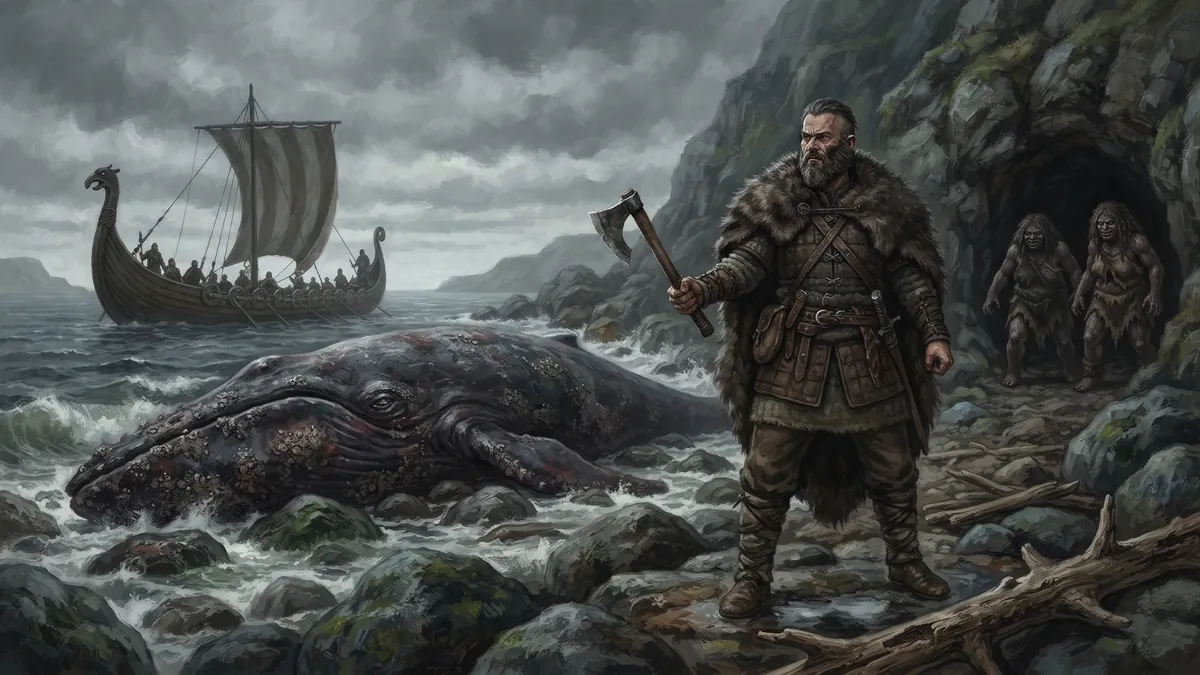
In a time of famine, Grímr sails to Gandvík with two companions. A storm drives the fish away, and at night he finds two troll-women trying to wreck the boat. He kills one with an arrow and the other with his axe, and then kills a troll couple in a nearby cave. A dying troll reveals that Grímhildr cursed Lopthæna.
The whale and the troll-woman
Grímr faces Hreiðarr the Rash and his twelve men over a stranded whale. Nearly all die, and Grímr is badly wounded. A hideous troll-woman, Geirríðr Gandvíkrbeðr, rescues him. She sets three conditions for lifting the curse: that a human accept her help, that he kiss her and that he share a bed with her. Grímr accepts all, and the troll-woman reveals herself as Lopthæna. He burns the troll skin. The two sail to Hrafnista with a boatload of whale meat, and people think Grímr has returned from the dead.
The duel against Sörkvir
Grímr returns to Haraldr’s land and has Grímhildr killed. He and Lopthæna have a daughter, Brynhildr. When she is twelve, the berserker Sörkvir asks for her hand. She refuses, and Sörkvir challenges Grímr to a duel on an island. Grímr kills Sörkvir’s shield-bearer, Þröstr, with a single blow and cuts off the rival’s legs. His ally Ingjaldr and Grímr’s men kill the other berserkers. Grímr swears that his daughter will not be married by force while he lives. Ingjaldr, of Berurjóðr, is introduced as the foster-father of Oddr, the future Örvar-Oddr.
The last chapter is a genealogy: the descendants of Grímr, the family of Ketil Trout and the paths that lead to Icelandic families, among them that of Gunnarr of Hlíðarendi.
What is uncertain
The saga has close parallels with the Hálfdanar saga Brönufóstra, and the two may come from a lost common source. The version of the nickname “hairy-cheek” in the Ketils saga (son of a Finnish troll) and in the Örvar-Odds saga (another explanation) shows that the tradition varied. Dates, place names and the transformation into a troll are tale motifs. Read it as legend, not as history.
To pick up pieces of whale without touching the trolls’ claws, play The whale of Gandvík.
Sources.
- Gríms saga loðinkinna, Icelandic legendary saga (fornaldarsaga), in Guðni Jónsson and Bjarni Vilhjálmsson (eds.), Fornaldarsögur Norðurlanda (Reykjavík, 1943–1944)
- Peter Tunstall (trans.), Gríms saga loðinkinna (2005)
- Ben Waggoner (trans.), The Hrafnista Sagas (The Troth, 2009)